
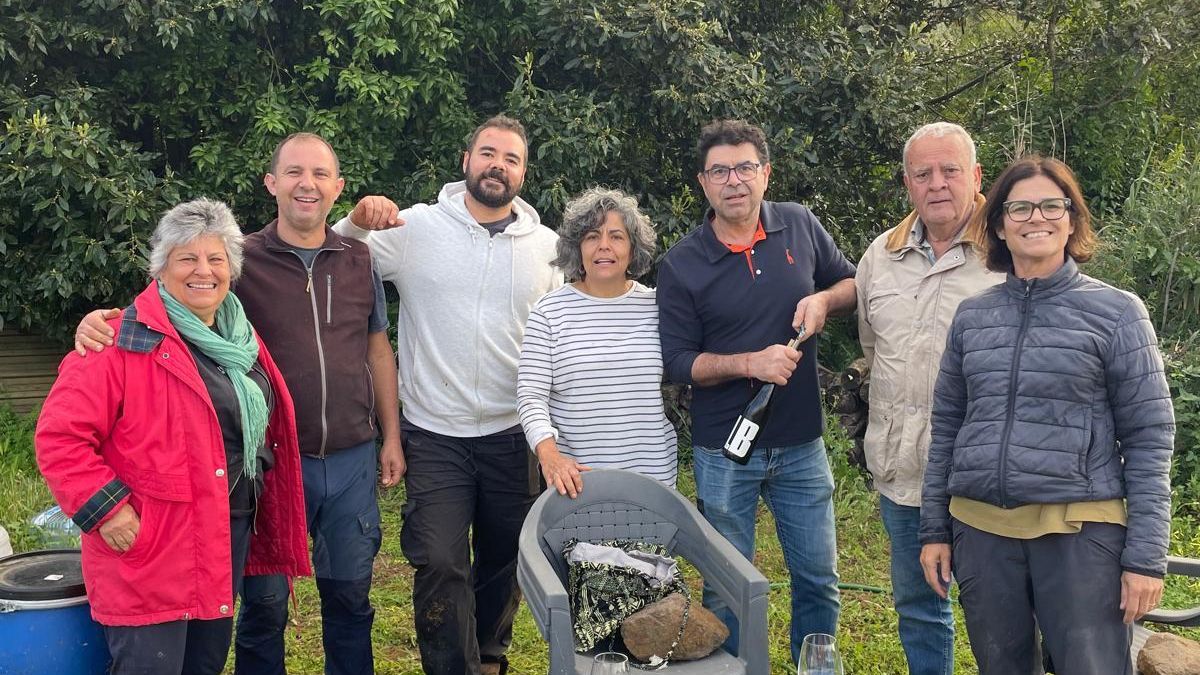
In the shade of avocado trees, Pedro Reyes, 54, takes a break while clearing his farm in Tegueste, in the northeast of Tenerife. The plot, dedicated mainly to vine cultivation, was inherited from his father, who belonged to the generation of chemicals: those who bet on the application of fertilisers and phytosanitary products day after day to increase production and reduce work in the field. “But that massive use of chemicals left the soils very poor,” says Reyes, “even burnt.”
Bringing life back to the soil
Until a friend told him about regenerative viticulture, a way of farming that chooses not to till the land and returns life to the soil. To do this, the practice creates plant covers and increases organic matter, favouring the activity of insects and microorganisms that help recover the natural balance of the land and control pests. More living soils are also better able to retain water, strengthen the resistance of the vines and store more carbon, thus helping to mitigate climate change caused by the burning of fossil fuels. “It’s about bringing life back to the soil. And from there, everything changes. You see health, more and more health. Even the plums from the plum tree I have down there are tastier. In the end you find a balance that sustains itself,” sums up Reyes.
A sector in crisis
Since the beginning of this year, Reyes has been a member of the Tegueste Association of Regenerative Viticulture and Agriculture (AVARTE), an initiative seeking to promote these practices in the Canary Islands at a time when the primary sector is going through a deep crisis and vine cultivation, in particular, is at a low ebb. Grape production reached 10,828 tonnes in 2024, according to the Canary Islands Institute of Statistics (ISTAC), the lowest figure since 2016. The cultivated area, for its part, has been stabilised for years at between 6,000 and 8,000 hectares, far from the nearly 19,000 it occupied at the beginning of the century.
In Tenerife, the decline is even more evident. In 2024, 6,374 tonnes of grapes were harvested, the second worst figure in the historical series, only surpassed by the 6,312 tonnes of 2023. The cultivated area, meanwhile, has fallen from more than 11,600 hectares in 2007 to barely 3,380 in 2024. “This is sinking,” laments Reyes.
Asphyxiated soils
Carlos Alfonso, a technician in Agricultural Resource Management and agricultural technical engineer at the Canarina Foundation, explains that many plots dedicated to vine cultivation are asphyxiated by decades of fertiliser, herbicide and pesticide use. “The soils have become compacted and, like a shoe sole, barely allow water to filter through or roots to breathe.” The chronic water shortage in the Archipelago has also forced the use of reclaimed water for irrigation in the low-lying areas, continuously introducing salts into coastal plots. Alfonso assures that analyses of these farms show yield losses of up to 50% solely due to soil salinisation. Added to this is continuous tillage, which breaks the biological structure of the earth, accelerates the oxidation of organic matter and releases into the atmosphere the carbon that the soil should store.
The phylloxera plague in July 2025 was the final blow a weakened sector needed. “Many people are seeing that the vine produces less and less grapes and that, therefore, the yield per hectare is decreasing,” says the president of AVARTE, Joaquín Poggio.
A demonstration of regenerative practices
Poggio says he recently began working a new 7,000 square metre farm. Of these, around 2,000 were occupied by vines, another 1,500 had been used for growing potatoes and onions, although they had been abandoned for years, and the rest remained in a natural state, uncultivated. The plot with the worst soil quality, to the point that he is not even recommended to cultivate it, is precisely the one dedicated to the vine, according to Poggio. He attributes this situation to the management applied over the years: “Conventional soil management was carried out, using chemical products that we thought the plant needed. But the plant needs much more than just an NPK fertiliser. Therein lies the proof,” he concludes.
Fran Beltrán, who passed away during the preparation of this report, shared a similar story with Canarias Ahora about the farm she had in Tegueste, where she also cultivated vines. She inherited the land from her grandfather, which had remained uncultivated for decades, and began working it following the conventional model: use of glyphosate (a herbicide) around the farm; application of fungicides to combat common pests and diseases in the Canary Islands; use of fertilisers to increase production; and ploughing and clearing to keep the soil bare. After a while, she found that this model was not working, quite the opposite. “I realised how my farm was going backwards. I needed more and more water, the soil was getting drier and drier, without plants, without grass, only weeds, horrible ones, which were the ones that resisted all the rubbish I was throwing on,” she recounted. “The plants suffered more diseases, more fungi. The first harvests were wonderful. But then I started having a lot that didn’t work.”
Beltrán said that, in this way, she was losing in every sense: production, money (because she had to apply more and more chemical treatments to the plants) and the soil itself, which was deteriorating due to the use of those products.
A tool against climate change
Conventional agriculture (including a good part of viticulture) has also contributed to the increase in greenhouse gas emissions. The use of nitrogenous fertilisers generates nitrous oxide (N2O), a gas that remains in the atmosphere for more than a century and whose warming potential is around 273 times greater than that of carbon dioxide (CO2) over a hundred-year horizon. Agriculture and livestock farming actually represent 15.1% of greenhouse gas emissions in Spain, according to the advance of the 2025 National Inventory of Emissions to the Atmosphere. In the Canary Islands, where the weight of the primary sector is smaller, the figure drops to 1.4%. It may seem little, but it is around 183,000 tonnes of CO2 equivalent (the unit of measurement used for this type of gas), an amount almost three times greater than that generated by the construction sector in the Islands (63,000 tonnes).
Regenerative viticulture seeks to reduce that figure and turn the soil into an ally against climate change, creating a positive impact from the activity, in the words of technician Carlos Alfonso. “It’s about turning the tables and starting to work in favour of nature, taking advantage of the soil’s own biological activity and stopping relying on external inputs, which were actually deteriorating our soils,” he maintains.
A community to break isolation
The AVARTE association was born in Tenerife with the aim of demonstrating that restoring soil life and reducing dependence on chemical products is neither a utopia nor a romantic stance. Its president, Joaquín Poggio, assures that more than half of its members are professional farmers who make a living from working their farms. Poggio explains that the group also aims to break with the isolation that has traditionally characterised agriculture in the Canary Islands, marked by smallholdings and the fragmentation of farms, creating an active community to share knowledge and techniques. The objective is also to coordinate collective purchases, take advantage of zero-kilometre resources and jointly produce natural liquid biofertilisers, known as bioles, whose preparation is very complex for an individual farmer. “Regenerative agriculture is a model that not only benefits the environment, but also improves the conditions of those of us who work the land and our productions,” he stresses.
Working with nature, not against it
In Beltrán’s case, the change was radical: tilling the land became out of the question. “Ploughing leaves the soil bare and alters its structure. Instead, she sowed wheat, barley and legumes, such as broad beans, and mowed them before they flowered, leaving them to decompose on the ground. That cover provided organic matter and favoured the natural cycle of nutrients. The vegetable mulch acted as a kind of hat for the soil: it conserved moisture, protected its life and reduced erosion. Rainwater, instead of running off the surface, infiltrated the earth. To prevent fungi, she resorted to traditional treatments, such as powdered sulphur and bentonite. She also made and applied compost tea, a preparation made from mature compost to incorporate beneficial microorganisms into the soil and plants.
And she had patience. A lot of patience. Because the vine stocks, she explained, go through a kind of withdrawal syndrome when the transition to regenerative management begins, while the soil gradually recovers its balance. “What you can’t do is change suddenly. It has to be gradual,” she insisted. “The countryside is not a company. The countryside has its own life, its own moment, its own time, its own climate. It has its own way of developing. And as long as we go against that reality, which is much bigger than us, we will fail. We will fail because the countryside does not move at our pace.”
Quality over quantity
Pedro Reyes, for his part, admits that with the transition to regenerative viticulture he may have lost between 10 and 20% of production. But he assures that now his vines produce grape bunches of much higher quality. And that, if instead of getting 5,000 bottles from his winery he ends up producing 1,500, those will have much more value. “That the product is healthier and better, almost unique. That’s how I see it,” Reyes concludes.
Technician Carlos Alfonso shares that vision. “In small and fragmented territories like ours, we have to bet more on quality than quantity, because we will never be able to compete with a wine from La Rioja, for example, with enormous production. In the Canary Islands, what works is small quantities, with cultural value, differentiated… and respecting the environment we have through a set of practices that benefit society and also the producers.”
Beltrán summed it up like this: “It is vitally important to understand how nature works and go hand in hand with it, not against it.”
What’s happening in the Canaries – straight to your phone
News, weather alerts and practical updates – direct from the islands, in English. We live here and know what’s going on – before the international media catch up. Everything lands on our WhatsApp channel – no middlemen, no algorithm. Curated for families, expats and travelers.

Canary Islands sea hits second-hottest year on record

Legal bid to halt tree felling in Santa Cruz’s La Salud

Fiesta del Charco: A journey through La Aldea’s past

Corralejo dunes power line set for removal

ULPGC launches 14 research projects at Las Canteras

TMT will never be built, says Canary Islands astrophysics chief

Pedro Duque: Canarias is the “ultimate dream” for rockets

Court blow to Tenerife motor circuit project
La Palma faces new volcanic risk planning deadline
