
Compiled with the help of artificial intelligence, based on Spanish-language information. Source below the article.
Playa Jardín closed again after contamination detected
Playa Jardín, the main bathing area in the tourist town of Puerto de la Cruz, has been closed to swimmers once again. The council ordered the preventive closure this Wednesday, 12 August, after a water analysis carried out by Public Health – the department of the Canary Islands Government responsible for monitoring bathing waters across the Islands – returned an unfavourable result. Specifically, the test showed levels of Escherichia coli (E. coli) bacteria, which is associated with faecal contamination, above permitted limits.
The incident brings water pollution back to the forefront for this complex of three coves in Puerto de la Cruz, just weeks after a similar episode in June – although on that occasion the council did not decree a temporary closure as it has now – and a little over a year after the beach had only just reopened following a nearly year-long closure between 2024 and 2025 caused by sewage discharge problems.
Council awaits verification of results
Puerto de la Cruz Town Council received the official request from the health authority and proceeded with the temporary closure of Playa Jardín while the results are verified. The decision has been taken as a preventive measure to guarantee the safety of beachgoers. However, the data that triggered the restriction sits alongside a second reading: the council insists that the five samples it commissioned during the same period came back with optimal results for bathing.
It should be remembered that, in any case, the analyses used to make decisions about a bathing area come from Public Health, through the routine sampling it carries out along the coasts of the Islands. The discrepancy between the two sampling campaigns is now one of the central elements of the situation. The council has already forwarded its own results to Public Health and has requested an immediate cross-check of the analyses to establish the true state of the water. Until the health authority assesses its data and expressly authorises reopening, Playa Jardín will remain closed.
The council stresses that the unfavourable result now reported is just one among more than 200 satisfactory analyses carried out across the full programme of checks. The corporation insists, nonetheless, that the request from Public Health must be honoured and that the preventive closure is the responsible decision while the discrepancy is resolved.
A familiar problem for the beach
The latest episode takes on greater significance when viewed in perspective. Playa Jardín has been grappling with water quality problems for years, so the current closure is far from an isolated incident. In June of this year, another contamination episode forced the reactivation of control measures and once again placed this beach in Puerto de la Cruz at the centre of public concern.
The Directorate General of Public Health of the Canary Islands Government detected another episode of “short duration” contamination in one of the coves of the complex between 22 and 23 June this year. That episode coincided with the San Juan Night festivities, which attracted thousands of people precisely to Playa Jardín. On 22 June, technicians from the regional government body took water samples from Playa Jardín – as they do on a regular basis – and the following day, the 23rd, with results in hand, the Directorate General called the council and sent an email warning that anomalous parameters had been detected which advised a temporary closure.
At that time, the local government did not decree a closure, arguing that the telephone call and email – confirmed by both the council and Public Health – did not constitute an official administrative notification, which would normally come in the form of a report with an entry registration number. Public Health had clarified that, in its alerts of 23 June by phone and email, it used “the usual channels for adopting the measure of temporarily prohibiting bathing at the sampling point Playa Jardín PM5 (Playa Chica-Centro)”, popularly known as El Charcón, one of the three coves of Playa Jardín. The department of the regional Health Ministry maintains that these are protocolised channels used with all municipalities across the Canary Islands when analyses come back positive for contamination, and points out that it is the councils themselves that hold the competence to decree the temporary closure of bathing areas on the basis of such alerts. This time, however, the governing group of the council has given official status to the communication from Public Health and has therefore proceeded with the temporary closure.
Long history of closures and controversy
That June situation arose when the beach had only recently reopened after one of the longest closure periods ever suffered by a stretch of Tenerife coastline. Playa Jardín remained closed to swimmers for almost 349 days – from 3 July 2024 until its reopening on 17 June 2025 – after Public Health detected bacterial levels that made bathing inadvisable. That closure turned the Playa Jardín problem into one of Tenerife’s major environmental disputes. The contamination sparked strong controversy among the various authorities over the origin of the discharges and the measures needed to put an end to them. Over several months, different hypotheses were studied and problems detected in the sanitation infrastructure around the beach were put on the table.
The reopening in June 2025 provisionally brought that crisis to an end. But the succession of episodes since then demonstrates that the problem has not fully disappeared from the horizon. The current closure forces attention back onto Playa Jardín, one of the main bathing areas of Puerto de la Cruz and a space of particular importance both for residents and for the town’s tourist trade.
Council insists it is taking action
The council says it has not been sitting idle. Since last Monday, work has been underway to clean and condition the sand, and these efforts will continue while the restriction remains in place. In addition, a new cycle of cleaning the sewage and rainwater networks is planned, accompanied by civil works and coordinated efforts with the operator responsible for the water service. The corporation has also informed the opposition municipal groups and the Stop Vertidos platform of the situation, sharing both the communication received from Public Health and the results of its own samples. The council says it will keep the analyses available and will facilitate information on the actions taken.
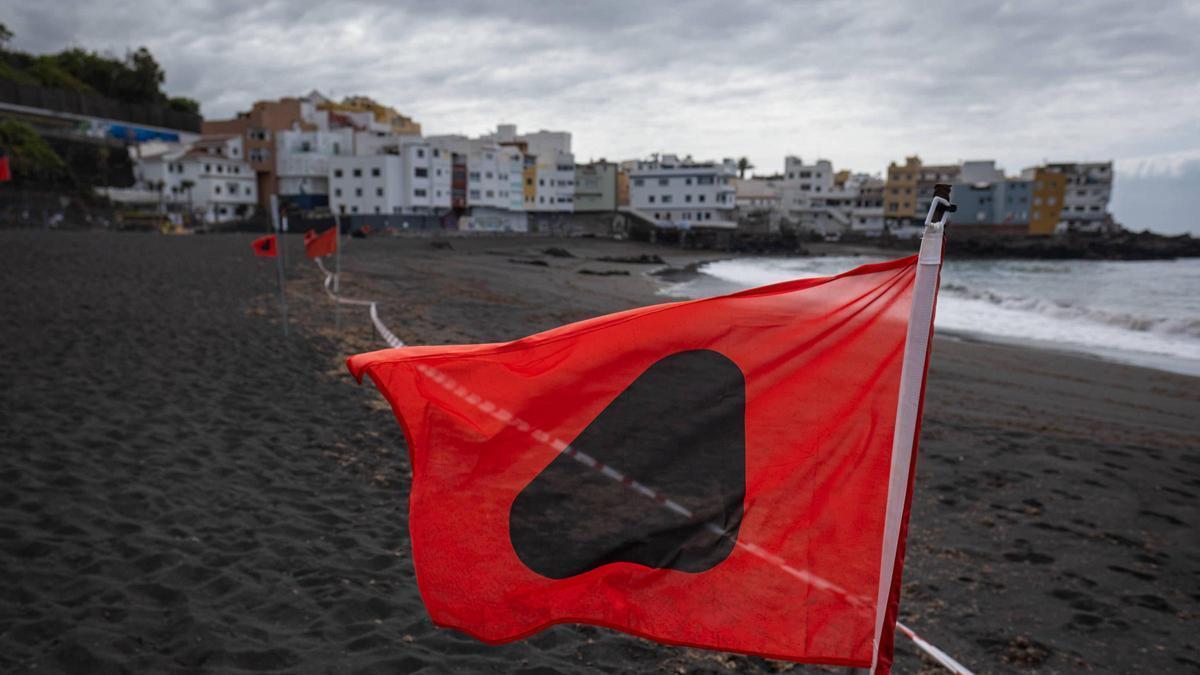
The mayor, Leopoldo Afonso, defends the closure as a matter of “responsibility”, insisting that “the priority is to guarantee the safety of bathers”. At the same time, he is calling for urgency in clarifying the difference between the municipal analyses and those carried out by Public Health, so that the beach can be reopened as soon as health guarantees are in place. The health authority will have the final say on reopening. Until then, the red flag is once again part of the landscape at Playa Jardín. The council will maintain permanent surveillance of water quality and will communicate any change that allows the restriction to be lifted.
What next for Playa Jardín?
The image is difficult to separate from the recent memory of this coastline. Just over a year ago, Playa Jardín was once again welcoming bathers after months of closure. Now it has closed again, although this time preventively and amid contradictory analytical results. The question remains the same: what is happening in the waters of Playa Jardín, and will the work on the sanitation systems be enough to stop contamination from driving bathers out of the water again?
The immediate objective is clear: clarify the unfavourable result as soon as possible and reopen once guarantees exist. The underlying challenge is greater. Puerto de la Cruz needs Playa Jardín to stop appearing periodically in the headlines for its contamination problems and to finally recover its status as one of the great bathing spaces in the north of Tenerife.
What’s happening in the Canaries – straight to your phone
News, weather alerts and practical updates – direct from the islands, in English. We live here and know what’s going on – before the international media catch up. Everything lands on our WhatsApp channel – no middlemen, no algorithm. Curated for families, expats and travelers.

Canary Islands sea hits second-hottest year on record

Legal bid to halt tree felling in Santa Cruz’s La Salud

Fiesta del Charco: A journey through La Aldea’s past

Corralejo dunes power line set for removal

ULPGC launches 14 research projects at Las Canteras

TMT will never be built, says Canary Islands astrophysics chief

Pedro Duque: Canarias is the “ultimate dream” for rockets

Court blow to Tenerife motor circuit project
La Palma faces new volcanic risk planning deadline
