
Compiled with the help of artificial intelligence, based on Spanish-language information. Source below the article.
Perseids still visible after the solar eclipse
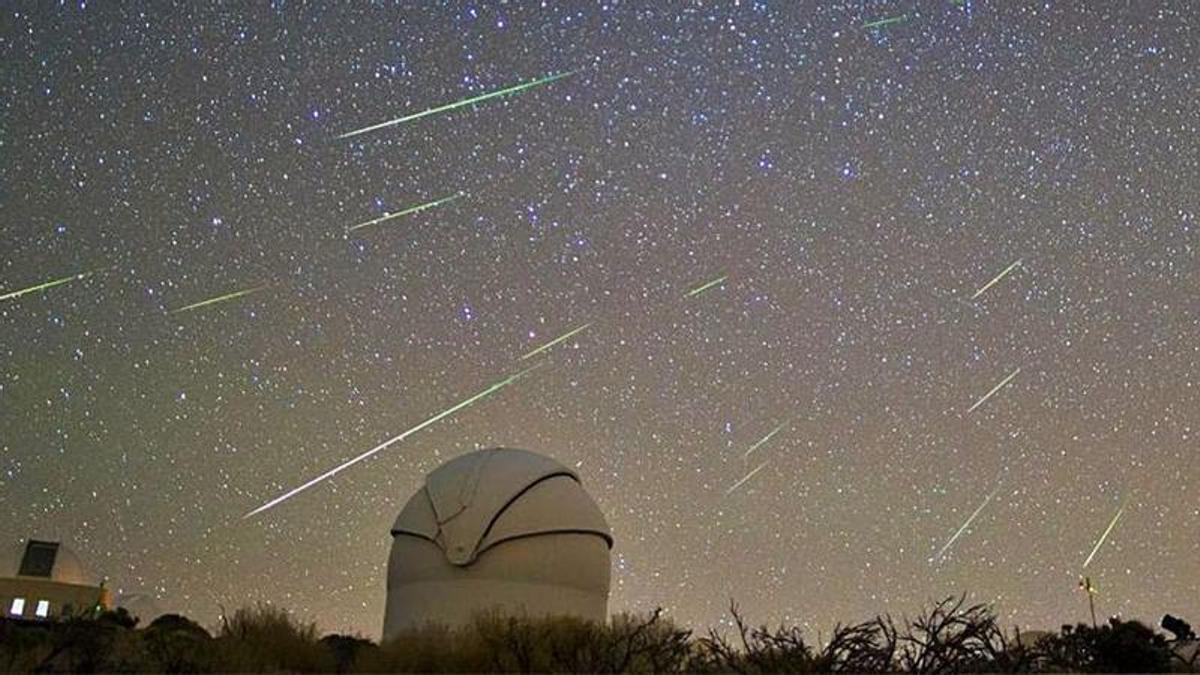
Even after the solar eclipse, stargazers still have plenty of reasons to look skyward. The Canary Islands remain one of the world’s most privileged vantage points to observe a different astronomical phenomenon that draws the attention of thousands every year: the Perseid meteor shower, otherwise known as the Tears of St Lawrence.
Although this year the shower’s peak activity coincided with the eagerly awaited solar eclipse – taking place in the early hours of 13 August – there are still opportunities to catch a meteor streaking across the celestial dome and make a wish. Specifically, the Earth will continue passing through the debris left by the Swift-Tuttle comet, the source of this meteor shower, until 24 August.
And while the likelihood of spotting one of these lights crossing the sky within a given hour diminishes daily, the cosmos has provided a summer activity to marvel at the natural wonders of our universe. What is more, the Moon is in its waxing crescent phase at present, so its subdued glow will allow for far clearer viewing of the spectacle.
Why the Perseids happen every year
The Perseids occur annually when our planet ventures into a cloud of rocky fragments shed by comet 109/Swift-Tuttle – a colossal body of ice measuring 26 kilometres in diameter, twice the size of the asteroid believed to have wiped out the dinosaurs. When this rock strays too close to the Sun, which happens every 133 years, it releases pieces of its tail in the form of tiny particles, many no larger than a grain of sand – and often much smaller.
Scientists believe that the Earth may currently be passing through fragments the comet shed around the year 1800 or 1900, rendering the phenomenon not merely a source of wonder and contemplation but also, in a sense, a time capsule linking the present with the past.
The comet was first discovered in 1862 by American astronomers Lewis Swift and Horace Parnell Tuttle. Yet long before that discovery, humanity had already been captivated by the fleeting streaks of light that cross the sky each summer. Indeed, in medieval and Renaissance times, people would gather in the early days of August to watch the display of shooting stars and offer up their wishes.
So great was the event’s popularity that Catholics also sought to incorporate it into Christian tradition. It became known as the Tears of St Lawrence, linking the shower to the tears the saint was said to have shed while being martyred on a gridiron. Lawrence is the most celebrated martyr of the Church of Rome, and the comet has been continuing its highly elliptical orbit around the Sun, completing one circuit every 135 years. Its most recent close approach to the star at the heart of our solar system was in 1992; it will not come this way again until far into the next century, around 2126.
Best spots in the Canary Islands for watching the meteor shower
The Perseids can be observed streaking across the sky from almost anywhere sufficiently dark. In the Canary Islands, many venture to Teide National Park or other high-altitude zones, assuming that these are the finest locations for enjoying the display. They are not wrong – but these spots are not the only option, nor is it always necessary to reach the summit to appreciate the celestial show.
Scientists insist that anywhere with clear skies and minimal light pollution can provide an ideal setting. The essentials are giving your eyes time to adjust to the darkness, gazing up at the stars and waiting patiently. It is also advisable to dress warmly and make yourself comfortable lying on the ground, as it turns decidedly cold during the night.
Weather forecast for the coming days
According to the State Meteorological Agency (Aemet), the Canary Islands will see rising temperatures and calima dust from the Sahara until Friday. From the weekend onwards, the trade winds will pick up considerably and temperatures will drop. Skies will be cloudy across the north of the islands with more mountainous terrain, with a slim chance of the odd patch of light rain at mid altitudes.
How and where to look for meteors
Once settled in, the most important step is to locate the constellation of Perseus in the sky. This is where the shower’s radiant point lies – the direction from which the meteors appear to emanate across the celestial vault. Looking directly at the radiant makes it far more difficult to see shooting stars; astronomers therefore advise directing your gaze to any other part of the night sky.
According to calculations based on standard models, Perseid activity reaches around 100 meteors per hour at its peak. These meteors are exceptionally fast, more so than the Geminids, the winter shower par excellence. Scientists note that a single meteor can vanish into the vastness of space within barely a minute.
Throughout every meteor shower, amateur astronomers perform meteor counts and submit their observations to the International Meteor Organization (IMO) to help calculate the activity rates of each shower. The aim of initiatives like this is to offer the wider public a simple means of taking part and understanding this fascinating astronomical event.
What’s happening in the Canaries – straight to your phone
News, weather alerts and practical updates – direct from the islands, in English. We live here and know what’s going on – before the international media catch up. Everything lands on our WhatsApp channel – no middlemen, no algorithm. Curated for families, expats and travelers.

Canary Islands sea hits second-hottest year on record

Legal bid to halt tree felling in Santa Cruz’s La Salud

Fiesta del Charco: A journey through La Aldea’s past

Corralejo dunes power line set for removal

ULPGC launches 14 research projects at Las Canteras

TMT will never be built, says Canary Islands astrophysics chief

Pedro Duque: Canarias is the “ultimate dream” for rockets

Court blow to Tenerife motor circuit project
La Palma faces new volcanic risk planning deadline
