
Compiled with the help of artificial intelligence, based on Spanish-language information. Source below the article.
A symbolic replanting
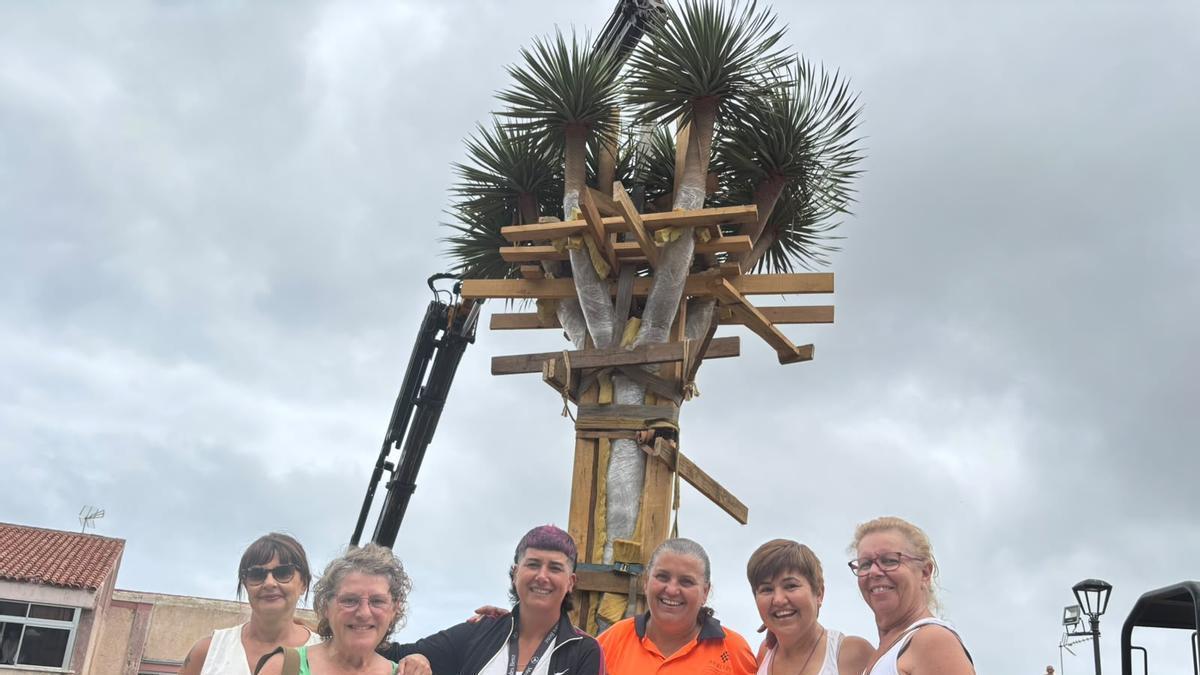
It will be decades before the new drago at San Francisco cemetery commands the same monumental presence as its predecessor, but this burial ground in Realejo Bajo has at last recovered the plant that so defined this corner, with its privileged views over the municipality of Los Realejos. Workers have just planted a seven-metre specimen of the iconic Canary Islands species Dracaena draco in the exact spot where the centuries-old San Francisco drago once stood.
At around 8.30pm on Wednesday 4 March, the historic specimen – also known as the Buenpaso Drago – came crashing down, a casualty of the intense rains and strong winds of last winter. Standing 17 metres tall and estimated to be more than 200 years old, it was one of the largest and most cherished dragos on Tenerife, and its loss sent shockwaves through the local community. Mayor Adolfo González said at the time that the municipality had lost “a symbol”.
From the very outset, González was clear that another plant of the same species should be placed in the space to fill the enormous emotional void. That moment has now arrived – and it has been no simple task of just planting a replacement.
Careful preparation
The Los Realejos town hall first carried out restoration work on the walls damaged when the previous drago fell. This involved demolishing the front wall and planters of the old parterre and rebuilding them to match the original finish, while considerably increasing their capacity and the area of soil, as well as installing a drainage system. The plot was also filled with suitable earth for the development of this type of plant – the drago is technically a plant, not a tree – with no irrigation system to avoid damp patches, and a specialist treatment was applied to the base after planting.
Finding the best young drago candidate for the replacement was no easy feat either. After assessing a dozen specimens from within the municipality itself, gardeners selected one located in the gardens of the municipal market that was already in need of transplanting. Standing seven metres tall with a very upright bearing and a symmetrical crown, the substitute enjoys good health and sufficient strength to have withstood the journey on a crane lorry and all the positioning work, which was carried out following preparatory treatment of the base and root zone two months in advance, plus splinting reinforcement and partial covering of the trunk.
A blessing for the new drago
The new San Francisco drago will even be blessed. Next Monday, during the procession of Nuestra Señora Madre de Los Afligidos as it makes its way through the streets of Realejo Bajo, the Bishop of the Diocese of Tenerife, Eloy Santiago, will bless the specimen when the procession pauses in front of the historic portico of San Francisco cemetery. The event, organised by the parish community, will be attended by the town’s mayor, the brotherhood of the Marian image and representatives of the parish of Nuestra Señora de la Concepción in Realejo Bajo.
The news comes at a time when dragos are back in the spotlight. Last Saturday, another monumental drago, 15 metres tall and standing in Plaza de Los Remedios in La Laguna’s historic quarter, directly opposite the main facade of the Cathedral, came down for the same reasons as the San Francisco specimen: waterlogging caused by last winter’s heavy rains.
In both cases, the town halls saved offshoots of the fallen plants. In Los Realejos, however, they could not wait for one of those to replace its parent, opting instead for a carefully selected specimen to guarantee it will live for at least 200 years, just like the one that fell six months ago.
An emblem of the Canary Islands
The drago is arguably the most emblematic species in Canary Islands flora. Its branching crowns, shiny grey bark and the mystique surrounding these trees, dating back to Guanche times, make them a symbol of the islands – something far more than mere ornamental greenery. The collapse of the centuries-old San Francisco specimen in March and the monumental Cathedral drago this Saturday 15 August has thrust the Dracaena draco into the news spotlight. This species grows on crags, cliffs and inaccessible ravine slopes at altitudes of between 30 and 800 metres.
These plants are endemic to Macaronesia – found in the Canary Islands, Madeira and Cape Verde – and, according to José Alberto Delgado, head of the Biodiversity Unit at the Cabildo of Tenerife, their significance “goes beyond biology, as they form part of the collective, landscape, historical and cultural memory of the Canary Islands”. So much so that a law passed by the Canary Islands Government even declared it the natural plant symbol of the island of Tenerife.
Few forests or groupings of dragos now remain in the wild in the islands. Their ease of reproduction, as well as their spectacular appearance, has turned them into an ornamental plant, although specimens can still be spotted in remote corners of ravines, particularly on Tenerife, La Palma and Gran Canaria.
José Alberto Delgado drew up a list of the most monumental dragos on Tenerife, with the intention of turning it into a catalogue of protected specimens. He has not yet succeeded, as the Canary Islands Government transferred that responsibility to the town halls, which have not developed specific lists. There were 39 on the list, but the collapse of the San Francisco drago has reduced it to 38. The one in Plaza de Los Remedios in La Laguna was not among them. They are found in cities, towns and ravines – and they are worth seeing at least once in a lifetime.
What’s happening in the Canaries – straight to your phone
News, weather alerts and practical updates – direct from the islands, in English. We live here and know what’s going on – before the international media catch up. Everything lands on our WhatsApp channel – no middlemen, no algorithm. Curated for families, expats and travelers.

Canary Islands sea hits second-hottest year on record

Legal bid to halt tree felling in Santa Cruz’s La Salud

Fiesta del Charco: A journey through La Aldea’s past

Corralejo dunes power line set for removal

ULPGC launches 14 research projects at Las Canteras

TMT will never be built, says Canary Islands astrophysics chief

Pedro Duque: Canarias is the “ultimate dream” for rockets

Court blow to Tenerife motor circuit project
La Palma faces new volcanic risk planning deadline
