
Desalojan a un centenar de personas de la antigua fábrica de Mr. Leacock en Gran Canaria
On 30 June this year, around one hundred people will be evicted from the former Mr. Leacock factory on the road from Guía to Gáldar, in the north of Gran Canaria. According to the order issued by the Court of First Instance and Investigation number two of Santa María de Guía, to which this newspaper has had access, the eviction is being carried out by Félix Santiago Melián SL, the most powerful business group in the north of the island. The same company that once helped some of these people register as residents in the municipality because they worked on its land is now, paradoxically, evicting them. All of them are currently in a vulnerable situation, and some are families with children in their care. At least 79 of them are registered as living on the property owned by the group, according to the town council. All this is happening just a few metres from the urban centre of Santa María de Guía, on a stretch of land bordering Gáldar, where the mansion of the communist Mr. Leacock stands. Around this mansion, some one hundred people have built their lives. They have no housing alternative now, nor will they have one after the eviction. Their stories are difficult, marked by poverty, unemployment, uprootedness, and illnesses requiring life-saving treatment such as dialysis.
A small neighbourhood among the ruins
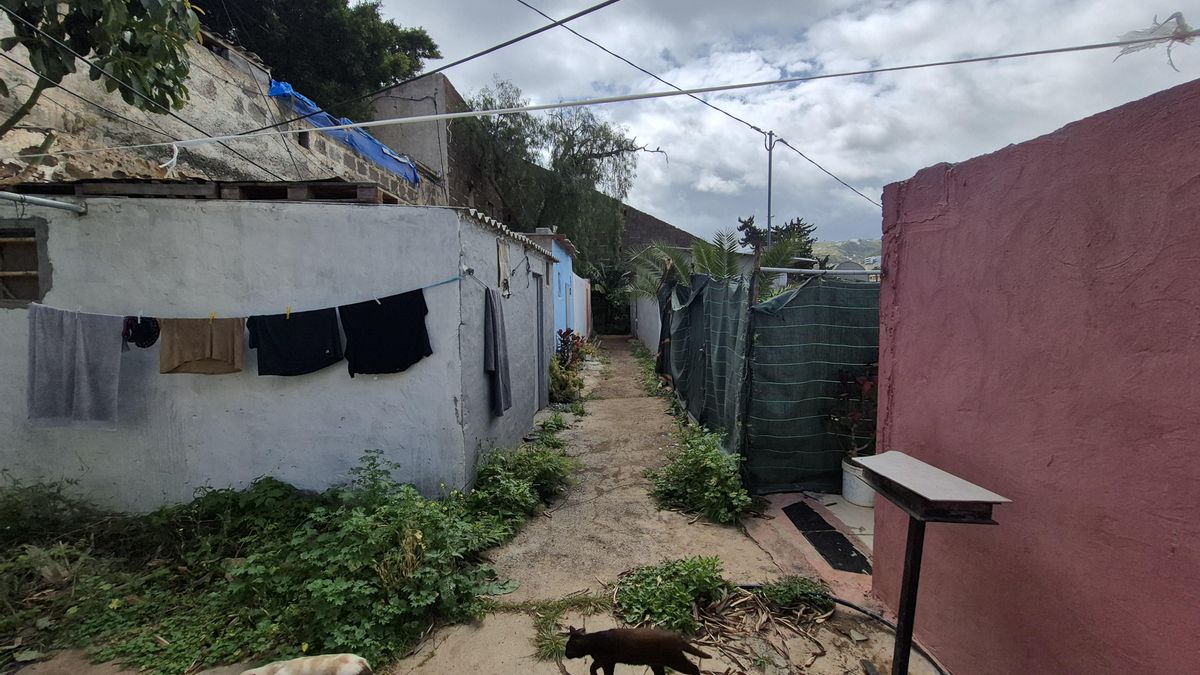
Among the ruins of the old Mr. Leacock warehouse, a small neighbourhood has sprung up. The residents themselves are responsible for rubbish collection and for bringing light, water, and supplies to the half a hundred dwellings, substandard homes, and shacks that have been built over decades. During the day, life goes on as normal. The journalists from this newspaper found it difficult to get testimonies from those affected during working hours, as most residents are out trying to make a living; they are bricklayers, farmers, street vendors, and almost all of them are registered as living there. The news came to light when the mayor of Guía, Alfredo Gonálvez, requested inter-institutional collaboration in the face of the eviction threat for these people. He told this newspaper that the council no longer registers those living on the property, although it did so until last year. The first people to formalise their residence in the old sugar factory were workers of FSM. Even today, only a few work on the banana plantations for one of Félix Santiago Melián’s companies. The Guía town council claims there could be 200 people living there, but the residents themselves say no more than one hundred, including eleven minors. “We are at most 70 or 80 people in total,” they clarify. The mayor of Guía explains that currently 24 residents of the property attend municipal social services; two families with three children each in their care, all of them schooled in Guía. Currently, according to the mayor, there is one more family with four children who will no longer be allowed to register, a basic document for accessing all benefits such as the health card.
“I have nowhere to go”
Abdul El Guerouh tells Canarias Ahora that he has nowhere to go. “There is no change,” he says, referring to the fact that he has no housing alternative after the eviction on 30 June. “I don’t like that,” he says, pointing to the rubble at the upper entrance to the property. “I swear to God, that embarrasses me, people walk past on the street and see it.” He has lived on the property since 2007. “I have been here for 18 years.” At night he cannot sleep thinking about where to go after the eviction. “There are many problems here, people here have children,” and he counts house by house the number of children who will be affected. By his estimate, there are more than ten. Abdul, who is currently ill with a lung condition, tells this newsroom that he was a farmer and wonders if the eviction problem has a solution… “Inshallah,” he sighs. “God willing.” Etuani is asking for a solution for all those affected, not just for those who, like him, have minor children in their care (three). He says that if there is an eviction on 30 June, the residents of the property will protest peacefully to stay. He has been in the Canary Islands for 25 years and holds dual nationality (Moroccan and Spanish for seven years). He works in construction, but is currently unemployed. Etuani spent €19,000 building his own house and fitting it out. “No one has spent as much as I have.” Others have spent €3,000, €4,000, and €5,000.
Dialysis and a shack made of sticks and plastic
Ahmed Ouarar has nowhere to go. He was released from prison on 17 January this year, ill with kidney disease. He served four years for being the captain of a small wooden boat (patera). He has been going to the Doctor Negrín Hospital for dialysis every few days since 2023. He looked for shelters in Las Palmas de Gran Canaria that could help him, but none called him. Until one day he picked up some sticks and plastic and built himself a humble shack. He is grateful to the authorities for helping him with medication and supermarket food vouchers. “Having a home, his biggest problem is getting his medication.” He insists that he wants to work, but there is no work and his administrative situation is irregular. “Sometimes I walk all day looking in the rubbish for something to sell, but sometimes there is nothing.” The case of Salah Daaif is also very complicated. “I have everything in bags in a corner of my house, just in case.” As he could not find a rental he could afford, he bought his home on the Mr. Leacock property for €1,000. “I accepted this house without furniture and had to invest €2,000 to be able to live in it because it was just like a garage.” Salah is worried about the outside, the state of the entrance to the settlement, the cleanliness. “There is only one small rubbish bin and that means no one thinks about you, abandoned,” he states. Salah insists that he wants to pay rent, that his son also works, but that there is no housing, “everything is for tourism.”
Company declines to comment
This newspaper contacted the Félix Santiago Melián group to find out how long the company has owned the property, what it knows about the people living there, whether there are families with children, what it plans to do with the property, and its position on this eviction, among other questions, but it declined to answer the questions asked. Specifically, it replied that it appreciates the interest shown, but that “at this time, the company does not plan to give interviews on this matter.” The FSM Group was founded by Félix Santiago Melián in 1961 in the north of Gran Canaria. It began as a family business, first dedicated to agriculture, then to construction, and today has diversified into the energy and hospitality sectors, that is, catering, accommodation, events, and tourism. On its website, it explains that, through its values, “our group demonstrates its commitment to ethics, social responsibility, and respect for people and the environment.” It is currently one of the most important companies in Gran Canaria, whose general manager and sole administrator is Juan Carlos Santiago Cubas, one of the founder’s five children, while the executive director is Laura Santiago, the founder’s granddaughter.
A distinguished businessman
Félix Santiago received the distinction of Favourite Son of the City of Gáldar in 2008. He was also named an adopted son of the sister city of Santa María de Guía and a patron of the University of Las Palmas de Gran Canaria. During his long career, he was vice president of the Construction Business Association, and also vice president of the Chamber of Commerce, Industry, and Navigation of Las Palmas. After his death at the age of 87 in Sardina (Gáldar) in July 2022, the mayor, Teodoro Sosa, declared three days of official mourning. Months later, he met with Martha Leacock (Scottish heir of the Leacock family) to discuss the future of the Leacock buildings and the old warehouse, which are in a state of abandonment. At the time, Teodoro Sosa expressed his desire to find a solution to highlight the influence of the historic businessman in Gáldar and Gran Canaria.
The communist who loved this land
Mr. John Milburn Leacock arrived in the Canary Islands at the end of the 19th century, settling in the north of Gran Canaria, where he developed an important agricultural and industrial network. His son David expanded that legacy, but over time many of those properties have fallen into ruin, while today dozens of people face eviction on those same lands. During the years of scarcity of the Second World War, Leacock grew basic foodstuffs to distribute among his workers, reflecting a strong sense of social responsibility. That commitment was deeply linked to his ideology: according to his own son, he was a “convinced communist,” a reader of the Daily Worker, the communist newspaper of New York, and a firm supporter of the Second Spanish Republic. After the 1936 coup, he was arrested along with his wife, forced to pay for their release, and to hand over control of his assets under Francoist surveillance. The subsequent exile, first in England and then in the United States, was one of the most painful episodes of his life, marked by constant nostalgia for having left behind his mountain in northern Gran Canaria. Upon his return in 1963, he resumed his agricultural activity, promoted new crops, and generated employment for hundreds of people, standing out for his fair treatment; he paid wages, overtime, and offered medical care even when it was not required by the laws of the time. He bequeathed his lands to eleven of his workers, faithful to the principle “the land belongs to those who work it.” Today, paradoxically, those same lands are about to evict those who inhabit them, while Leacock’s mortal remains rest a few kilometres away, in the La Atalaya cemetery. The irony of fate is that in one month, some of the workers registered by the current owner of those lands, which at one time had no owner, are being evicted. On the communist’s tombstone, one can read: “Rest in peace in the land he loved so much.”
What’s happening in the Canaries – straight to your phone
News, weather alerts and practical updates – direct from the islands, in English. We live here and know what’s going on – before the international media catch up. Everything lands on our WhatsApp channel – no middlemen, no algorithm. Curated for families, expats and travelers.

Vivanta shuts all dental clinics including six in Tenerife

Civil Guard warns of digital skimming threat to online shoppers

Tenerife shifts FDCAN funds from roads to housing

PSOE warns Arrecife plan could ‘bury’ El Cable beach in concrete

Canary Islands faces loss of 20% of self-employed workers

Canary Islands to get 26 new substations by 2030

Canary Islands poverty rates stuck since pandemic

Court backs eviction over verbal room rental in Arona

Canary Islands pushes for 10-year residency rule for foreign buyers
