
Compiled with the help of artificial intelligence, based on Spanish-language information. Source below the article.
A surprising evolutionary journey
At first glance, the map of the Canary Islands suggests a straightforward, step-by-step colonisation: from Africa to Lanzarote and Fuerteventura, then hopping consecutively to Gran Canaria, Tenerife, La Gomera, La Palma and El Hierro. However, biogeographical research has shown that this spatial logic does not match the evolutionary reality. To decipher the true route of the genus Gallotia, scientists have had to synchronise two fundamental sources of information: the molecular clock (DNA), which determines the degree of relatedness between populations and calculates exactly when their lineages diverged, and the geological clock (rocks), which establishes when each volcanic edifice emerged above sea level.
By cross-referencing genetic data with the age of the islands, the colonisation route reveals an unexpected twist that breaks with geographical continuity.
Three key stages of colonisation
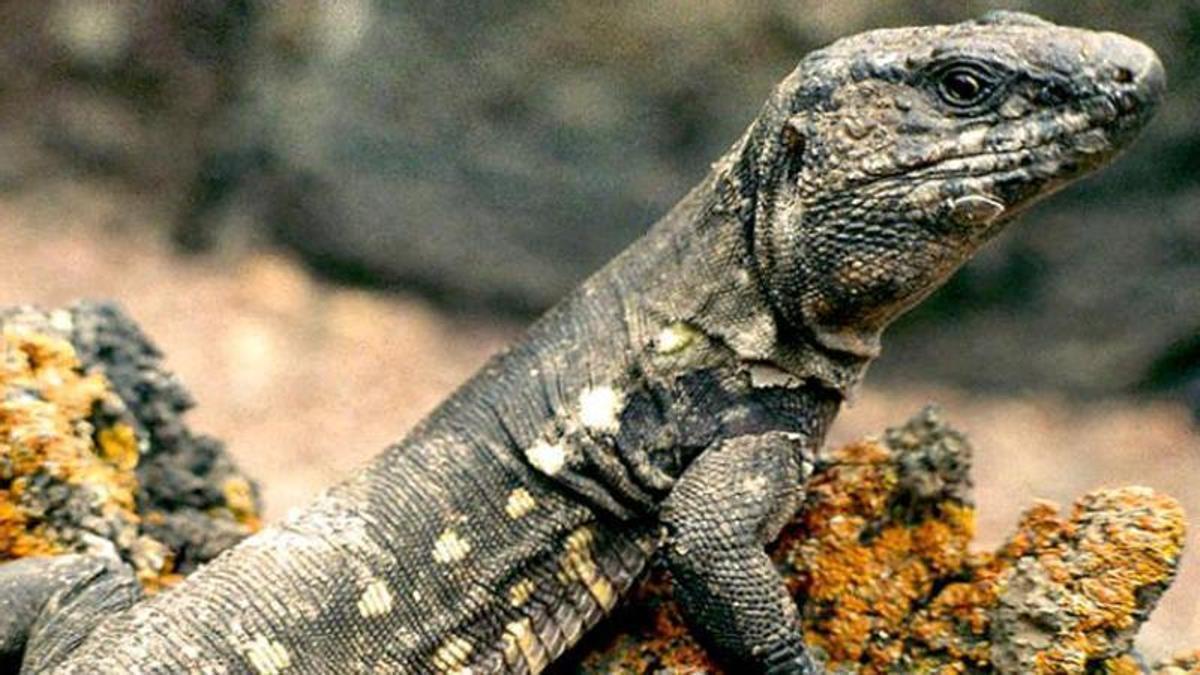
The first arrival occurred around 20 million years ago, when the earliest ancestors crossed from the African continent to the eastern islands of Lanzarote and Fuerteventura, giving rise to the lineage of Gallotia atlantica. From there, they subsequently colonised Gran Canaria, where they evolved in isolation to become the modern giant lizard of Gran Canaria (Gallotia stehlini).
Then comes the surprising part. Contrary to popular belief, the lizards of Tenerife, La Gomera, La Palma and El Hierro do not descend from those on Gran Canaria. Genetic evidence confirms that they travelled directly from the Lanzarote-Fuerteventura landmass to La Gomera or the ancient palaeo-territory of Tenerife around 10 million years ago. Millions of years of isolation on each island mass ultimately shaped the distinct species and subspecies that inhabit the Canaries today.
The mystery of the crossing
The great question that remains on the table is the mechanism of transport. Passive dispersal on rafts of vegetation swept out to sea by flash floods or major forest landslides continues to be the hypothesis with the strongest scientific backing for explaining how a terrestrial reptile managed to cross tens of kilometres of open ocean.
What’s happening in the Canaries – straight to your phone
News, weather alerts and practical updates – direct from the islands, in English. We live here and know what’s going on – before the international media catch up. Everything lands on our WhatsApp channel – no middlemen, no algorithm. Curated for families, expats and travelers.

Canary Islands sea hits second-hottest year on record

Legal bid to halt tree felling in Santa Cruz’s La Salud

Fiesta del Charco: A journey through La Aldea’s past

Corralejo dunes power line set for removal

ULPGC launches 14 research projects at Las Canteras

TMT will never be built, says Canary Islands astrophysics chief

Pedro Duque: Canarias is the “ultimate dream” for rockets

Court blow to Tenerife motor circuit project
La Palma faces new volcanic risk planning deadline
