Compiled with the help of artificial intelligence, based on Spanish-language information. Source below the article.
A different kind of conference
It was no ordinary conference. There were scientists and engineers, but also companies, funding bodies and technical staff from public administrations. There were so many acronyms that, with a little imagination, you could have arranged them into another constellation. The idea, however, was quite clear: to ensure that the science carried out on La Palma leaves more knowledge, more jobs and more economic activity on the island itself. The La Palma Quantum Interferometer (LP QI Workshop 2026), held from 8 to 10 September at IACTEC in La Laguna, opened by putting that question front and centre.
The welcome session brought together Valentín Martínez Pillet, director of the Instituto de Astrofísica de Canarias (IAC), Javier Franco Hormiga, director of the Canary Islands Agency for Research, Innovation and the Information Society, and Héctor Izquierdo Triana, special commissioner for the reconstruction of the island of La Palma. The image had value for what it represented. A major scientific project needs researchers, but also administrations that understand its timescales, companies capable of manufacturing components and bodies that fund developments whose results do not appear overnight. Patience is also part of scientific infrastructure.
Science, territory and funding around one table
That mix took shape in the round table on the transformative potential of technology for the sustainable development of La Palma, moderated by José Fernández Arozena. Alongside the heads of the IAC, the Canary Islands Agency and the Commissioner were Joaquín Hernández Brito, director of PLOCAN, María Pilar González Gotor, representing the CDTI, and Braulio Quintana Sánchez, from the emerging companies association EMERGE. Science, territory and funding shared a table. That does not happen every day. And it should happen more often.
The conversation soon landed on the economy. During the meeting, it was noted that scientific and astrophysical activity accounts for around 4% of La Palma’s GDP. The horizon set out is to approach 10% in the coming years with the consolidation of the LPQI, the European Solar Telescope and the CTAO, the future large gamma-ray observatory. The possible arrival of the Thirty Metre Telescope, the TMT, would increase that impact even further. It is a projection, not a guarantee written in the stars, but it points in a direction.
The underlying question is simple. An observatory generates science, but around it there is also a need for electronics, optics, computing, maintenance, communications and specialist staff. If a growing share of that work is carried out from the Canaries, the sky ceases to be merely an exceptional natural resource and also becomes a base for diversifying the economy.
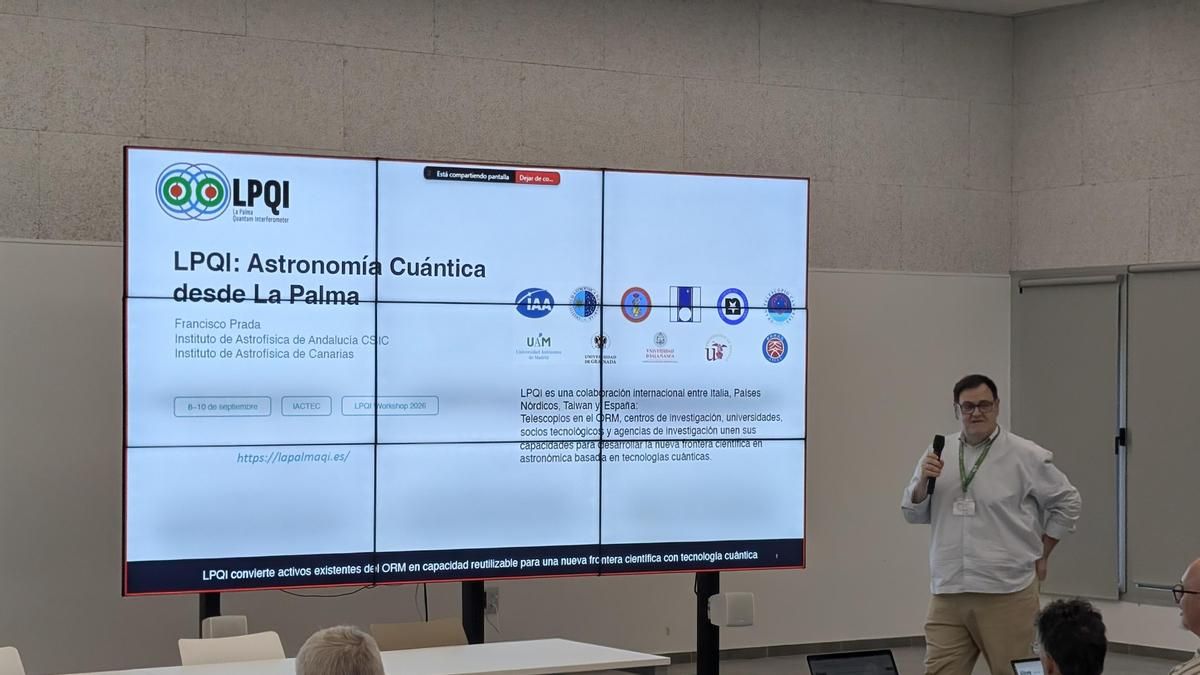
Paco Prada and the soul of the LPQI
At the heart of the conference was Paco Prada, a researcher at the Instituto de Astrofísica de Andalucía, part of the CSIC, and at the Instituto de Astrofísica de Canarias. He is the principal investigator and the driving force behind the La Palma Quantum Interferometer, the LPQI. For years he has been pushing an ambitious proposal, the kind that forces you to look up and, at the same time, reach for the calculator.
The LPQI will not build a gigantic telescope from scratch. It aims to connect five facilities at the Roque de los Muchachos Observatory – the NOT, the TNG, the GTC, the WHT and the INT – so that they work as a network. The first phase, called LPQI Pathfinder, will link the Nordic Optical Telescope and the Telescopio Nazionale Galileo, separated by some 550 metres.
The network will not simply add together photographs. Each telescope will observe the same object and record tiny variations in the intensity of its light. Computers will then look for matches between signals captured hundreds of metres apart. From those correlations it will be possible to reconstruct information that none of the telescopes would obtain on its own. It is a different way of looking: less like an enormous camera and closer to several instruments comparing their notes until they complete the same story.
Counting individual photons
The system will record the arrival of photons, the elementary particles of light, and compare those signals with extraordinary precision. The goal is to reach around 50 microarcseconds, enough to distinguish structures up to a thousand times smaller than those the Hubble Space Telescope can resolve. With that capability it will be possible to study stars, planetary systems, supernovae and the regions close to black holes.
That resolution matters because many of those objects appear from Earth as simple points of light. The LPQI aims to discover what happens inside those points, measure sizes and movements and track phenomena that change with enormous speed. It does not promise a conventional photograph of the universe. It promises something more useful for science: new measurements.
The word quantum may sound like blue lights and films where nobody is quite sure what is going on. Here it means counting individual photons, measuring tiny times and processing enormous amounts of information. The photon arrives, it is recorded, and it does not wait for the computer to finish its coffee.
From drawings to laboratory work
The conference showed that the project has already moved from the general drawing to laboratory work. The teams have defined the architecture of the LPQI Pathfinder and are developing the cameras that will detect each photon, the electronics that will read their signals, the cooling systems that will keep the sensors stable and the software that will coordinate the whole. Some parts are still at the design stage and others have begun tests of operation and thermal stability. They are also preparing FIRNAS, the LPQI’s first spectrograph, an instrument that will separate light into its different colours to extract information about the objects observed.
Guillermo González de Rivera, from the Universidad Autónoma de Madrid, explained the work carried out on the control and readout electronics. Carmen Vélez and Pedro Ortega, from the Real Instituto y Observatorio de la Armada, presented progress on time synchronisation. In a system like this, two telescopes must share time with an accuracy of one trillionth of a second. If their clocks disagree, even very slightly, the observation loses scientific value.
The experience of the TNG and NOT telescopes
The project also draws on the experience of the teams at the Italian TNG telescope and the Nordic NOT telescope. Adriano Ghedina, from the TNG, chaired the first technical sessions and helped place each development within the real operation of a telescope. Alongside him, Luca Di Fabrizio and Rosario Cosentino are working on the cameras, the optical fibre and the cooling of the sensors. From the NOT, Jacob Clasen contributed the perspective of the Nordic telescope and led one of the meeting’s sessions, while Joonas Viuho explained the fibre connection, the synchronisation systems and the programme that will allow communication with the rest of the network.
Their work may seem less eye-catching than the final image of a star, but it is decisive. The telescopes were not built at the same time and do not use exactly the same equipment. Interfaces have to be adapted, procedures coordinated and checks made that everyone understands the same commands. Getting facilities from different countries to work as a single instrument is not easy. Sometimes getting two computers to share a printer already feels like astrophysics.
Companies complete the mechanism
Companies complete the mechanism. Jorge Sánchez Capuchino, co-founder of Sagittal Optics, spoke about the barriers and opportunities that arise when taking a scientific idea through to industry. His company is involved in the mechanical development of the LPQI Pathfinder cameras. It is a concrete example of how a scientific need can become design, manufacturing, knowledge and contracts for technology companies.
That journey also requires knowledge transfer. Scientists define what they need and engineers look for a reliable way to build it. Companies then turn that design into a component that must work for years at a mountain observatory. The process is slow, painstaking and not very compatible with improvisation. Precisely for that reason, it leaves behind capabilities that can later be applied in communications, medicine, navigation or precision instrumentation.
Competing on the world astronomy map
La Palma competes on a world map where Chile and the Atacama Desert concentrate large astronomical facilities. There the European Southern Observatory is building its ELT, a 39-metre telescope. The decision on the TMT also remains open, with La Palma still a candidate. Spain and the European Investment Bank have prepared a framework that would allow up to 1 billion euros to be mobilised if the international consortium chooses the island.
The decision on the TMT has not yet been taken. That is why La Palma’s strategy cannot rest on a single card, even if that card has a thirty-metre mirror. The LPQI, the CTAO and the European Solar Telescope are already charting a path of their own. Each project brings research, engineering, specialist services and jobs that are difficult to relocate.
Knowledge, but also economic activity
That was the message left by the workshop. Science is knowledge, but it is also economic activity. It trains professionals, attracts investment and allows Canarian companies to enter high-value international projects. Paco Prada wants the LPQI to open a new window for observing the universe. The meeting was a reminder that this window also looks towards La Palma, towards its reconstruction and towards its future. Sometimes, looking further away helps you get a better footing on the ground.
What’s happening in the Canaries – straight to your phone
News, weather alerts and practical updates – direct from the islands, in English. We live here and know what’s going on – before the international media catch up. Everything lands on our WhatsApp channel – no middlemen, no algorithm. Curated for families, expats and travelers.
Tajogaite’s scientific legacy five years on
Magnitude 3.0 earthquake recorded west of Lanzarote
Canary Islands look to volcanic heat for energy

Canary Islands’ ancient potatoes face climate threat
Tenerife deploys drones to cut drowning deaths
Gran Canaria wildfire breaks out in Telde
Court backs Chira-Soria power plant in Gran Canaria
Twelve earthquakes recorded across the Canary Islands
The Tenerife ghost town built for lepers who never came