
Greenpeace challenges Ocean Citizen project in Tenerife’s protected marine zone
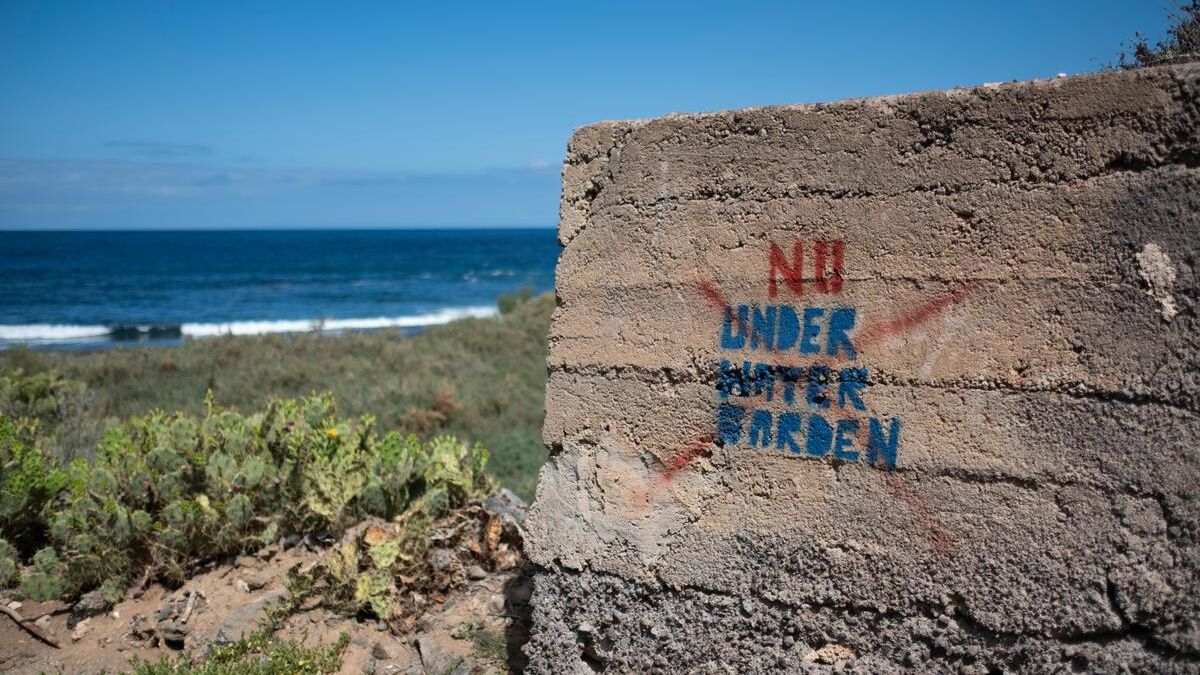
Greenpeace has filed formal objections with the Canary Islands Directorate General for Coasts and Maritime Space Management concerning a request to occupy the maritime-terrestrial public domain for the Ocean Citizen project at Punta Blanca, in Guía de Isora, southern Tenerife. The intervention would take place within the Teno-Rasca Marine Strip Special Area of Conservation (SAC), a natural treasure belonging to the Natura 2000 network and home to the European Union’s only whale sanctuary.
‘A clear case of greenwashing’
The environmental organisation maintains that this project, financed with European funds, presents itself in Tenerife as a non-profit scientific research initiative but is, in fact, an inseparable part of the so-called Sea Garden, a component of the wider Underwater Gardens Park Tenerife megaproject. This was declared of insular interest in 2022 by the Cabildo of Tenerife and is promoted by the same company at Punta Blanca.
Greenpeace is calling for the application to be rejected, arguing among other points that splitting the project by separating the marine component from the land-based complex is a deliberate attempt to avoid a comprehensive and cumulative environmental assessment, and to conceal the true recreational and tourism nature of the intervention.
Ocean Citizen is a consortium of more than 20 public and private entities from various European countries, including Spain, Germany, Denmark, Italy, and even two companies from Israel. However, the application to the coastal authorities has been submitted by Underwater Gardens International, S.L., the consortium’s private partner.
The project’s activities in Tenerife include installing 86 artificial reef modules bearing trademarks registered by the same company, at various depths. The bulk of these would be placed in shallow waters off Punta Blanca, coincidentally at the exact location where the promoting company intends to build its theme park and sell different underwater experiences, such as ‘submarine gardening’ and ‘ecological diving’.
“The promoter systematically uses concepts like ‘ecological restoration’ or ‘regeneration’ to dress up what is, in practice, a lucrative leisure business, disguising it as scientific altruism. It is pure greenwashing. The ultimate goal is not the advancement of scientific knowledge or the restoration of ecosystems, however much the consortium’s scientific bodies are cited for convenience, but rather the creation of a recreational diving venue within the Natura 2000 network to support the planned theme park at Punta Blanca,” said Kilian López, spokesperson for Greenpeace in the Canary Islands.
No proven need and hidden impacts
Among the most notable points in the objections, Greenpeace also argues that the project fails to demonstrate any real need for the intervention within the Teno-Rasca SAC, and that it would cause artificial and unjustifiable changes to marine habitats rather than restoring them. Furthermore, it has identified other shortcomings in a project that claims to restore supposedly degraded habitats but takes no action to halt or eliminate the causes of that degradation. Instead, it would worsen the situation through the mass influx of tourists to the terrestrial and marine theme park.
“It is unacceptable that an initiative funded with European public money is being used to pave the way for a private theme park in such a sensitive area as Punta Blanca and in a protected zone already under as much pressure as Teno-Rasca. We are facing a clear case of abuse of process, with which common natural heritage is being commodified under a false rhetoric of sustainability. Punta Blanca is one of the few undeveloped areas left in the south of the island and should be restored to nature, not punished with the 3,000 daily visitors that Underwater Gardens intends to bring there,” the spokesperson concluded.
A natural gem under immense pressure
The southwestern region of Tenerife represents one of the most biologically and geologically significant areas in the Canary archipelago, and therefore within the European Union as a whole. Of particular importance is the marine biodiversity, with resident populations of cetaceans of global significance, sea turtles, important bird colonies, habitats of Community interest, and a coastline that harbours several botanical endemics and many soil and geological assets.
This natural heritage is under enormous anthropogenic pressure, resulting from a development model that has prioritised urban and tourism expansion over ecosystem integrity. Although this is already one of the areas of the Canary Islands with the highest concentration of tourist establishments, new projects such as Underwater Gardens at Punta Blanca or Cuna del Alma at Puertito de Adeje threaten to destroy the few remaining virgin spaces on the coast and further overcrowd the Teno-Rasca marine strip, one of the most important marine SACs in Europe.
Widespread social opposition
The Underwater Gardens project has generated a social conflict of a magnitude rarely seen in the Canary Islands. Opposition has been coordinated around Salvar Punta Blanca, a platform formed by 34 groups, including Greenpeace, united in their efforts to stop both the terrestrial development and the marine project that is the subject of these objections. The international petition on WeMoveEurope has already surpassed 62,000 signatures.

Iberdrola plans Tenerife’s biggest battery storage plant

The wild canary that gave its name to the Canary Islands

Canary Islands sea hits second-hottest year on record

Legal bid to halt tree felling in Santa Cruz’s La Salud

Fiesta del Charco: A journey through La Aldea’s past

Corralejo dunes power line set for removal

ULPGC launches 14 research projects at Las Canteras

TMT will never be built, says Canary Islands astrophysics chief

Pedro Duque: Canarias is the “ultimate dream” for rockets
