
Compiled with the help of artificial intelligence, based on Spanish-language information. Source below the article.
Breakthrough study at Loro Parque
An international team of scientists has uncovered new insights into how bottlenose dolphins (Tursiops truncatus) combine echolocation and movement to distinguish objects made of different materials while swimming. The research, conducted entirely at Loro Parque’s facilities in Tenerife, represents the first scientific study to combine cognition and acoustics with the institution’s animals, placing the park at the forefront of global research.
The study, authored by researchers from the University of Southern Denmark and the Loro Parque Foundation, demonstrates that dolphins can distinguish between spheres made of different materials—including plastic, aluminium, brass and steel—using exclusively their biosonar, even when the objects are visually identical.
How dolphins ‘see’ with sound
Through a sophisticated system of ultrasonic “click” emission and analysis of the echoes these generate upon rebounding, dolphins construct a real-time mental representation of their surroundings, in a manner similar to how a high-precision ultrasound scanner reconstructs an image from sound.
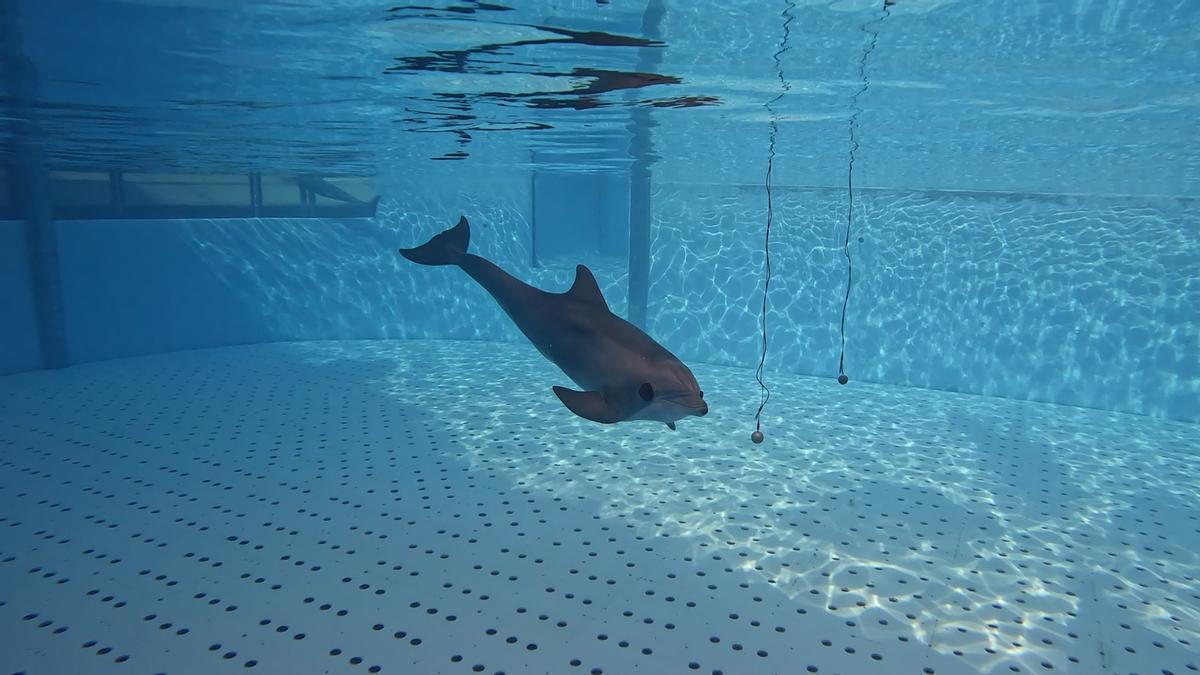
To achieve this, the scientific team trained Achille and Clara, two bottlenose dolphins resident at Loro Parque, to swim towards a pair of spheres suspended in the water and select, using sound alone, the one made of the correct material. Using highly sensitive hydrophones and synchronised underwater cameras, the researchers recorded how the animals oriented their heads, modified their swimming trajectories and adjusted their echolocation clicks in the fractions of a second preceding their final decision.
Voluntary participation and animal welfare
This research would not have been possible without the unique environment offered by Loro Parque. Achille and Clara participated entirely voluntarily in each of the work sessions—a fact that reflects the high standard of animal welfare and the bond of trust built between the dolphins and their care team over years of positive reinforcement training. The quality of veterinary care, the expertise of the trainer team and the specialised infrastructure at Loro Parque are factors that prove very difficult to replicate in other contexts, enabling scientific data of exceptional rigour and precision to be obtained.
The president of the Loro Parque Group, Wolfgang Kiessling, emphasised: “This study reaffirms our unwavering commitment to science and the protection of biodiversity. At Loro Parque we not only care for our animals to the highest welfare standards, but we also open our doors to the international scientific community to generate knowledge that is vital for saving our oceans.”
“Without the close collaboration between our team of experts and the researchers, discoveries of this magnitude simply could not be made,” Kiessling added.
Species comparison reveals evolutionary adaptations
The study also compares, for the first time and under the same experimental protocol, the performance of bottlenose dolphins with that of harbour porpoises, another cetacean species equipped with echolocation. The results show that both species deploy very similar active exploration strategies—turning their heads and varying their swimming trajectory to scan the target—but that their acoustic signals, differing in frequency and structure, confer different discrimination abilities upon them.
This finding offers valuable clues about how evolution has shaped each species’ sonar according to its biological needs and the acoustic environment in which it lives.
Conservation implications
Understanding with this level of detail how cetaceans perceive and interpret their acoustic environment has direct applications for conservation. It enables better prediction of how underwater noise of human origin can interfere with these animals’ ability to locate food, orient themselves or communicate, and helps design more precise and effective protection measures for their wild populations.
Sara Torres, the scientist responsible for the project, noted: “We have been able to discover that dolphins actively adjust their movements and sound production to ‘see’ the composition of objects while swimming.” She added: “It is fascinating to observe how Achille and Clara use their clicks to obtain detailed information about their surroundings. This fundamental knowledge is essential for understanding how changes and noise in the aquatic environment affect cetaceans, and allows us to develop much more effective conservation measures tailored to the biology of each species.”
Publication and funding
The article has been published in The Journal of the Acoustical Society of America (JASA), one of the world’s leading journals in acoustics, and involved collaboration between the University of Southern Denmark (SDU) and the Loro Parque Foundation. The work, funded by the Office of Naval Research, the Human Frontiers Science Program and the Carlsberg Foundation, expands the frontier of knowledge on animal cognition and provides essential scientific tools for the management and protection of cetacean populations.
What’s happening in the Canaries – straight to your phone
News, weather alerts and practical updates – direct from the islands, in English. We live here and know what’s going on – before the international media catch up. Everything lands on our WhatsApp channel – no middlemen, no algorithm. Curated for families, expats and travelers.

Canary Islands sea hits second-hottest year on record

Legal bid to halt tree felling in Santa Cruz’s La Salud

Fiesta del Charco: A journey through La Aldea’s past

Corralejo dunes power line set for removal

ULPGC launches 14 research projects at Las Canteras

TMT will never be built, says Canary Islands astrophysics chief

Pedro Duque: Canarias is the “ultimate dream” for rockets

Court blow to Tenerife motor circuit project
La Palma faces new volcanic risk planning deadline
