
Historic instrument restored for new eclipse
More than a century after taking part in observations of the historic total solar eclipse of 1905, a century-old telescope is set to point skywards once again on 12 August. The Instituto de Astrofísica de Canarias (IAC) has restored this historic instrument to return it to scientific use during a new eclipse, combining its original optics with 21st-century technology.
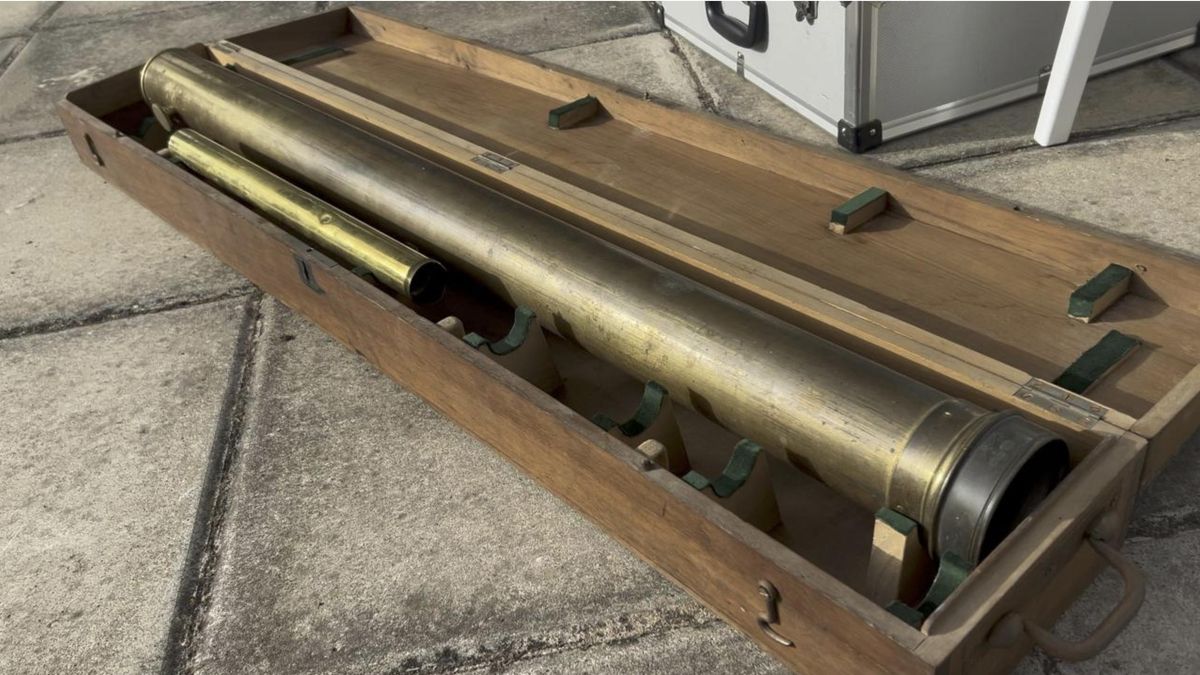
The instrument, a refractor from the prestigious manufacturer Breton Frères, lay forgotten for decades in a monastery attic after forming part of the scientific apparatus deployed in Palencia during the 1905 eclipse. Recovered and restored by astrophysicist and optical engineer Félix Gracia, a researcher at the IAC, it will be used again in observations for the NATE project, which the institute will carry out in Palencia on 12 August.
To this end, a conservative restoration has been undertaken, recovering its mechanical and optical function while respecting its original components as much as possible, in order to adapt it and have it ready to join the astronomical observations of the NATE project, which the IAC will conduct in Palencia on the 12th, as the astrophysics centre recalled in a statement on Thursday.
A pivotal moment for astronomy in 1905
The eclipse of 30 August 1905 turned the province of Palencia, and in particular Carrión de los Condes, into an international hub for astronomy of the era, with various scientific expeditions and commissions from the Society of Jesus travelling to the area to record the phenomenon. While other teams analysed the solar corona or recorded light spectra with specialised instruments, this Breton telescope had a crucial strategic mission: to observe the Sun by projection in order to determine with mathematical precision the contacts – that is, the exact moments when the lunar disc entered and exited the solar disc.
Following the scientific milestone of 1905, the instrument was stored in the monastery premises and gradually fell into oblivion for more than a hundred years, until local authorities recently handed it over to the IAC directorate, as part of the collaboration maintained for the great astronomical event that Palencia will experience on 12 August.
Challenging restoration work
The recovery process carried out by Félix Gracia in the IAC workshops posed a challenge of conservation and technical precision, as the telescope had sustained serious structural and functional damage after a century of inactivity. Gracia explains that during the restoration process, the focuser was completely dismantled and the internal mechanics rebuilt while preserving and maintaining the original components. Following this process, a custom-made adapter was designed and installed to allow contemporary eyepieces and high-sensitivity digital detectors to be attached. Finally, the original rigid and unstable wooden tripod, which lacked automated tracking, was replaced with a mount equipped with modern technology to follow the Sun’s trajectory continuously.
“We believe this may be a virtually unique case: a historic telescope which, more than 120 years on, will be used again to observe a total solar eclipse, combining its original optics with 21st-century technology and building a bridge between the astronomy of the early 20th century and the present day,” says Félix Gracia.
Looking ahead to 2027
The North African Telescope Eclipse (NATE) project, led by the IAC in cooperation with Mohammed VI Polytechnic University and the NSO, will establish in Morocco in 2027 a coordinated network of stations with telescopes operated by teams made up of secondary school students, university students and teaching staff from the three countries involved, as well as astronomers and engineers. Ahead of that, during this year’s eclipse in Palencia, crucial testing and training of the various teams will take place.
The scientific work will be carried out in full view of the public, and the team of experts will also be deployed over three days across Palencia and its surroundings to bring the passion for science, astronomy and solar physics to a wider audience.
What’s happening in the Canaries – straight to your phone
News, weather alerts and practical updates – direct from the islands, in English. We live here and know what’s going on – before the international media catch up. Everything lands on our WhatsApp channel – no middlemen, no algorithm. Curated for families, expats and travelers.

Canary Islands sea hits second-hottest year on record

Legal bid to halt tree felling in Santa Cruz’s La Salud

Fiesta del Charco: A journey through La Aldea’s past

Corralejo dunes power line set for removal

ULPGC launches 14 research projects at Las Canteras

TMT will never be built, says Canary Islands astrophysics chief

Pedro Duque: Canarias is the “ultimate dream” for rockets

Court blow to Tenerife motor circuit project
La Palma faces new volcanic risk planning deadline
