
Fifty years of a lie
Imagine spending 50 years believing your father was Chinese, as your mother always insisted, despite not having the slightest oriental feature. Imagine calling him “Daddy” all that time. Then, suddenly, after all these years, you discover it was a lie. The man you thought was your father – the one who married your mother, raised you, and formed a multicultural family with a Latina woman from the Dominican Republic – was not your biological father. Your real father was a man born in Tenerife, of whom you knew nothing. And your mother hid it, for reasons unknown. This is not an Almodóvar film or a Netflix series. It is real. It happened to a New York-based journalist and speaker.
A new identity
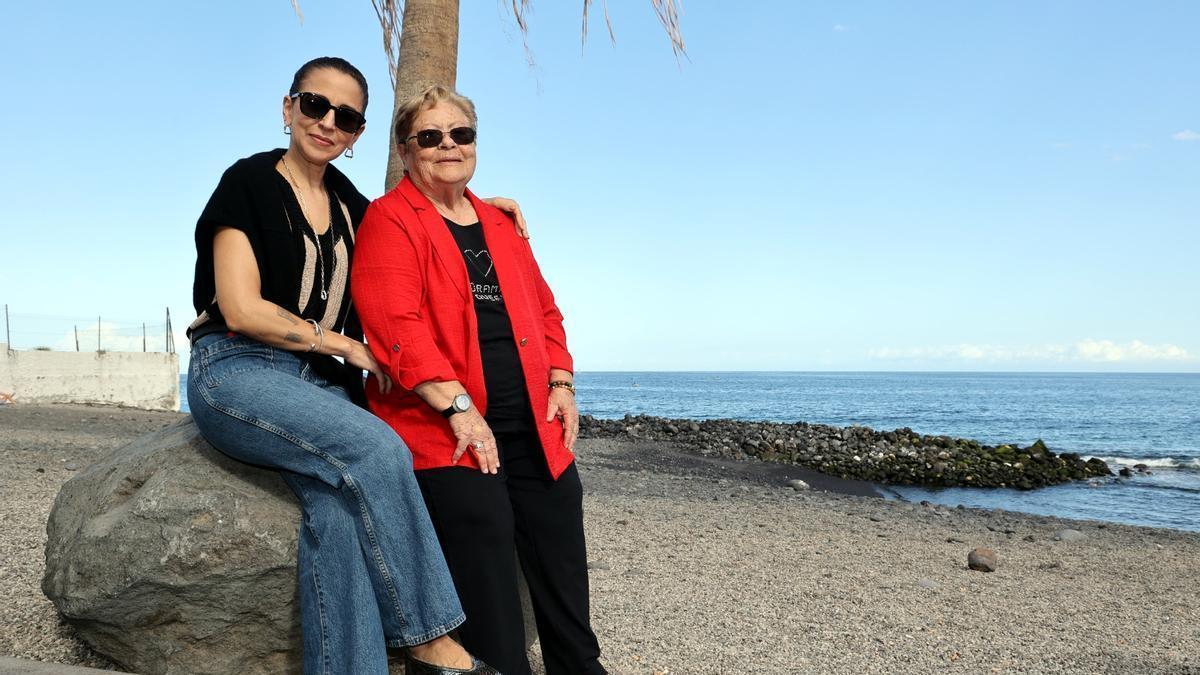
Carmen Rita Wong should really be called Carmen Rita Expósito. She has not yet changed her surname – nor has she said she intends to – but she has met her biological father’s family. The encounter happened recently, when Carmen travelled from the city of skyscrapers to the island of Mount Teide to meet her uncles, cousins, nephews and nieces for the first time. Those who were there for half a century until she finally discovered them. Those who did know her father. She did not. He had died long before she learned her true ancestry. Her true identity. “It was a beautiful reunion,” says Carmen Rita from the United States. “Seeing my aunt and cousins was very emotional. And it was incredible to see how much we looked alike! In their eyes, I saw my own and my daughter’s. My sister-in-law and I were received with such warmth and affection that it was a true blessing.”
How the truth came out
How did she find out so late who her real father was? How did this incredible story – linking places as far apart as the Dominican Republic, the United States, China and the Canary Islands – come to light? Everything emerged in 2022. Carmen Rita Wong, a well-known figure in the United States – an NBC journalist, contributor to The New York Times and Oprah Magazine, and professor at New York University – published an autobiographical book. The title – Why Didn’t You Tell Me? – already hints at the most crucial event in its 269 pages. Becoming a bestseller – named one of the best books of the year – the author recounts in detail the curious way she discovered her Canary Island roots.
The daughter of Guadalupe Altagracia, a Dominican woman based in New York, Carmen believed for most of her life that her father was a Taiwanese man of Chinese descent called Peter Ting Wong, who gave her his surname. Her mother was a seamstress for Oscar de la Renta, the famous Dominican-American fashion designer who dressed personalities such as Jacqueline Kennedy, the former First Lady of the United States as wife of John F. Kennedy. It was in the Big Apple that Lupe met Peter Wong, whom she married.
Growing doubts
During Carmen’s childhood and youth, Lupe made it clear to her, without any shadow of doubt, that Daddy was Peter. Yet from an early age, doubts began to creep in. Not only because she lacked the slightest Asian feature, but also due to feelings that grew over the years and some details her mother provided that did not fit the timeline. Lupe soon separated from Peter and fell in love with Marty. She swapped a Chinese gambler and opportunist for a typical white American. Carmen left Harlem, where she had grown up in a diverse environment of Latinos, Chinese and African-Americans, for New Hampshire, a typical middle-class white residential area. “Something didn’t add up about Daddy,” writes Carmen Rita Wong in Why Didn’t You Tell Me? “It wasn’t so much that I didn’t look Chinese; there was something else,” she adds in the publication, in which she admits: “I started to hear a voice inside me. I didn’t want to listen to it, but I couldn’t get rid of it. It was doubt.”
Her mother had separated for a second time, met another man, left him… She had had six children, five girls and one boy, two supposedly with Peter and four with Marty. Despite her mother’s comings and goings, Carmen maintained a close relationship with both Peter and Marty. So close that she called both of them “Dad”. But if her mother’s back and forth fuelled her suspicions, they intensified when Marty, seeing Lupe fall ill, confessed to Carmen that he was her biological father and that her mother had hidden many more things. The New Yorker was already over 30, and the revelation left her stunned. “How do you stop being Chinese? Do you shed 31 years of life like a snake shedding its skin? Do you erase all the days of your past like wiping a blackboard?” she asks in the book.
DNA testing
Carmen Rita had always shared with her brother Alex her misgivings about her paternal ancestry and the possibility of using genetics to solve the dilemma. But they also shared a certain insecurity about using DNA. Such was her curiosity that she decided to be the first to take the test. She did so through the company Ancestry. Moreover, her mother had just died without ever changing her story. It was time. The first results were inconclusive, although they made it clear there was no trace of Asian DNA, but European and African. In 2018, Alex bought a kit from another company: 23andMe. Carmen confirmed there was not the slightest Chinese trace in her blood, and the prevalence placed her origins between Africa, Italy and Portugal. Amid the investigations, another theory emerged: Lupe might have conceived Carmen in a relationship with a Cuban doctor.
The ball of uncertainty grew. Carmen then decided to hire a team of genealogy experts with access to Ancestry, 23andMe and GEDmatch, the US DNA database. She also joined Facebook genealogy groups and The DNA Detectives, where she presented her case. She had begun writing her story when the answer finally came. “In the summer of 2021, while writing the book, without genealogists, investigations or phone calls, suddenly my biological father stopped being a ghost dad.” She only had to refresh her Ancestry account to discover him. The company had sent her a list of people with DNA compatible with hers. Topping the list was a woman who shared 11% of genetic material. She could be a niece. She sent her a message. She was the granddaughter of her real father, who had died 19 years earlier. They also lived in the United States. “I cried all day,” Carmen recalls. “I had lost the chance to meet my father.” They met. At the appointment, the young woman came with her mother, who was Carmen’s sister. “We didn’t look alike, but we felt alike.”
The father from Tenerife
The father’s name was Florencio Expósito Velázquez. Born in the Tenerife municipality of Icod de los Vinos, into a large family of 11 siblings, he had emigrated to Venezuela and eventually settled in New York in the early 1970s. He was a handsome ladies’ man known as Frank. He had remained in constant contact with his family on the island, travelling regularly to see them. The person Florencio was closest to was his sister Carmen Expósito. Now 83, Carmen lives in Candelaria. She recalls with great emotion how she unexpectedly learned she had a new niece, whose existence she had not known about. “The family in New York had already told me that an unknown daughter of Florencio had appeared,” says Carmen Expósito. “I didn’t know the details. Until one day I received a video call. It was Carmen Rita. I was surprised, speechless, but at the same time I felt great joy to put a face to her.”
Carmen Rita invited her Tenerife aunt to New York. She had already been there to visit her New York relatives. What Carmen Rita did not know until they met in Manhattan was that her namesake, besides being her flesh and blood, was quite a character: the first woman to drive a rally car in Tenerife and the first to ride a large-capacity motorbike on the island. Carmen Rita wanted to meet the rest of her Tenerife relatives. So she decided to catch a plane, along with her brother Alex’s widow, and arrived on the island very recently, in the last week of March. It was not an unfamiliar place for the writer and producer, as she herself acknowledges. “I hadn’t been there, but of course I knew the Canary Islands before coming. I’m a cultured person and, with my diverse origins, I’ve always been curious about the world and its people.”
An emotional reunion
Her main Tenerife host, Aunt Carmen Expósito, recalls the meeting was “impressive, full of emotions”. It took place in a restaurant in Candelaria, during a lunch attended by around 30 people. “Although her Spanish is not very fluent, we immediately felt she was family,” reveals Carmen Expósito. “The physical resemblance, the gestures… There was no doubt.” At that gathering, over wrinkled potatoes and fresh fish, there was someone who felt a special, immediate connection. It is Raquel Couto, one of Carmen Rita’s island cousins. “I arrived a bit late,” remembers Raquel. “From the very first moment I saw her, I said to myself: she is one of us. It wasn’t just the resemblance. There was a spontaneous connection. We got emotional. We cried. She told me that looking at me was like seeing herself in a mirror. It was a moment I will never forget.”
None of those present will forget it, least of all Carmen Rita, who also thoroughly enjoyed her excursions around Tenerife. “The island is beautiful. I was very impressed by the windmills and the quality of the infrastructure.” She enjoyed the trip to Mount Teide, which she described as “magnificent”. And one of the things that struck her most was the change in climate from the south, where she was staying, to the north. But what she liked most, above all, was having rediscovered her roots, on the other side of the Atlantic, where she never imagined they would be.
What’s happening in the Canaries – straight to your phone
News, weather alerts and practical updates – direct from the islands, in English. We live here and know what’s going on – before the international media catch up. Everything lands on our WhatsApp channel – no middlemen, no algorithm. Curated for families, expats and travelers.

Vivanta shuts all dental clinics including six in Tenerife

Civil Guard warns of digital skimming threat to online shoppers

Tenerife shifts FDCAN funds from roads to housing

PSOE warns Arrecife plan could ‘bury’ El Cable beach in concrete

Canary Islands faces loss of 20% of self-employed workers

Canary Islands to get 26 new substations by 2030

Canary Islands poverty rates stuck since pandemic

Court backs eviction over verbal room rental in Arona

Canary Islands pushes for 10-year residency rule for foreign buyers
