
Compiled with the help of artificial intelligence, based on Spanish-language information. Source below the article.
Canary Islands telescopes spot record-breaking cosmic lighthouse
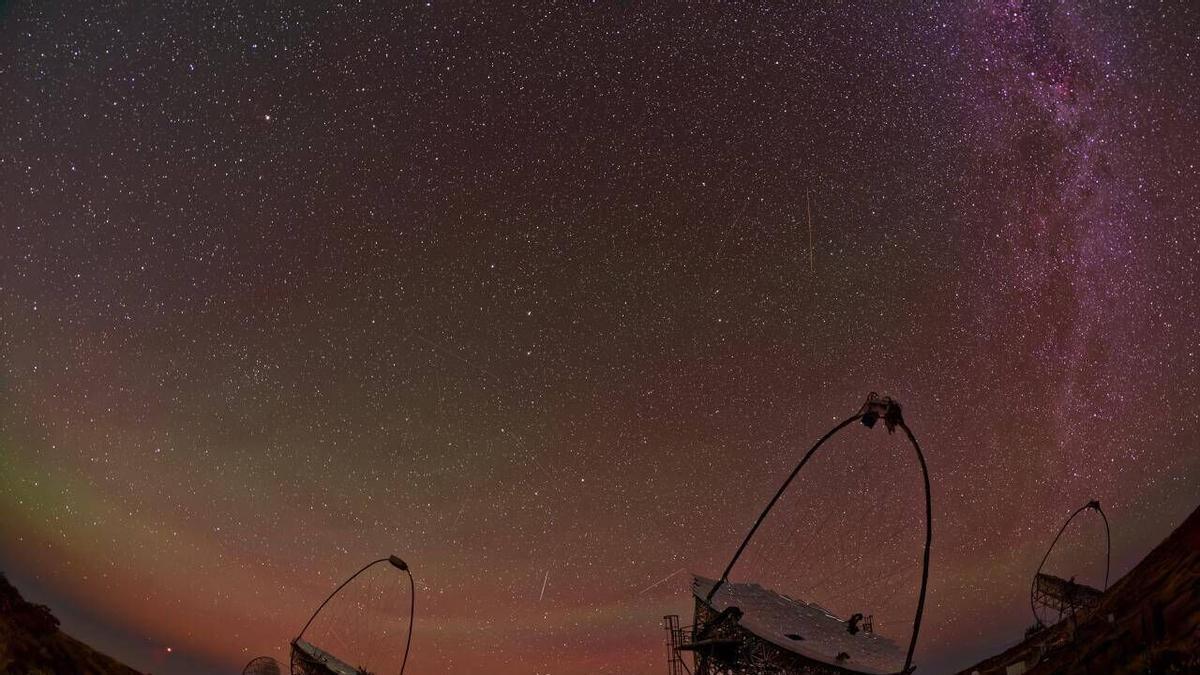
Astronomers using the Canary Islands’ telescopes at the Roque de Los Muchachos Observatory on La Palma have detected the light of a cosmic “lighthouse” located 8 billion light-years away — the most distant such signal ever observed.
The multiple eyes of the LST-1 telescope (still in its testing phase) and the Magic telescopes have been aimed at a blazar — a very distant galaxy with a giant black hole at its centre — which emitted extremely energetic radiation in the early days of the universe. The arrival of that gamma-ray beam on Earth now holds the key to unravelling how much light has accumulated across the cosmos since the Big Bang.
A relic from the Cosmic Noon
The galaxy under observation is known as OP 313, classified as a flat-spectrum radio quasar — a specific type of blazar that emits the most powerful radiation in the universe. Its existence dates back to the end of one of the most active periods in cosmic history: the Cosmic Noon.
This frenetic phase, which lasted between 2,000 and 3,000 million years, was the prelude to the eruption of this blazar. Specifically, this powerful outburst occurred just as that phase began to slow down and galaxies matured, giving way to the quieter era that continues today.
A signal weakened by cosmic fog
What makes the discovery particularly interesting is that, on their journey through the cosmos, these gamma rays interacted with the extragalactic background light — a persistent field of radiation emitted by cosmic objects throughout the universe’s history. When the gamma-ray signal collides with this ancient haze, it weakens and transforms into pairs of particles, specifically one electron and one positron. As a result, the original gamma-ray flow diminishes over the distance it travels.
“Each new detection of very distant objects, whose light has taken billions of years to reach us, opens a new window to study the extragalactic background light and understand how the cosmos has evolved,” explains Mireia Nievas Rosillo, a researcher at the IAC and corresponding author of the study.
By measuring exactly how much the gamma-ray beam that reached La Palma was weakened, astrophysicists can calculate the density of that accumulated light and gain a better understanding of how stars have been born and evolved throughout cosmic history. Indeed, the scientist insists that “these observations bring us closer to the era of maximum cosmic star formation” and reveals that “with the start of CTAO operations planned for the coming years, this is only the beginning.”
A promising future for the LST telescopes
The LST-1 is the prototype of the Large-Sized Telescopes (LST), currently in its commissioning phase at the CTAO-North site on La Palma. The discovery of the most distant very-high-energy blazar during this commissioning phase is proof of the telescope’s proper performance.
On 15 October this year, the full LST sub-array, which includes three additional telescopes, will be inaugurated on La Palma by the LST Collaboration. Tasked with delivering the CTAO’s low-energy sensitivity down to 20 GeV, future observations with the LSTs will expand the gamma-ray horizon and observe extreme radiation at distances never before reached.
TIME CONTEXT: Original article publication date: 2026-08-24T21:50:05.416Z Current date: 24 August 2026, MondayWhat’s happening in the Canaries – straight to your phone
News, weather alerts and practical updates – direct from the islands, in English. We live here and know what’s going on – before the international media catch up. Everything lands on our WhatsApp channel – no middlemen, no algorithm. Curated for families, expats and travelers.

Canary Islands sea hits second-hottest year on record

Legal bid to halt tree felling in Santa Cruz’s La Salud

Fiesta del Charco: A journey through La Aldea’s past

Corralejo dunes power line set for removal

ULPGC launches 14 research projects at Las Canteras

TMT will never be built, says Canary Islands astrophysics chief

Pedro Duque: Canarias is the “ultimate dream” for rockets

Court blow to Tenerife motor circuit project
La Palma faces new volcanic risk planning deadline
