Fiscal watchdog issues fresh warning
Spain’s Independent Authority for Fiscal Responsibility (AIReF) has once again cautioned the Government of the Canary Islands – and this is not the first time in the current 2023-27 legislative term. The official body, which reports to the Ministry of Finance, has reiterated its concerns following its latest analysis contained in the Fiscal and Structural Medium-Term Plan 2025-2028 (PFEMP) and its monitoring of the Canary Islands Autonomous Community (CAC).
The warning comes in AIReF Report 29/2026, published on Thursday 14 May 2026, which examines the financial years from 2026 to 2028. The watchdog’s projections for the CAC during this period – updated in line with similar reviews for Spain’s other autonomous communities – take into account the information included in the Medium-Term Budgetary Plan (PPMP). In the Canary Islands’ case, this plan was submitted to the independent body and approved by the regional government on 24 April 2026, alongside any changes in information from the November 2025 and April 2026 reports that might affect the years now under review (2026-28).
Central conclusion: overshoots forecast for three straight years
Drawing on the Canary Islands’ Medium-Term Budgetary Plan (2026-2028), the new AIReF report reaches a central conclusion: the watchdog predicts that, under a constant-policies scenario, the spending subject to the national spending rule will grow above the reference rate in 2026, 2027 and 2028 in the Canary Islands Autonomous Community.
It is worth recalling that non-compliance with the spending rule was already confirmed for the 2024 financial year in the Canary Islands. As a result, an adjustment plan – which must be submitted and approved by the Ministry – is to be applied during 2026, requiring a reduction of €445 million in the Canary Islands budget.
For 2025, AIReF has already stated that the same breach will occur, although the final decision from the Ministry of Finance is still pending. If the shortfall is confirmed, another adjustment plan will have to be drawn up, with effect from 2027, subject to approval by the State Ministry of Finance.
Detailed projections for 2026-2028
AIReF has estimated the spending subject to the national spending rule for the coming years using its forecasts on the evolution of total expenditure and the items excluded from the spending calculation, together with current information on permanent revenue measures already adopted and planned. Based on these parameters – and as reflected in the identified AIReF report – spending subject to the rule is expected to grow by 5% in 2026, 7.1% in 2027 and 5.2% in 2028. In all three cases, these figures are above the respective annual limits of 3.5%, 3.4% and 3.2%.
The same analysis reiterates that the CAC will breach the spending rule in 2025, with an increase in computable spending of 8% (having already confirmed the breach in 2024), while the authorised rate for that financial year is 3.2%. Furthermore, the report notes that net primary spending after revenue measures – for the purposes of the European spending rule – will grow in the Canary Islands by an average of 5.5% over the period 2025-2028, in what is termed the medium term. AIReF also acknowledges that this spending will rise at annual rates of between 4.8% and 6.7% over the 2025-2028 period, with an average of 5.5% across the reference period – above the 3.4% committed in the PFEMP for all Spanish public administrations.
Spending compliance not a priority, report suggests
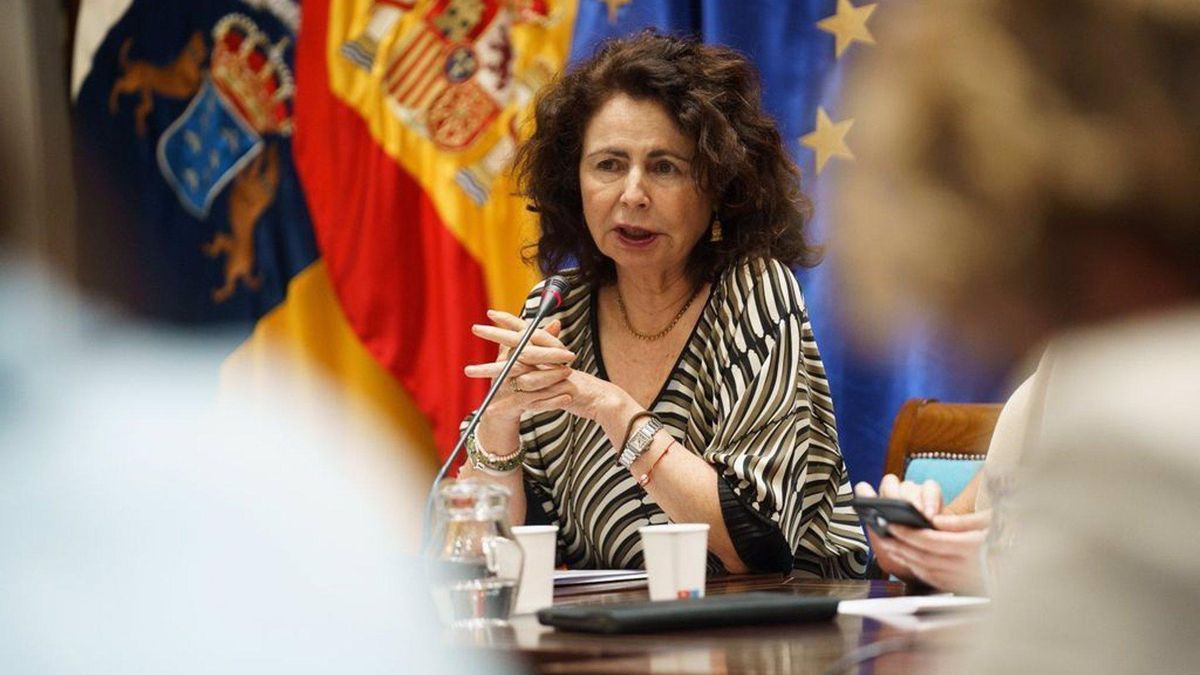
As is evident from the consolidated results and AIReF’s most recent forecasts, compliance with the spending rule does not appear – at least for now – to be a priority for the Government of the Canary Islands, led by Fernando Clavijo of the Canarian Coalition (CC), with Matilde Asián of the People’s Party (PP) serving as Minister for Finance and Relations with the European Union.
Consequently, adherence to the spending rule is not a primary part of the CAC’s current budgetary policy, even though there is no doubt that Organic Law 2/2012 on Budgetary Stability and Financial Sustainability has been back in force since 1 January 2024, following the end of its suspension due to the COVID-19 pandemic during the 2020-2023 period.
What’s happening in the Canaries – straight to your phone
News, weather alerts and practical updates – direct from the islands, in English. We live here and know what’s going on – before the international media catch up. Everything lands on our WhatsApp channel – no middlemen, no algorithm. Curated for families, expats and travelers.

Canary Islands tourism chief offers dialogue on residentialisation

Canary Islands office helps small councils ditch the peseta

Two tonnes of illegal tropical fruit seized at Tenerife port

Canary Islands approves new €1.6bn development fund

Mogán mayor says her €65,000 salary is too low

Abandoned cars in Canary Islands: hundreds left to rot
Work resumes on 27 affordable rental homes in Las Palmas

Los Realejos residents fight on against propane gas plant

Canarias among Spain’s poorest regions as 36.2% live on low incomes