Compiled with the help of artificial intelligence, based on Spanish-language information. Source below the article.
Tourism chief offers dialogue over residentialisation crisis
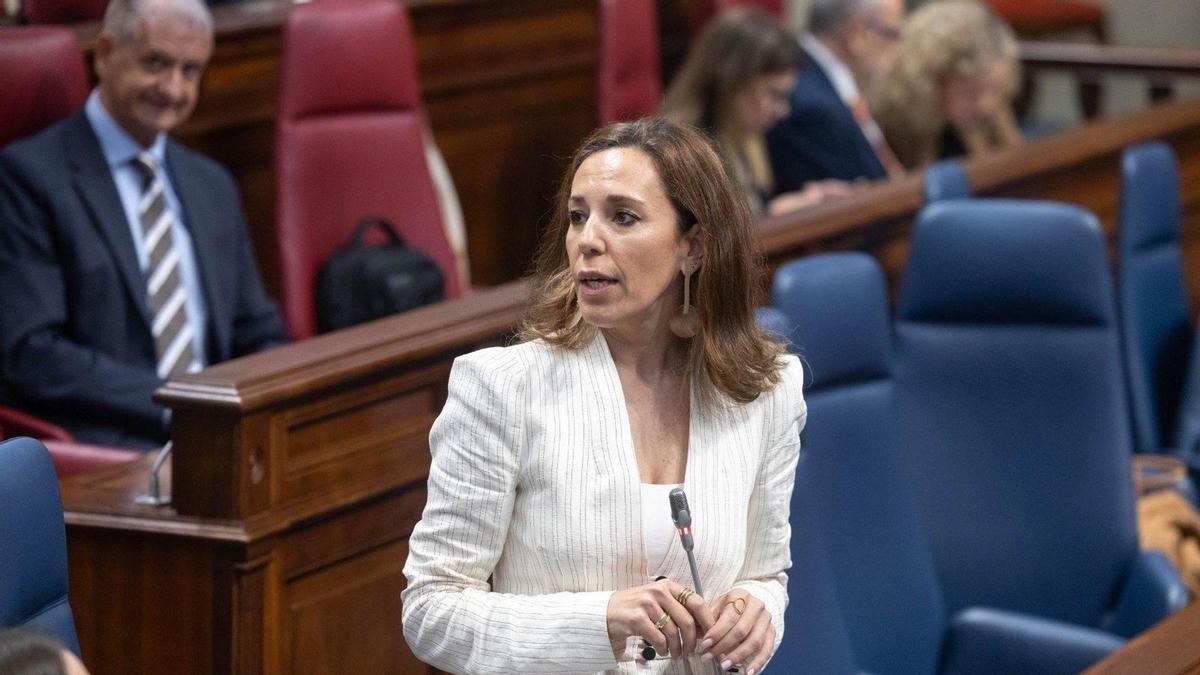
The Canary Islands government’s tourism and employment minister, Jessica de León, offered “dialogue and consensus” to parliamentary groups on Tuesday in a bid to resolve the “difficult” situation surrounding residentialisation in tourist zones. Her appearance before the regional parliament came as the PSOE called for her resignation, while Nueva Canarias–Bloque Canarista (NC-bc) and Vox urged her to leave legislative changes to the next chamber.
The issue affects around 70,000 people who own homes in areas that were declared tourist zones after they bought their properties. Under the rules, they are prevented from living in them and obliged to hand them over to a tourist operator. Those who fail to comply face fines of more than €2,000.
Minister deflects resignation calls
In her address to the full parliament, De León deflected criticism and joked ironically that she takes “as a joke” the socialists’ demand for her resignation when Spain’s prime minister, Pedro Sánchez, is embroiled in numerous corruption cases. She insisted on the regional government’s “firm commitment” to finding a solution, which she said involves reforming the 1995 tourism law, the 2013 modernisation law and the more recent holiday rental law, approved during this parliamentary term but which likewise fails to resolve the situation for those affected.
Opposition questions who the government serves
Gustavo Santana of the PSOE recalled that last July he twice asked her whether she intended to approve a decree-law “and she did not answer”. Two weeks later a draft was leaked to the press, and only a week ago it reached CC, the PP’s coalition partner and the minister’s own party, while the opposition “is still begging” for the same document. It later emerged that the draft had already been sent to the Santa Cruz de Tenerife hoteliers’ association, Ashotel, whose response requested that, given the importance of the matter, it should be processed as a bill and that the case for urgent necessity had not been established. At that point, Santana asked her: “Who are you governing for? Don’t let it be for someone whose surname is the same as a Spanish province,” in reference to the PP’s José Manuel Soria.
Along the same lines, Esther González of NC said that “the hand that rocks the cradle” in the whole affair “is someone closer to Segovia than to the Canary Islands”, who “sets the score and the government plays it without complaint”, acting as “a lightning rod for a ferocious policy dictated from outside offices”.
Minister admits conflict “was foreseeable”
The minister acknowledged that the conflict in tourist zones “was foreseeable” because Canary Islands tourism regulation over the past twenty years has been geared towards separating tourist use from residential use in order to raise the quality of the destination — a stance defended in the past even by the PSOE and NC-bc. She read out direct quotes from former Canary Islands vice-president Román Rodríguez and socialist MP Rosa Bella Cabrera, despite the fact that they were made in very different social, economic and tourism contexts, without the current housing crisis and without the touristification of the islands.
She added that the application of the rules “leaves a great deal to be desired”, citing the case of the unit of exploitation, since there are properties in tourist zones where the owners live and are registered with their local councils. “Now we have to see how we handle a difficult situation without losing our bearings and the raison d’être of tourist zones and tourist establishments, which is to provide this economic service,” she explained.
Fines continue despite pledge to halt them
Those affected by the law are owners of flats bought to live in long before the areas were declared tourist zones. The legislation prevents them from residing in their homes and obliges them to hand them to a third party for tourist exploitation. Although the Clavijo government pledged to halt the fines, they have continued to arrive. This same month, the PSOE tabled a bill backed by those affected, but both CC and the PP voted against even admitting it for consideration. It is also worth recalling that Fernando Clavijo himself gave a written commitment to these owners before the 2023 elections to find them a solution.
Calls for “imaginative formulas”
The minister criticised the creation of “a great deal of social alarm, whether self-interested or not” and argued that “this is not solely a question of planning” but of gaining competitiveness and ensuring the Canary Islands remain a “leading destination”. “We are facing a difficult matter with only one path that I can see, and that is dialogue,” she said, calling for “imaginative formulas” that allow all parties to “coexist” and for the modernisation of the archipelago to continue.
De León also said that all measures adopted “will be of no use” without “strict controls”, pointed out that as many as three court rulings have sided with her department, and argued that more coordination is needed across the entire administrative chain. “The government and tourism planning are as important as the local councils,” she noted.
Opposition accuses government of broken promises
Esther González of NC-bc attacked the government for failing to honour its commitments to those affected with just six months to go before the parliament is dissolved, saying the draft amendment to the law has been left “in a drawer” and that ministers intend to opt for a decree instead. She said she could not understand why MPs remain “in the dark” about the legal text when the tourism lobby groups already have it, and accused the minister of “muddying” the debate so that “nobody understands anything”. She also criticised president Fernando Clavijo for signing a commitment to those affected days before the last election while knowing “they were never going to honour it”.
Jesús Ramos of ASG said an “update” of Canary Islands tourism regulations was needed to achieve greater legal certainty, avoid duplication and promote the environmental, social and economic sustainability of tourism. He also called for the new law not to “contradict” the development of the ‘green islands’ and for island councils and local authorities to be involved.
Vox and PP weigh in
Paula Jover, deputy spokesperson for Vox, said the parliamentary term had been “lost” from a tourism point of view, since instead of reforming the rules the government has “made them more convoluted”, excluded small owners and set them against tourism businesses. She urged the government to stop pushing through the “decretazo” with “obscurantism” and described it as “incoherent” that, while attempts are made to ban foreigners from buying homes, residents are being “expelled from villas, bungalows and their own flats”.
David Morales of the PP reproached the socialists for having defended tourist specialisation over residentialisation in the past, saying the aim now is to renew the Canary Islands tourism law “with full legal guarantees” in a global context that is “highly complex and full of difficulties and uncertainty”. According to the PP MP, “it is not a question of eliminating unified management or tourist specialisation, or of abandoning planning and regulation, but the ultimate goal, in support of the economy and employment, is to guarantee the quality of establishments, consistency of services, the competitiveness of the destination and territorial sustainability”.
Socorro Beato of CC said the reform of the law is an “opportunity” to shore up the “success” of tourism in the Canary Islands, bearing in mind that there are “unresolved issues” such as the unit of exploitation, the residentialisation of tourist complexes and coexistence between different uses, and that planning must be adapted to the “particularities” of each island. “We need the collaboration, dialogue and shared responsibility of everyone, because neither public authorities can solve everything on their own, nor can the private sector remain detached from the problems,” she said.
What’s happening in the Canaries – straight to your phone
News, weather alerts and practical updates – direct from the islands, in English. We live here and know what’s going on – before the international media catch up. Everything lands on our WhatsApp channel – no middlemen, no algorithm. Curated for families, expats and travelers.

Canary Islands office helps small councils ditch the peseta

Two tonnes of illegal tropical fruit seized at Tenerife port

Canary Islands approves new €1.6bn development fund

Mogán mayor says her €65,000 salary is too low

Abandoned cars in Canary Islands: hundreds left to rot
Work resumes on 27 affordable rental homes in Las Palmas

Los Realejos residents fight on against propane gas plant

Canarias among Spain’s poorest regions as 36.2% live on low incomes

Canary Islands bananas lose ground to imported bananas