
Compiled with the help of artificial intelligence, based on Spanish-language information. Source below the article.
Fred. Olsen to collect sustainability award
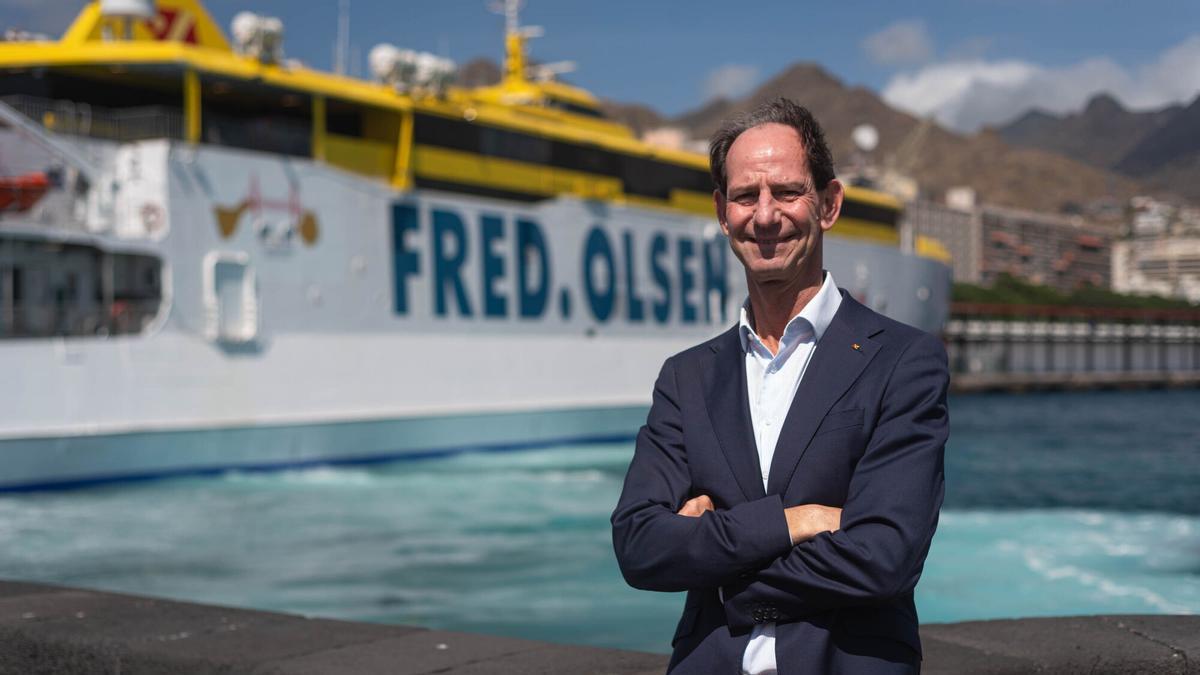
Andrés Marín, director general of Fred. Olsen, will collect the Empresa + Sostenible award at the Banco Sabadell Company of the Year Awards. The ferry operator, which is essential to connectivity in the Canary Islands, combines innovation in its vessels with measures to protect marine wildlife and reduce its environmental impact. It is also seeking alternatives to move towards cleaner transport without compromising connections.
A fundamental service for a fragmented archipelago
“It is a challenge. We have been working on sustainability for many years because we believe that looking after our environment is very important,” Marín said. “In the Canary Islands we provide a fundamental service connecting a remote and fragmented archipelago. That is why we have the In Harmony with the Sea programme, which brings together more than 90 measures relating to innovation, sustainability, awareness-raising and volunteering.”
Pioneers in aluminium high-speed craft
Marín explained that the company was a pioneer in the Canary Islands in 1999 when it moved from conventional ferries to high-speed vessels built from aluminium, which weigh less and consume less. The firm also backed fuels with a lower sulphur content, anticipating by more than twenty years the international regulations that came into force in 2020.
In addition, it runs an eco-route between Tenerife, La Gomera and La Palma on which the ships take a detour to avoid an area of special conservation for cetaceans. Although the crossing takes somewhat longer, it helps to protect the wildlife.
Fuels are the great challenge of the future
“The great challenge for the future lies in fuels. We continue to depend to a large extent on fossil fuels and we are working to find alternatives, such as ammonia or methanol. Our engineers take part in forums where these options are being studied, but it is still necessary to guarantee that there is enough fuel to move the ships,” he said.
“We must also find the balance between sustainability and connectivity. If an alternative means sailing more slowly, we could reduce daily rotations and the number of seats available. In the Canary Islands, where many people need to travel between islands for health, administrative or study reasons, maintaining connections is fundamental.”
Carrying heavy cargo at high speed
Asked whether the company’s commitment to innovation is part of its DNA, Marín replied: “I think it already is. In 1999 and 2000 we brought in express vessels, pioneers in carrying heavy cargo on high-speed craft with aluminium hulls. Until then, these vessels mainly carried passengers and some vehicles. Over time, that model spread to other markets. Our dependence on the sea obliges us to seek solutions and stay at the forefront.”
“The Canary Islands can be a testing ground for projects that are developed here first and then exported to the rest of the world. The great challenge is to find less polluting alternative fuels that are available and sufficient. It is not enough to develop a technology; you also have to guarantee that it allows the frequency and capacity of the ships to be maintained. The transition must reduce emissions without harming the connectivity that the Islands need,” he concluded.
What’s happening in the Canaries – straight to your phone
News, weather alerts and practical updates – direct from the islands, in English. We live here and know what’s going on – before the international media catch up. Everything lands on our WhatsApp channel – no middlemen, no algorithm. Curated for families, expats and travelers.

Air Canada launches Tenerife direct flights from Canada

Captain investigated over Mein Schiff 3 crash in Bremerhaven

Air Canada launches Tenerife flights from Toronto and Montreal

€120m boost for Canary Islands resident travel discounts

Air France to launch weekly Paris-Tenerife South winter flight

Vueling plane lands with landing gear fault at Los Rodeos

Ferry contract to Canary Islands declared void

Bomb threat on Vueling flight triggers Gran Canaria airport security operation

Cruise to Canaries cancelled after collision in port
