
Compiled with the help of artificial intelligence, based on Spanish-language information. Source below the article.
The cruise ship bound for the Canary Islands that is still making headlines in Germany
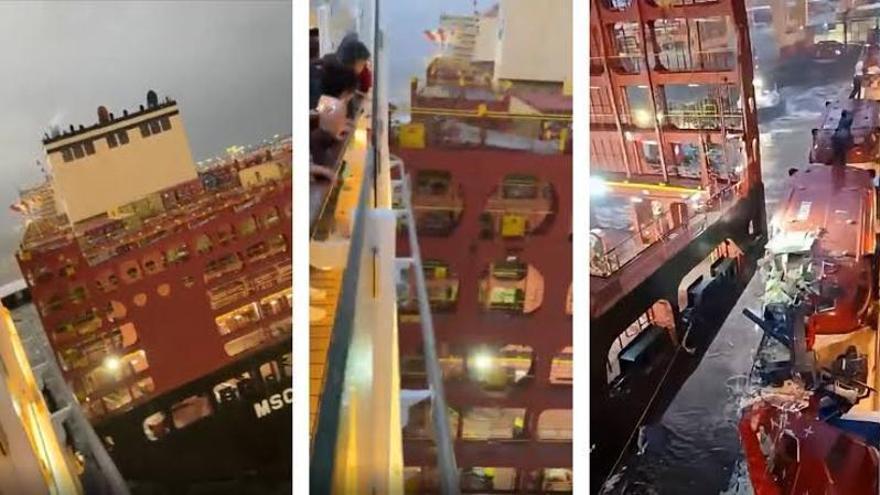
The cruise ship that was due to carry 2,428 tourists to the Canary Islands is still generating headlines in Germany. What began as a spectacular port accident, with two container ships rammed and several lifeboats destroyed, has given way to an investigation that now focuses on one specific decision: why did the captain choose to set sail while a severe weather warning was still in place? The question has taken on particular significance following the latest information published by the German newspaper Bild.
According to the paper, the wind lost intensity approximately one hour after the Mein Schiff 3 left its berth in Bremerhaven. That circumstance is now being examined alongside tidal conditions and the manoeuvres carried out before the collision. But there is another detail that has caught the attention of the German press. TUI Cruises has temporarily removed photographs and videos of its captain, Jan F. Schubert, from the internet. He had taken command of the ship on 13 September, barely six weeks before the accident. The company acknowledges that it has hidden this content, although it insists the decision relates to its communications policy while the events are being investigated.
Who is Captain Jan F. Schubert?
Jan F. Schubert had assumed responsibility for the Mein Schiff 3 on 13 September 2026. Just over a month later, the ship was involved in a collision that forced the cancellation of its crossing to the Canary Islands and caused material damage valued at millions of euros. According to Bild, the Bremen Maritime Police are investigating the captain to establish whether his decision to leave port in adverse weather conditions may have amounted to a breach of his duties of care. In parallel, the shipping company has removed his profile from the captains section of its corporate website. Several videos published on Facebook describing his professional career, from his beginnings as a dishwasher to taking command of a cruise ship, have also ceased to be available.
The disappearance of this content has raised questions in Germany, although TUI Cruises denies it should be interpreted as a conclusion about responsibility for the accident. A company spokesperson told Bild that, given the current situation, they had decided to concentrate communications on relevant information about the incident and gather it on their website. For that reason, she added, other content has been temporarily hidden. The company also says it is cooperating with the authorities and declines to comment on the investigations under way.
The timing of the departure under scrutiny
One of the aspects attracting most interest is the timing chosen to begin the crossing. The Mein Schiff 3 set sail from Bremerhaven at around 17.20 on Sunday 25 October, when difficult weather conditions were still being recorded. According to data compiled by Bild, winds of force 6 on the Beaufort scale were blowing at that moment, equivalent to speeds of roughly 39 to 49 kilometres per hour. Gusts of up to 95 kilometres per hour had also been recorded during the day. The severe weather warning remained in force until 18.00.
The detail that introduces a new unknown is that approximately one hour after the cruise ship’s departure, the wind decreased appreciably. The information does not prove that waiting would have prevented the accident, but it does raise a question that could prove relevant to investigators: whether conditions advised delaying the departure manoeuvre. Moreover, the wind was not the only factor complicating navigation. The ship left its berth on the ebb tide, a circumstance that, according to the information published by the German newspaper, exerted additional force on the cruise ship and pushed it towards the container ships located nearby.
A second cruise ship sought shelter
There is a second detail that adds context to the decision to set sail. Hours before the accident, the cruise ship MSC Preziosa had altered its route and sought shelter in Bremerhaven in the face of the adverse weather conditions. The vessel remained moored precisely behind the Mein Schiff 3 while the latter began its departure manoeuvre. The comparison between the two decisions forms part of the circumstances highlighted by the German press, although the operating conditions of each vessel may differ. In any case, the investigation will have to determine what role the wind, the tide and the decisions taken during the manoeuvre played.
A port pilot was on board
The captain was not alone either. A port pilot was on board, tasked with advising during the departure. Another pilot was subsequently due to take over assistance duties for navigation towards the North Sea. However, the cruise ship never completed that phase of the journey. Barely a few minutes after leaving the Columbuskaje quay, the Mein Schiff 3 struck two container ships that were moored there.
The accident caused serious damage to the cruise ship, particularly on its starboard side. Several lifeboats were destroyed and damage was also caused in the area of the bridge. One of the affected cargo ships, the MSC Victorine, suffered significant damage to its port side, with an opening several metres wide, according to the information published by Bild. The scale of the damage requires repair work on both the cruise ship and the merchant vessel. The German newspaper reports that the damage amounts to millions of euros, although a definitive assessment has not yet been established. Numerous containers will also need to be removed from the affected cargo ship. According to the forecasts reported by the paper, the merchant vessel was due to enter dry dock on Thursday for repairs. Despite the violence of the collision, no one was injured and no water entered the cruise ship.
Canary Islands cruise cancelled for 2,428 passengers
While the German authorities attempt to clarify the circumstances of the accident, its consequences are already a reality for the passengers. The Mein Schiff 3 had been due to make a crossing to the Canary Islands, but the damage sustained forced TUI Cruises to cancel the trip entirely. The 2,428 passengers who had been looking forward to their holidays in the archipelago had to return to their places of origin without ever beginning the planned crossing. The cancellation also opens the door to possible financial claims from those affected, a question that is being addressed by the German media in the wake of the accident. For the time being, it has not been clarified whether repairs to the Mein Schiff 3 will force other scheduled departures to be modified or cancelled.
TUI group president Sebastian Ebel had already stressed that his main relief was to see that no one had been injured. He also asked for speculation to be avoided until the conclusions of the investigation are known. Now, with the captain under investigation, his profiles temporarily removed from the internet and new questions about the weather conditions, the accident involving the cruise ship that was due to reach the Canary Islands has gone from being a port incident to an issue of growing interest in Germany.
What’s happening in the Canaries – straight to your phone
News, weather alerts and practical updates – direct from the islands, in English. We live here and know what’s going on – before the international media catch up. Everything lands on our WhatsApp channel – no middlemen, no algorithm. Curated for families, expats and travelers.

Air Canada launches Tenerife direct flights from Canada

Air Canada launches Tenerife flights from Toronto and Montreal

€120m boost for Canary Islands resident travel discounts

Air France to launch weekly Paris-Tenerife South winter flight

Vueling plane lands with landing gear fault at Los Rodeos

Ferry contract to Canary Islands declared void

Bomb threat on Vueling flight triggers Gran Canaria airport security operation

Cruise to Canaries cancelled after collision in port

Tenerife tram delays worsen amid staff shortages
