Compiled with the help of artificial intelligence, based on Spanish-language information. Source below the article.
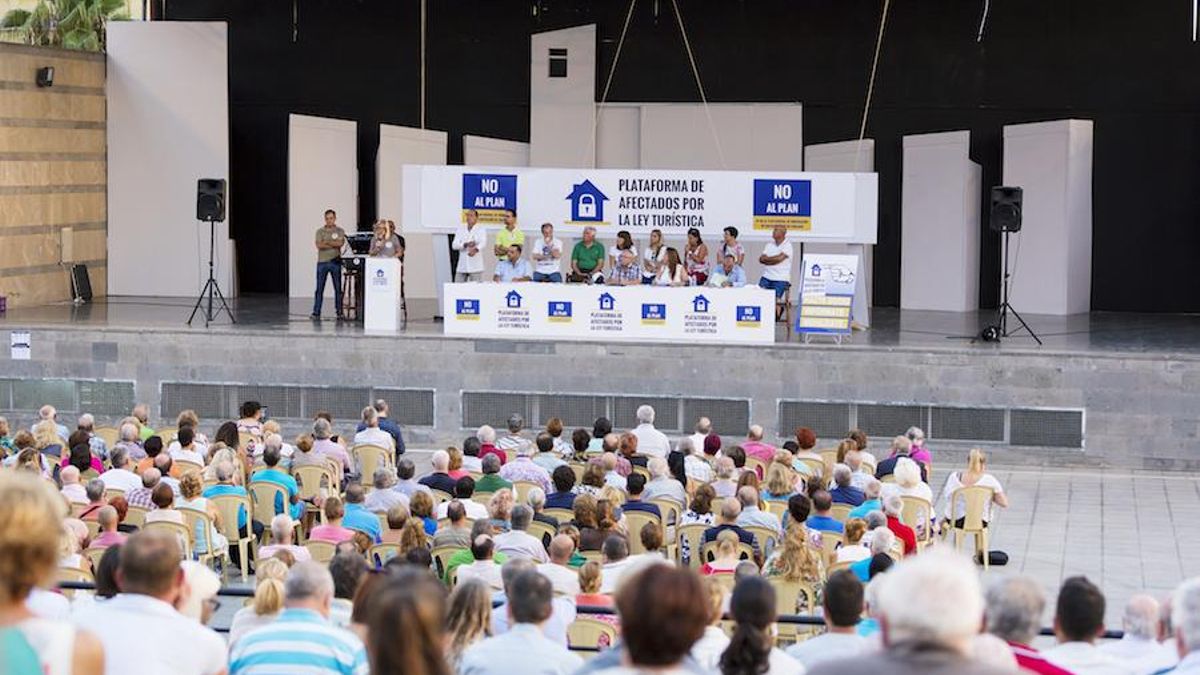
A delegation of affected property owners from every island in the Canary Islands, united against the region’s tourist law, will travel to the Parliament of the Canary Islands this Wednesday to witness first-hand the possible admission for consideration of the bill proposed by the PSOE.
What the bill would mean for owners
According to the platform leading the campaign, that proposal “brings back legal certainty and legitimate expectation for citizens, because it respects the original title and the rights with which we acquired our properties.” It concerns, the group adds, “homes belonging to people who had been stripped of their rights by Law 2/2013 and, above all, by the recent holiday rental law approved last December.”
Heavy criticism of the holiday rental law
The platform has laid into that holiday rental law, arguing that while it supposedly defended citizens’ right to housing, “in the hybrid coastal areas what it has actually done is usurp them, causing the property registrar to change the entries and the registered publicity with which we bought our homes. That leaves us having to hand our homes over to tourist use – in other words, the touristification of our homes, promoted by regulations approved by our own rulers, who want our complexes to be governed by the tourist law and not by the horizontal property regime we were born under.”
Owners’ plea to all parliamentary groups
The PALT is calling for this bill to mark the beginning of a process of consensus, not the end of a debate that “still needs the whole of Canarian society”. For that reason, the PALT has sent every member of the chamber a request for the bill to be admitted, as have a “very large” number of owners who wrote to their MPs this weekend. In the platform’s view, admitting the bill means allowing the initiative to be debated, studied and improved during its parliamentary passage. “It means opening a door for proposals to be incorporated, shortcomings to be corrected and agreements to be reached that do not yet exist,” it says.
No favour to any one party
The organisation adds that it must not act out of “affinity or rejection” towards any particular political party, and recalls that its duty is to defend owners’ rights and to judge legislative initiatives by their capacity to help solve the problems affecting them. “For years we have argued that flats and bungalows legitimately acquired by their owners cannot be left subject to interpretations that ignore their legal nature, the circumstances of their acquisition or the rights that correspond to them. It is essential to distinguish tourist establishments from property complexes subject to the horizontal property regime, and to distinguish between those who freely choose to run a tourist activity and those who simply wish to enjoy their property as a home,” the organisation stresses.
Tourist activity should not decide everything
The mere existence of a tourist activity should not, on its own, turn every owner in a complex into a compulsory participant in that activity, nor grant the operator powers over other people’s property, it underlines. “We need legal certainty, respect for acquired rights and regulation that reconciles tourist activity with the rights of those who own their homes.” For this reason, it adds, the future law must not be the property of a single party, since a question of such “importance” should not be settled exclusively from the positions of the government of the day, nor be conditioned by the interests of a single political party.
A law for the whole of Canarian society
The PALT therefore considers it necessary for all parliamentary groups – both those currently supporting the government and those in opposition – to have the opportunity to take part in drafting a consensual law. The contributions of affected owners, workers, businesses, professionals, local authorities and Canarian society as a whole must also be heard. That is why, it concludes, “it would be reasonable to open the door to an initiative that can serve to begin the debate the Canary Islands needs.”
What’s happening in the Canaries – straight to your phone
News, weather alerts and practical updates – direct from the islands, in English. We live here and know what’s going on – before the international media catch up. Everything lands on our WhatsApp channel – no middlemen, no algorithm. Curated for families, expats and travelers.

Canary Islands approves new €1.6bn development fund

Mogán mayor says her €65,000 salary is too low
Abandoned cars in Canary Islands: hundreds left to rot
Work resumes on 27 affordable rental homes in Las Palmas
Los Realejos residents fight on against propane gas plant

Canarias among Spain’s poorest regions as 36.2% live on low incomes

Canary Islands bananas lose ground to imported bananas
Canary Islands bottom of Spain’s social housing table

Three migrant boats reach Canary Islands in 24 hours