Compiled with the help of artificial intelligence, based on Spanish-language information. Source below the article.
Residents before tourists: a Mallorcan idea with Canarian echoes
Residents before tourists. That, at least, is the stance of the PSOE in Palma de Mallorca, which has proposed changing the order of access to EMT (Municipal Transport Company) buses so that locals take priority over visitors. The question now is whether the Canary Islands could feasibly follow that model.
Iago Negueruela, general secretary of the Socialist Group in Palma and candidate for mayor, presented a measure on 16 September that would create two separate queues at bus stops. One would be reserved for residents holding a TIB or Única card, and the other for all remaining users, so that if demand exceeds a vehicle’s capacity, locals are not left behind.
Venetian precedent for priority boarding
The initiative has precedents in cities such as Venice. There, the transport company ACTV operates priority boarding access – in its case for waterborne services – for holders of the Venezia Unica card who live in the municipality. Some workers and students who regularly travel to the historic centre or the lagoon islands can also benefit from this priority.
Transport union warns drivers would bear the brunt
But the measure is not to the liking of the SATI transport union. Its general secretary, Andrés Rodríguez, says that if the measure were implemented, it would fall to the driver to deal with any problems that arose. He also highlights the collapse of private transport, which he believes must be tackled in order to improve the public bus service.
Overcrowding: a problem the islands know well
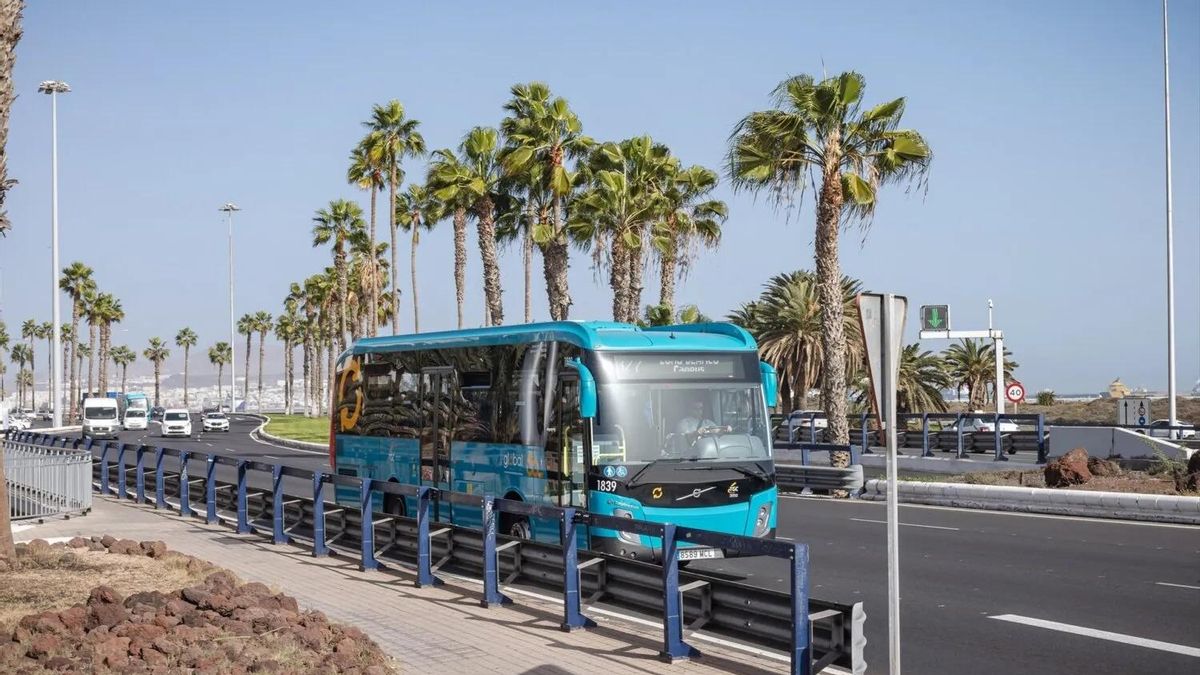
The crux of the matter is the overcrowding the municipality currently experiences – a scenario mirrored in the Canary Islands. Social tension over the lack of priority in queues, especially on lines operated by TITSA in Tenerife and Global in Gran Canaria, stems from the fact that routes connecting airports, island capitals and tourist hotspots run at extremely high occupancy. This breeds resentment among Canarians who, when they need the guagua to get to work or to their place of study, are left behind because the vehicle fills up with tourists.
According to Promotur’s 2025 Tourist Profile report for the Canary Islands, 12.6% of tourists arriving in the archipelago use public transport. On Gran Canaria, use is even more intensive: 29.32% of visitors say they used urban public transport to get around during their holidays.
Transport chief: a distinction of this kind would be “discriminatory”
However, Ruymán Santana, managing director of Gran Canaria’s Single Transport Authority (AUTGC), argues in conversation with Canarias Ahora that establishing a distinction of this kind would be “discriminatory”. He points out that Article 36 of the regulations implementing Law 13/2007 of 17 May on the Organisation of Road Transport in the Canary Islands, covering the provision of permanent regular public passenger transport services and the right of admission, states that “all those persons who wish to do so must be admitted to use the service, provided that the stipulated conditions are met”. It is “a right of citizenship”, he stresses.
To this difficulty can be added another: how to verify who is entitled to that priority. Santana maintains that the system would be legally awkward to fit into place: “It is difficult to determine a traveller’s residence.” He also points to a circumstance specific to Gran Canaria Airport. “The terminal already has a high frequency of the express guagua, which connects the airport with Las Palmas de Gran Canaria and the south of the island quickly and frequently.” In Santana’s view, that transport offering already helps to limit the number of potential users of the service.
Las Palmas operator sees no specific problem
For his part, Miguel Ángel Rodríguez, general manager of Guaguas Municipales de Las Palmas de Gran Canaria, echoes Santana’s words and adds that “these are models that exist or have been proposed in other cities, but each transport network responds to a different reality”. “In the case of Guaguas Municipales, the presence of tourists is not currently a specific problem for the operation of the service, so there is no need to establish a differentiation between residents and visitors,” he tells this newspaper.
He also argues that “from a purely technical and operational point of view, establishing differentiated access would mean introducing elements such as new passenger identification checks, queue organisation or divided spaces at stops, which would have to be weighed against the benefits that were intended to be achieved”.
Persistent anger on routes to the south
This contrasts with the persistent social discontent on lines connecting the southern resorts, especially on islands such as Tenerife and Gran Canaria, where passengers wait at intermediate stops to board a guagua that sometimes cannot even pull in because it is at the limit of its capacity. Indeed, in Tenerife, workers in hotel areas have repeatedly complained that they cannot get on the guaguas at peak times because they arrive already packed with tourists carrying suitcases.
Free travel has fuelled a surge in demand
Santana maintains that the debate over the pressure the guaguas are under does not begin and end with the presence of tourists, and he identifies the main source of tension as vehicle occupancy, especially since free public transport was introduced. “The significant increase in demand has meant that passengers with a specific destination are left without a seat because other users have opted for a guagua that makes a more direct journey, even though their trip is shorter,” he explains.
The situation has generated distortions on certain interurban lines, he notes. For this reason, “on the table is the possibility of limiting urban journeys on services designed to connect different municipalities, so that available seats can be reserved for those who need to make the complete interurban journey”. The aim would be to prevent high occupancy from ultimately squeezing out passengers whose travel depends precisely on that connection, he argues.
What’s happening in the Canaries – straight to your phone
News, weather alerts and practical updates – direct from the islands, in English. We live here and know what’s going on – before the international media catch up. Everything lands on our WhatsApp channel – no middlemen, no algorithm. Curated for families, expats and travelers.
Man, 33, injured in Tenerife crash on TF-652

Three fishermen rescued 230km off El Hierro coast
Canary Islands free transport for 2027 hangs in the balance
Roadworks to close main access to Cruz de Tejeda
GC-1 southbound closure at Belén María for resurfacing
Fatal lorry crash on TF-5 closes Santa Cruz access
Flight chaos at Tenerife North as fog and rain hit
Work begins on GC-1 motorway expansion in Gran Canaria
Fog forces flight diversions at Tenerife North airport