Compiled with the help of artificial intelligence, based on Spanish-language information. Source below the article.
The European Solar Telescope (EST) has been recognised as a Landmark — a declaration reserved for research infrastructures of the highest scientific priority — by the European Strategy Forum on Research Infrastructures (ESFRI), following a decision taken at its 97th meeting held in Cork on 23 and 24 September 2026, the Instituto de Astrofísica de Canarias (IAC) has announced in a press release.
A major step for the project
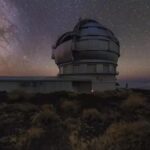
The recognition marks an important step forward for this infrastructure, which has featured on the ESFRI roadmap since 2016, and highlights the progress made in its preparations for future construction at the Roque de los Muchachos Observatory, situated in the highlands of the municipality of Garafía on La Palma.
Landmark status places the EST among the research infrastructures that ESFRI regards as strategic reference points for Europe. This category brings together facilities that are already operational alongside others that have reached an advanced stage of development. In the field of astronomy, the ESFRI roadmap includes major infrastructures recognised as Landmarks, among them the CTA Observatory (CTAO), the Extremely Large Telescope (ELT) and the SKA Observatory (SKAO).
For the EST, the move from Project to Landmark amounts to European recognition of the maturity the project has achieved and of its potential to drive forward solar research. It also strengthens its position in discussions with the institutions and participating countries ahead of construction of the telescope on La Palma. The next step is to consolidate the contributions needed to bring it to fruition.
Placing Europe at the forefront of solar physics
Valentín Martínez Pillet, director of the Instituto de Astrofísica de Canarias, said: “The distinction of the EST as a Landmark is great news for European solar physics and represents important recognition for a project in which the IAC and the Spanish scientific community have been deeply involved since its origins. The EST will place Europe at the forefront of high-resolution solar physics and further reinforce the position of the Canary Islands as one of the world’s leading centres for astronomical research.” He added: “The IAC is proud to contribute its scientific and technological expertise to making this ambitious European facility a reality.”
A Spanish-led European project
The European Solar Telescope is a project led by Spain, coordinated by the Instituto de Astrofísica de Canarias and also involving the Spanish National Research Council (CSIC) through the Instituto de Astrofísica de Andalucía (IAA). It will be the largest and most advanced solar telescope ever built in Europe.
Since 2023, development of the project has been centralised within the Canarian Foundation for the European Solar Telescope, created to steer it through the pre-construction stage and involving institutions from various European countries. Its future installation at the Roque de los Muchachos Observatory on La Palma will place a new infrastructure at the service of the international scientific community and reinforce the role of the Canary Islands in astronomical research.
European science from La Palma
The EST is designed to observe in great detail the Sun’s magnetic fields and the processes taking place in its atmosphere. Its ability to obtain simultaneous observations with different instruments will make it possible to study how phenomena linked to solar activity — solar flares among them — originate and evolve. The facility will provide the European research community with new tools to tackle questions that current telescopes are still unable to answer.
To achieve these goals, the EST will need to develop instruments and technological solutions that surpass the capabilities of today’s solar telescopes. This work brings together scientific and technical teams from different European countries, who collaborate on the design of the telescope and its instruments as well as on preparations for its future construction and operation.
On this point, Manuel Collados, coordinator of the EST, said: “The EST has been a European project since its origins. No single institution or country could carry out an infrastructure of this scale and ambition alone. Its designation as a Landmark by ESFRI is therefore a boost for the path of collaboration between European countries and scientists that has been laid out around the project. The task now before us is to transform that shared scientific ambition into the commitments needed for the EST to enter its construction phase.”
Opportunities for the Canary Islands
The construction and future operation of the EST will create activity for businesses and professionals in the Canary Islands in areas such as engineering, technology, facilities, logistics and specialist services, the press release adds. According to the project’s economic impact report, the EST will involve an estimated investment of 274 million euros and generate around 65 direct jobs in the Canary Islands. The study also forecasts annual spending of 8.1 million euros in the archipelago, particularly on La Palma, covering salaries, contracted services, purchases and supplies. Once the telescope is built, its scientific activity is expected to continue for at least 30 years.
Héctor Socas-Navarro, director of the EST Foundation, said: “For La Palma, hosting the telescope will mean continuing to increase the scientific potential of the Roque de los Muchachos Observatory and placing it at the forefront of solar research worldwide.”
What’s happening in the Canaries – straight to your phone
News, weather alerts and practical updates – direct from the islands, in English. We live here and know what’s going on – before the international media catch up. Everything lands on our WhatsApp channel – no middlemen, no algorithm. Curated for families, expats and travelers.

New Canary Islands foundation takes on climate change
Playa Jardín in Puerto de la Cruz closed over faecal bacteria
Invasive mosquito species detected in Gran Canaria
New planet born from dead star discovered
Telde fish kill: science points to emisario 222
Magnitude 3.2 earthquake shakes southwest Fuerteventura

Tiger mosquito detected in south of Gran Canaria
Quantum telescope network planned for La Palma
Third closure of Playa Jardín beach in Tenerife