Compiled with the help of artificial intelligence, based on Spanish-language information. Source below the article.
The Canary Islands Government has asked Costas to exercise extreme caution over the planned demolition on 21 September of a historic home in Cueva de la Negra, in Pájara, Fuerteventura, because of the presence of an archaeological site next to the property.
Regional government calls for demolition to respect cultural heritage
In a letter sent to the Ministry for Ecological Transition and the Demographic Challenge, the regional government has requested that any demolition work be carried out in a way that is compatible with the protection of cultural heritage, powers over which lie with the Canary Islands authorities.
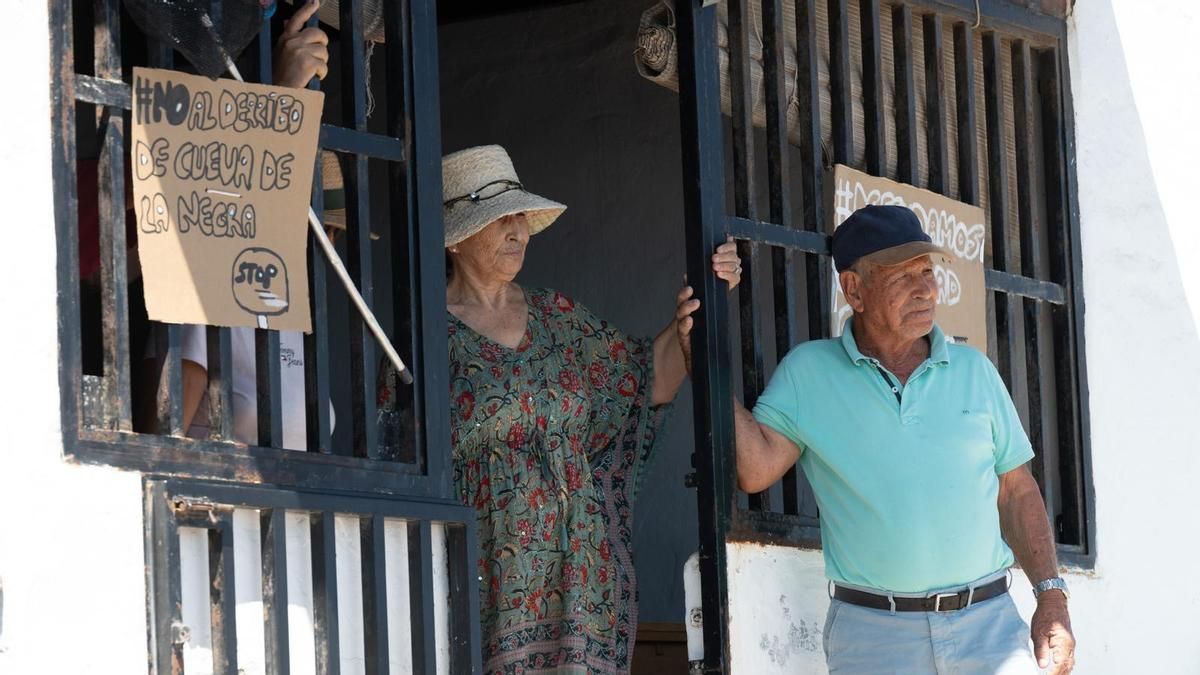
The family of the owner of the house, Pascuala Roger Pérez, 80, has told Canarias Ahora of its deep concern and fear at the possibility that Costas will demolish the home, which they say is more than a hundred years old and once formed part of a settlement of fishing families, as recorded in historical documents from the area.
The property is small and single-storey, with stone walls up to one metre thick. It is a traditional coastal construction dating back to its origins and was used seasonally. “This is the origin of Morro Jable,” summarises one of Roger Pérez’s daughters, Ana.
Costas notifies family of demolition under Coastal Law
The Canary Islands Coastal Demarcation notified the family on 11 September that it would proceed this Monday to enter the property and render it unfit for uses prohibited under the Coastal Law.
The property has been within the public maritime-terrestrial domain since 2005, when the boundary delimitation between the port of Jandía and Casa Las Señoras was approved, a strip in which residential use is prohibited.
The resolution, entitled “demolition notification”, comes just days after the Cabildo of Fuerteventura adopted precautionary measures on 25 August to suspend the demolition, initially planned for 26 August, while it studies its value with a view to including it in the inventory of elements that make up the island’s cultural and archaeological heritage.
Those precautionary measures were communicated to the affected authorities, according to a letter from the Directorate General of Culture and Cultural Heritage of the Canary Islands Government. They agree to suspend the demolition of the home and establish that the Pájara Town Hall will be the body responsible for protecting it until studies into its possible heritage interest are completed.
But Costas has decided to press ahead and has recalled that, since 28 July 2026, Court of First Instance number 6 in Las Palmas de Gran Canaria has authorised it to enter, demolish and restore the land to its original state.
Family says it feels pressured to leave the house
Roger Pérez’s family complains that Costas appears to be above the law and that it feels pressured to leave the house. It adds that, for weeks, family members have been taking turns to prevent the home from being left alone and that they have asked the Cabildo to go to court to demand compliance with the precautionary measures. They are also calling for those measures to be extended to halt a possible sealing-off of the property.
The relatives also recall that the Senate plenary approved a motion on 24 June urging the State to halt all boundary delimitation procedures and any actions that could entail a loss of rights, such as a demolition, while the amendment to the Coastal Law is being processed.
This newspaper has attempted to contact the Cabildo of Fuerteventura, but had received no response by the time of publication of this article.
The Canary Islands Government’s tourism minister, Jessica de León, has called on Costas to set aside its haste because “a pickaxe destroys history”, in comments to journalists.
Aboriginal shell midden next to the property
Next to Roger Pérez’s house is an archaeological site included in Pájara’s heritage inventory since 2007. It is an Aboriginal shell midden formed by the accumulation of mollusc shells and other waste that helps to explain the diet, seasonal cycles and adaptation to the environment of the Canary Islands’ populations.
The existence of that site is what has led the regional government to ask Costas to exercise extreme caution over any intervention that could affect the subsoil or the immediate surrounding area. It has not expressly requested that the work be halted, but rather that particular care be taken given that the operation involves earth movements, removal of materials, the movement of machinery and other work with possible archaeological implications.
The regional government’s heritage department has also indicated that projects that could affect elements of the Canary Islands’ cultural heritage must be submitted for a favourable report from the Cabildo of Fuerteventura, which in this case is responsible for setting the protective, corrective and compensatory measures needed to safeguard the cultural heritage affected.
“A final administrative resolution on coastal matters and a judicial authorisation to enter does not in itself alter this distribution of powers or determine the non-application of sectoral cultural heritage regulations,” the government says.
Family warns 21 September could be “the end”
Roger Pérez’s family, however, laments that the Canary Islands authorities “talk about protecting heritage, but do not act while Costas’s pickaxe advances”. In a statement, it warns that 21 September could be “the end of the last thing still standing of part of the history of Cueva de la Negra” and that “concern without decisions does not protect a house, a site or the history of a people”.
The family criticises at the same time what it considers a double standard between large establishments and traditional huts: “We cannot accept that small traditional constructions, used for generations by families of fishermen, sailors and workers of the islands, are treated as if they had no value while large coastal establishments and facilities find administrative mechanisms to continue existing.”
The family maintains that it is not asking for privileges, but rather that the authorities use all available legal instruments “when our historical, ethnographic and archaeological heritage is at risk”. “The Canary Islands cannot preserve only the coastline that produces economic wealth and allow the coastline that preserves the memory of those who lived here before us to disappear,” the letter concludes.
What’s happening in the Canaries – straight to your phone
News, weather alerts and practical updates – direct from the islands, in English. We live here and know what’s going on – before the international media catch up. Everything lands on our WhatsApp channel – no middlemen, no algorithm. Curated for families, expats and travelers.
Canary Islands opens applications for young renters’ bonus
Canarias has lowest salaries in Spain at 2,016 euros

Mesa y López bids to boost footfall by 20% in three years
Arrest order issued in Claudia Tacoronte feminicide case
Canary Islands clocks go back on 25 October
Trump tariffs hit Canary Islands wine exports to US

Foreign Social Security affiliates in Canary Islands rise 2.5%

Canary Islands push to limit foreign home purchases

Uber passenger falls asleep and collapses on Tenerife road