Compiled with the help of artificial intelligence, based on Spanish-language information. Source below the article.
The leper colony that never had any lepers
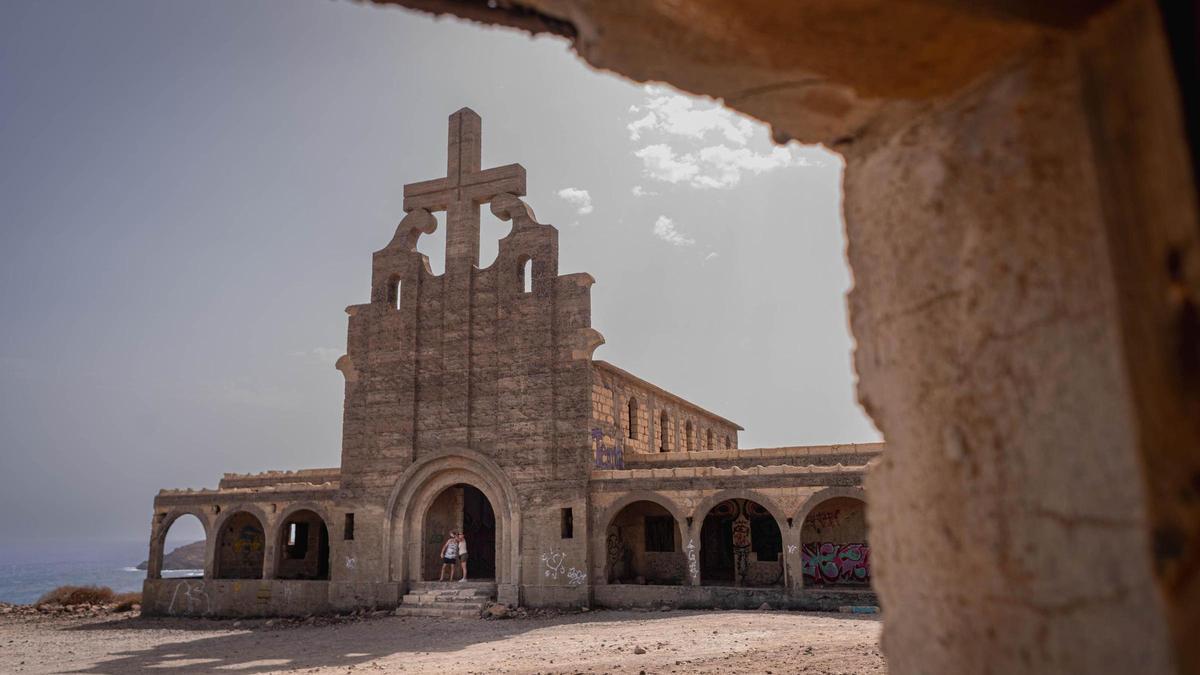
No patient ever made it through its doors. Yet it is hard to imagine that, between these walls battered for decades by salt-laden breezes, people cut off from the world were meant to live. People whose skin had been left marked by leprosy, with patches lacking sensation, damaged nerves and, in the most advanced cases, deformities of the hands and feet. In post-war Tenerife, the response to the fear the disease provoked was to remove the sick from society and take them far away, to a sunny, isolated spot by the sea. For them, a small city was built in Abades, complete with a hospital, homes, a school, workshops, a church and even a crematorium. It never came into operation. Today, eight decades later, that settlement designed to isolate the sick is a ghost town of empty walls. It is the leper colony that never had any lepers.
On one side, hundreds of white houses line up beside small coves of crystal-clear water, surrounded by the landscape of huge wind turbines that characterises this stretch of the Arico coast. On the other, the abandoned buildings of the old sanatorium, covered in graffiti, dirt and rubble. The paradox is a curious one. Those who rent a flat in Abades, own a second home there or simply come looking for peace and quiet end up passing through this ruined settlement too. Some do so to learn its history. Others, like Abades resident Raquel Hernández and her daughter Marta Ruiz, know it by hearsay, through what has been passed down by word of mouth over the years and the memories that have survived from that era. The truth is that, as if it were a story, they know it inside out.
A city that was meant to be self-sufficient
“Everything started going up around 1941, just after the Civil War ended,” says Raquel Hernández. She recalls a church, a house for the doctor, another for the priest, a hospital and a school. “There were about 36 buildings,” she adds. What Raquel recounts from memory matches the history reconstructed by researchers. One of them, Francisco Javier Castro Molina, a nurse, art historian and anthropologist, has pieced together the story of the old Abades leper colony in several of his works. What he explains is that, for centuries, leprosy patients in Tenerife were sent to Gran Canaria, where the Hospital de San Lázaro cared for sufferers from various islands. So great was the rise in cases that, in 1937, of the 200 recognised leprosy patients in the province of Santa Cruz de Tenerife, only 30 were confined. Tenerife had 74 registered and barely 22 were being housed. Gran Canaria no longer had the capacity to take them all in. Hence the need for the island to have its own centre.
“At first it was meant to be an isolated city, but one that supplied itself,” Hernández recalls. “Like a kind of city or citadel, really. For them, and so they wouldn’t infect the rest,” adds her daughter. The future sanatorium was to include not only medical facilities but also the services needed for the colony to function autonomously and keep its inhabitants cut off from the outside world. Before Abades, other sites were studied. In 1941 a leper colony was even planned at Cuevas Blancas, in El Rosario, but the initiative was discarded. The definitive decision came in August 1944, when an order from the Ministry of the Interior provided for the construction of the Arico Leprosy Sanatorium on a provincial basis. Abades met the conditions the authorities were looking for: space, a climate considered favourable and sufficient distance from the capital. The project was built on a plot beside the sea, in what was then a practically desert landscape, and was conceived as a combination of sanatorium and colony.
“A complete leper colony had been built there,” Ruiz also recalls, reconstructing the story from what her mother has told her over the years. “With a hospital, recreation areas, dining halls and general services, as well as a residential area for the patients, a school, a church and separate quarters for the healthy staff.” But the complex was never finished and the sanatorium never took in any patients either. “When almost everything was built, medicine had advanced a great deal and leprosy began to be eradicated,” Hernández recalls. The first effective drugs and home treatments began to gain ground, while isolation ceased to be the only response to the disease. The works were finally halted for good at the end of 1946.
From Falange camps to a military firing range
Since then, the site has served other purposes and accumulated new projects that never came to fruition either, from Falange camps to proposals to turn it into a centre for drug addicts, a cultural space or a campsite. It was not until 1981 that the site passed from the health authorities to the Ministry of Defence. The Army surrounded the area with wire fencing and made use of the buildings in the best condition, while the rest of the unfinished buildings served for military manoeuvres and shooting practice. It remained that way until the end of compulsory military service, when the Ministry of Defence put the nearly 900,000 square metres of land up for sale.
The property was acquired in 2002 by the Italian developer Alberto Giacomini for 17 million euros. The company Playa de Arico, linked to the Giacomini family, planned one of the largest tourism developments envisaged in the municipality at the time: four five-star hotels with around 3,000 beds, a spa and thalassotherapy centre, a shopping centre and two golf courses. The planned investment amounted to 360 million euros and the project initially had the backing of Arico Council, the municipality in which it is located. But the complex was never transformed. A year after the sale, the Island Council’s Historical Heritage Service had already flagged up the historical and artistic value of the site, and the application of the Tourism Moratorium ended up halting the project. Giacomini died in 2015 without a single stone of the planned development having been laid.
Parties, film shoots and curious visitors
The old leper colony then continued to accumulate other uses, many of them well outside any official planning. Its abandoned buildings played host for years to clandestine parties and gatherings, graffiti artists and other activities drawn by the isolation and the image of the complex. Over time, that same landscape of ruins also caught the attention of the audiovisual industry, and the site began to serve as a setting for shoots, films and shorts. It also attracts visitors today, such as Diego Lorenzo and María González, who came from Granadilla de Abona to take a photograph. “We came to see the place, out of curiosity and to take some photos,” they say. “What surprises us most,” explains Diego, “is the size of the place and the feeling it gives off, which is very powerful.” “It’s incredibly striking,” concludes María, referring to that sandy, silent and sinister air that spreads as it slips between the old buildings.
A few metres away, Néstor Nevado and Raquel Lerona, from Palencia and on holiday in Porís de Abona, discovered Abades while looking for a quiet beach. They were not expecting to find such an abandoned place. “It surprised us and we wanted to explore,” admits Nevado. Raquel, his partner, says she is “especially struck by the state in which some of the buildings are still preserved despite having been abandoned for decades”. She says this while pointing to the tiles of what appear to have been the bathrooms and the floors, made up of tiles that remain intact. They are small remnants of a ghostly city that never came to life, but which, almost a century later, still manages to draw others to discover it.
What’s happening in the Canaries – straight to your phone
News, weather alerts and practical updates – direct from the islands, in English. We live here and know what’s going on – before the international media catch up. Everything lands on our WhatsApp channel – no middlemen, no algorithm. Curated for families, expats and travelers.
Canary Islands look to volcanic heat for energy
Canary Islands’ ancient potatoes face climate threat
Tenerife deploys drones to cut drowning deaths
Gran Canaria wildfire breaks out in Telde
Court backs Chira-Soria power plant in Gran Canaria
Twelve earthquakes recorded across the Canary Islands

La Palma’s quantum telescope project to boost island economy
Canary Islands forests store 25% more carbon than thought
New map reveals 60+ closed beaches in Canary Islands