
Compiled with the help of artificial intelligence, based on Spanish-language information. Source below the article.
Outrage over concrete-encased palm trees
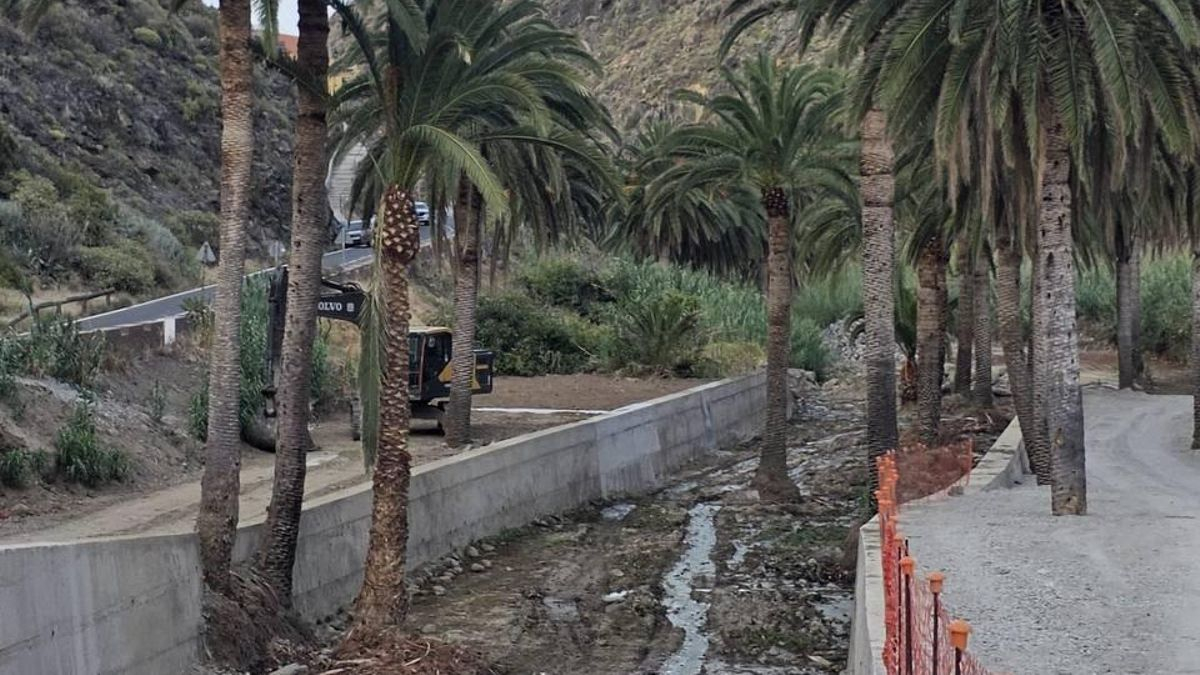
In early August, images of Canary Island palm trees encased in concrete in Vallehermoso, La Gomera, went viral on social media. The photographs brought into sharp focus a very “made in the Canaries” approach to landscape intervention – one that does not integrate nature, but rather insists on fighting against it. The images show work on the channelling and canalisation project for the Vallehermoso ravine, carried out by the Directorate General for Water with an estimated public investment of €5.9 million. The aim of the works is to prevent overflow during heavy rain and protect residents, homes, and public amenities near the watercourse from flash flooding.
The palm trees’ crime? Simply standing in a ravine where they have grown for over a hundred years. What is most serious, however, is that during the planning, execution, and review of the works, nobody thought it at all odd to coat these trees – which grew as a gift of the watercourse itself – in concrete. A channel that will only flow faster during rainfall if the only solution applied is impermeabilisation, among other shortcomings in the plan.
Architect’s damning verdict
Following the spread of the images, voices such as that of architect and urban planner Juan Palop-Casado were raised. He described the intervention on his X account as a telling image of the times: the graphic illustration of more than half a century of urban management that insists on tiling everything to the ceiling as a solution for any intervention, without considering aspects such as the landscape, the hydrological cycles of watercourses, ecological dynamics, the preservation of palm groves, public safety, the attenuation of runoff, or intangible factors such as the identity that emanates from the surroundings that envelop Canarians.
“We’ve had 50 years of this sort of turbo development in the Canary Islands, which has generated more problems than it has solved – without denying whatever progress may have been made,” the architect told this newspaper. “But now we need to intervene in landscapes in a multidisciplinary way and tackle a structural problem, where doing things properly means having a participation team, consulting experts and residents, and bringing in ecologists and landscape architects. But when all you have in your head are hammers, all you see are nails.”
Government admits error
In statements to Cadena Ser radio during the days the images were circulating, the Deputy Minister for Water and Emergencies, Marcos Lorenzo, admitted it had been a mistake: “The engineer accompanying us himself concluded that it was not the best solution, neither for the palm tree nor, fundamentally, for the stability of the works.” When approached by this newsroom, the Regional Ministry for Territorial Policy confirmed that the solution adopted was to free the trunks of the affected palm trees – that is, to break up the concrete layer – work on which the contracting company is currently carrying out.
For Palop-Casado, a multidimensional change is needed in the way the islands look at and intervene in their landscape, without entering into a war with it, respecting and harnessing ecosystems, with nature-based solutions implemented by teams with an ecological culture. “We accept those 50 years of turbo development, but now we need to regenerate cycles. The Canary Islands can no longer withstand another mistake.”
Councillor calls project a “disgrace”
Councillor Alejandro García, of Iniciativa por La Gomera, dismisses the intervention as an outright disgrace. “These are works with a high cost to the public purse and with little demonstrated efficiency. It’s over six million euros to concrete certain sections of the Vallehermoso ravine bed,” he argues. The councillor understands that, of the four sections to be worked on under this project, it is the town centre section where a few parking spaces or even an inter-urban promenade will be gained. “But the rest of the project is a disgrace that does not respond to the island’s needs, neither economic nor ecological.”
García also cannot understand why millions of euros are spent pouring cement into a ravine only to then recreate green areas: “It’s a contradiction in its own terms.” And it could have been worse, as the councillor told Canarias Ahora that in a first version of the project those palm trees were to be felled, and that felling was halted thanks to protests from residents and on social media.
What’s happening in the Canaries – straight to your phone
News, weather alerts and practical updates – direct from the islands, in English. We live here and know what’s going on – before the international media catch up. Everything lands on our WhatsApp channel – no middlemen, no algorithm. Curated for families, expats and travelers.

Canary Islands sea hits second-hottest year on record

Legal bid to halt tree felling in Santa Cruz’s La Salud

Fiesta del Charco: A journey through La Aldea’s past

Corralejo dunes power line set for removal

ULPGC launches 14 research projects at Las Canteras

TMT will never be built, says Canary Islands astrophysics chief

Pedro Duque: Canarias is the “ultimate dream” for rockets

Court blow to Tenerife motor circuit project
La Palma faces new volcanic risk planning deadline
