
Compiled with the help of artificial intelligence, based on Spanish-language information. Source below the article.
A study led by the Volcanological Institute of the Canary Islands (Involcan) has identified accumulations of magma at the base of the ancient oceanic crust beneath Tenerife, which correspond to the anomalous seismic activity detected since 2016. The findings, published in the journal Scientific Reports (Nature group), suggest a possible connection between processes occurring tens of kilometres underground and phenomena observable at the surface, such as seismicity and degassing.
Rigid crust layer and seismic anomalies
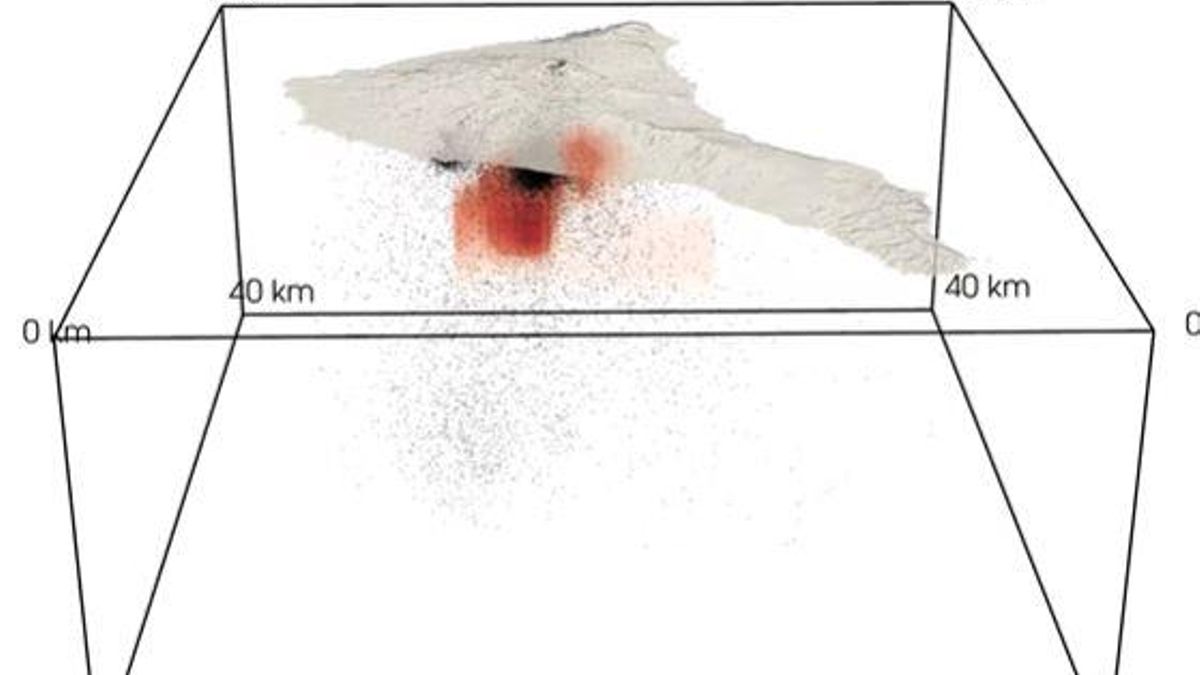
In its social media channels, Involcan highlighted that one of the main results of the study is the identification of a relatively rigid oceanic crust layer, approximately ten kilometres thick, characterised by relatively high seismic velocities. Beneath this layer lies a far more heterogeneous structure, in which four major low seismic velocity anomalies have been identified. These structures are distributed across different sectors of Tenerife and extend roughly between ten and 30 kilometres in depth.
The animation below shows a three-dimensional visualisation of the deep structure beneath the island of Tenerife. In red, the main low seismic velocity anomaly identified by the study is shown, while black dots represent the hypocentres of earthquakes located in recent years. The low seismic velocities observed are interpreted as indicating zones of elevated temperature and/or changes in the composition and physical properties of rocks, which could be related to the presence and accumulation of magmas from the upper mantle.
Significant molten material beneath western Tenerife
The most notable result of the study is located beneath the western sector of Tenerife, where exceptionally low S-wave seismic velocities have been identified. Combining these results with thermodynamic modelling indicates that this anomaly may contain a significant proportion of molten material, i.e., magma. The correspondence between the lowest seismic velocities and the largest melt fractions points to the existence of a zone particularly rich in magma in the upper mantle. This accumulation would be related to magmatic underplating processes, by which magma from the mantle progressively accumulates at the base of the oceanic crust.
Deep anomalies linked to recent earthquakes
The study also reveals a spatial relationship between the deep low-velocity anomalies and the seismic activity recorded recently on Tenerife. A significant proportion of the earthquakes located in recent years is concentrated above or at the edges of the main low-velocity anomaly. This distribution could be related to the accumulation and transfer of magma in this deep region. The ascent of magma from the upper mantle towards shallower levels causes a decrease in pressure, favouring the exsolution of gases dissolved in the magma. At these depths, according to Involcan, these volatiles are mainly composed of carbon dioxide (CO₂).
The subsequent migration of these volatiles and magmatic fluids towards more superficial levels, where they interact with Tenerife’s hydrothermal system, could help explain part of the seismic activity observed, including the hybrid and low-frequency seismic events recorded on the island.
Improved understanding of Tenerife’s magmatic system
Involcan assures that these results contribute to significantly improving the understanding of the deep architecture of Tenerife’s magmatic system and of the processes that may connect magma storage zones in the upper mantle with the seismicity and degassing observed at the surface.
The research, led by Víctor Ortega Ramos, researcher at the Volcanological Institute of the Canary Islands (Involcan) and doctoral student at the Complutense University of Madrid (UCM), is the result of collaboration between both institutions, the Technological and Renewable Energy Institute (ITER), the University of Geneva (Switzerland) and the Research Institute for Volcanology and Risk Assessment (IVAR) in Portugal.
What’s happening in the Canaries – straight to your phone
News, weather alerts and practical updates – direct from the islands, in English. We live here and know what’s going on – before the international media catch up. Everything lands on our WhatsApp channel – no middlemen, no algorithm. Curated for families, expats and travelers.

Canary Islands sea hits second-hottest year on record

Legal bid to halt tree felling in Santa Cruz’s La Salud

Fiesta del Charco: A journey through La Aldea’s past

Corralejo dunes power line set for removal

ULPGC launches 14 research projects at Las Canteras

TMT will never be built, says Canary Islands astrophysics chief

Pedro Duque: Canarias is the “ultimate dream” for rockets

Court blow to Tenerife motor circuit project
La Palma faces new volcanic risk planning deadline
