
Compiled with the help of artificial intelligence, based on Spanish-language information. Source below the article.
Nature’s night shift
When the forest falls silent, their working day begins. Tenerife’s bats live in the shadows of the island’s fauna, hidden by day and active while most residents sleep. But beneath that discretion lies one of the most fascinating pieces of the island’s natural machinery. Now, as the Corona Forestal recovers from the great fire of 2023, scientists are looking to the night sky to understand how the woodland is healing.
A home for the most vulnerable
For the past two years, the Cabildo de Tenerife has been running a programme to protect the island’s most vulnerable bats. The fire devastated 14,751 hectares of countryside and, among its less visible consequences, left a temporary shortage of shelter for these small flying mammals. The response combines science with something deceptively simple: giving them a place to hide.
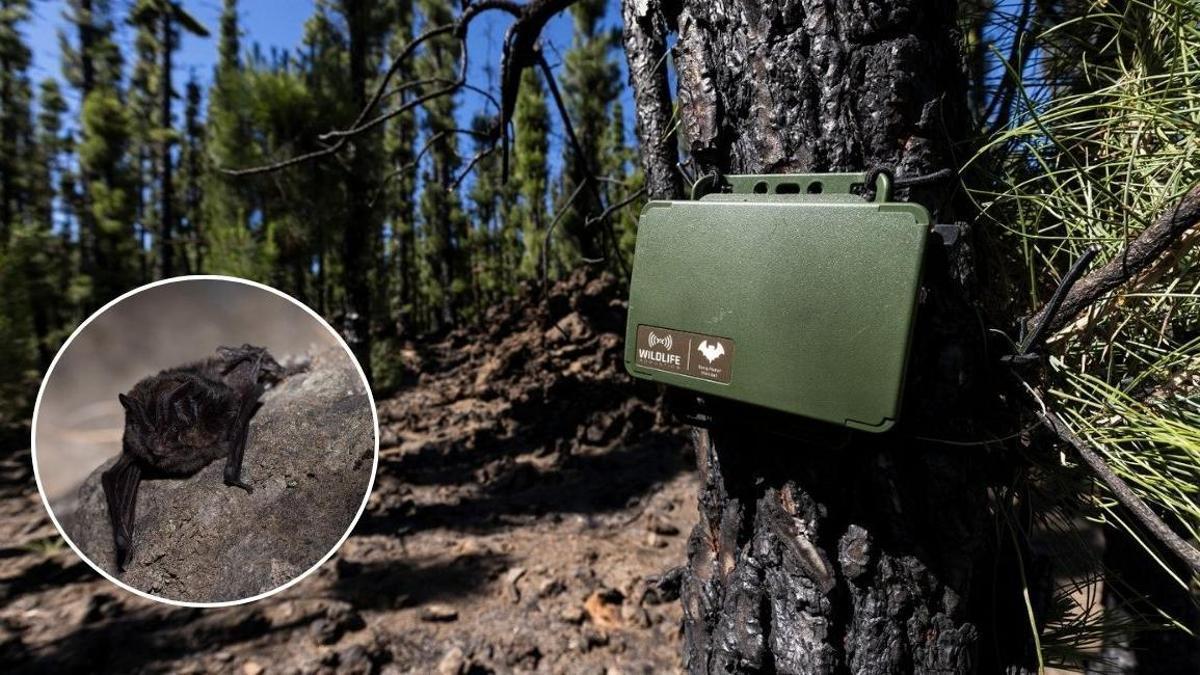
The goal is not merely to protect the bats themselves, but to support the recovery of the wider ecosystem and to track, night by night, how they respond to the transformed landscape. To that end, the project has installed 108 refuge boxes at various points across the Corona Forestal, compensating for the lost roosts and encouraging the recolonisation of the pine forests by their bat populations.
Encouraging signs among the pines
Preliminary data from two years of monitoring confirm the importance of the pine forests to two of the Canary Islands’ most threatened bat species: the Canarian big-eared bat and the Canarian barbastelle. In some sectors of the Corona Forestal, their presence and activity levels are higher than those recorded in other studied ecosystems. That is a significant signal: the pine forest is not merely a landscape that must turn green once more, but a home that must reclaim its inhabitants and its natural relationships.
Rosa Dávila, president of the Cabildo de Tenerife, said: “Bats are an example of that wealth which often remains invisible, yet is essential to the health of the countryside.”
Six species, one delicate balance
Tenerife is home to six species and subspecies of bats. Among them are the Madeira pipistrelle, endemic to Macaronesia; the Canarian big-eared bat, found only in the Canary Islands; the Canarian barbastelle, unique to the archipelago; the mountain bat, the lesser noctule and the European free-tailed bat.
The Canarian big-eared bat occupies an especially precarious position. It is classified as critically endangered by the International Union for Conservation of Nature (IUCN) due to its restricted range and declining populations. Where there had once been shelter, food and continuous woodland, the flames transformed the landscape. The refuge boxes now function as a temporary solution for fauna that cannot afford to wait for the forest to regain its former glory.
Indicators of forest health
Bats are not secondary residents of the countryside. They are the ecosystem’s night workers. By feeding in the pine forests, they contribute to the natural control of insect populations and help maintain environmental balance. Blanca Pérez, the island’s councillor for the Natural Environment, stressed that bats “are not only part of our valuable natural heritage, but act as true indicators of the health of our woodlands”. Their sensitivity to environmental change makes it possible to assess the state of the pine forests and their evolution after disturbances as severe as wildfires.
That is why this project is not simply about protecting species. It is also about reading the woodland through them. The scientific monitoring turns every record into a piece of the forest recovery map. Each bat that finds a refuge box provides a small sign that the forest is once again offering the conditions for life. The recovery of a pine forest does not end when the trees reappear; it also requires the return of those who live among the branches and form part of its invisible balances.
The silent storytellers
There is something paradoxical in all this. The animals most overlooked by day can become some of the best narrators of what happens in the darkness of the mountains. If they return, the forest is recovering something more than its green hue. As the Corona Forestal heals its burn scars, the bats are once again flying over its pine forests. We do not see them. But among the treetops and clearings, when Tenerife falls dark, they continue their quiet work.
What’s happening in the Canaries – straight to your phone
News, weather alerts and practical updates – direct from the islands, in English. We live here and know what’s going on – before the international media catch up. Everything lands on our WhatsApp channel – no middlemen, no algorithm. Curated for families, expats and travelers.

Canary Islands sea hits second-hottest year on record

Legal bid to halt tree felling in Santa Cruz’s La Salud

Fiesta del Charco: A journey through La Aldea’s past

Corralejo dunes power line set for removal

ULPGC launches 14 research projects at Las Canteras

TMT will never be built, says Canary Islands astrophysics chief

Pedro Duque: Canarias is the “ultimate dream” for rockets

Court blow to Tenerife motor circuit project
La Palma faces new volcanic risk planning deadline
