
Compiled with the help of artificial intelligence, based on Spanish-language information. Source below the article.
A century of coffee in the Valle de Agaete
More than a century ago, coffee cultivation began in Agaete, on the island of Gran Canaria, as a supplement to the region’s dominant banana trade. Rooted in volcanic soil at a lower altitude than is typical for the crop, the experiment quickly proved its worth, and the tradition has been handed down from generation to generation ever since. Now, this unique product is seeking recognition at a European level.
The coffee growers’ association, AgroAgaete, along with the town council of this municipality in the northwest of the island, has been working for several months on an application for Protected Geographical Indication (PGI) status. This symbol would officially acknowledge the product’s unique character, protecting and preserving its distinct identity and characteristics.
A family tradition, from father to son
Many of the municipality’s small-scale growers learned how to nurture this unusual plant from their parents, who first introduced them to the valley, and they promised to keep those new plantations alive. The story of Agaete coffee is, at its heart, a family affair, rooted in smallholdings and manual cultivation.
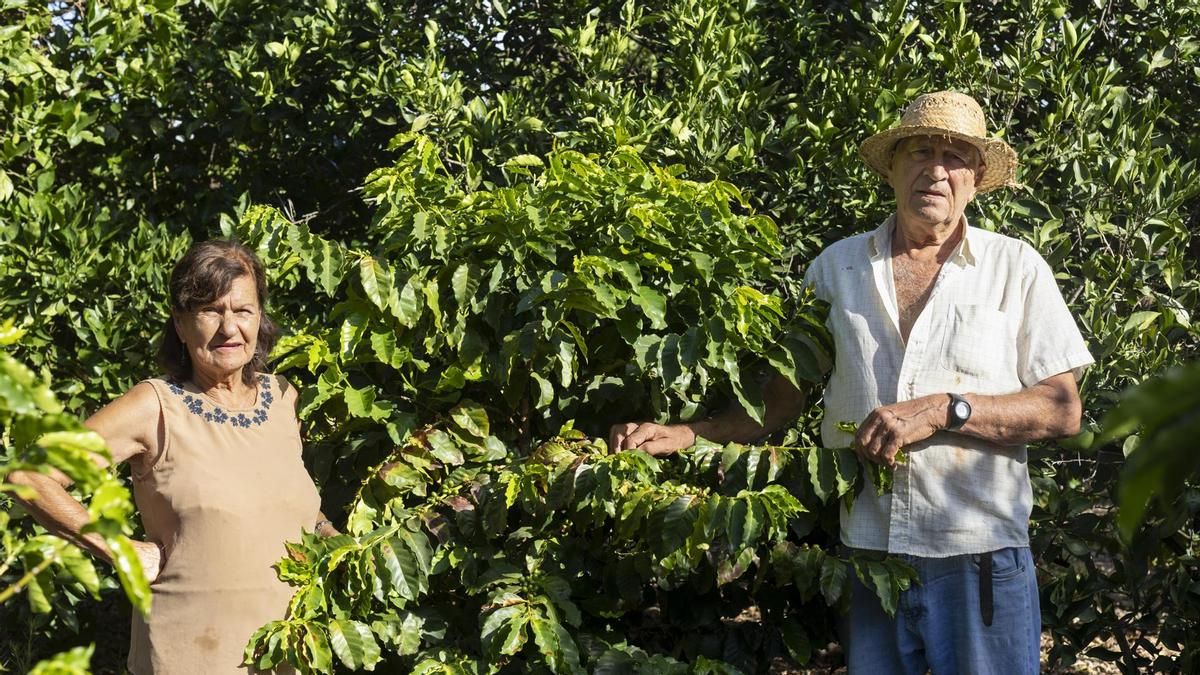
This is the view of Juan Sosa, president of AgroAgaete and owner of the Los Grimones estate. The association was founded two decades ago precisely to prevent the crop from dying out and to preserve what the previous generation had achieved. Those first coffee plantations did not yield large harvests, as Manolo Lugo, owner of the La Morreta estate, recalls. The idea, he explains, was more about growing coffee for personal consumption, to warm the belly during times of greater need and food scarcity, or to offer a small cup to distinguished visitors, who knew they could always find it at his parents’ farm.
But these crops have steadily gained in importance as their profitability has become apparent. Today, La Morreta is home to around 1,400 coffee plants which, beyond the production they offer, hold a deeper emotional value for its owners, Manolo and his wife, Julia García. “For me, coming to the farm every day is a dream come true. You couldn’t take me anywhere else,” Lugo says, resolutely.
Interest in the crop has grown so much that even people from outside Agaete have decided to take an interest in this bean of American origin. One such person is Patricia Juan, owner of the Los Quéqueres estate, who admits she has had to learn little by little how to pick, process and roast the coffee. Her contribution may be on a “small scale,” she says, but she explains that Los Quéqueres has become a meeting point for coffee lovers, where other women from the valley and her friends gather to pick and husk the beans whilst enjoying a good chat.
Why PGI, not PDO?
It is for these very reasons that AgroAgaete believes the coffee crop and its product should enjoy protection as a distinctive and unique item. “What we are trying to do is establish a means of protection, first for ourselves and then for the public,” Sosa argues, adding that any quality marks they can secure have a direct impact on visibility and on positioning the product in the market today.
The head of the growers’ association points out that the idea of somehow protecting the coffee crop has been debated within AgroAgaete almost since its inception, and that this idea has intensified in recent months, culminating in the decision to push forward with the PGI application. They opted for PGI status because, whilst the coffee is grown in Agaete, other processes take place outside the municipality, which would not fit within the framework of Protected Designation of Origin (PDO). PDO rules require the entire process, from cultivation through to commercialisation, to take place within the same geographical area.
With PGI status, Sosa reasons, a declaration of intent will be established, along with an external body responsible for ensuring that all the characteristics and requirements set out on the “Café de Agaete” label are met. “Any producer who wants to use the label will have to comply with them. It is about unification,” he summarises, adding that what this will bring is “credibility with the public.”
What makes Agaete coffee so special?
So, what exactly makes the coffee from this small corner of Europe so unique? Patricia Juan has no doubts: “The volcanic soil gives it great value, and the fact that it grows among other plants, surrounded by mandarins, orange trees and guavas, all of that gives it a very, very special flavour.” These are the subtle notes that ultimately reach the palate of a discerning coffee drinker, who can detect fruit flavours in the same way a wine enthusiast might.
For this small-scale producer, PGI status will give a product to which she devotes so much time and affection “more quality and more safety in consumption.” But above all, she says, it is about defending a cultural tradition that has lived in this town and its families for over a hundred years.
What’s happening in the Canaries – straight to your phone
News, weather alerts and practical updates – direct from the islands, in English. We live here and know what’s going on – before the international media catch up. Everything lands on our WhatsApp channel – no middlemen, no algorithm. Curated for families, expats and travelers.

Canary Islands sea hits second-hottest year on record

Legal bid to halt tree felling in Santa Cruz’s La Salud

Fiesta del Charco: A journey through La Aldea’s past

Corralejo dunes power line set for removal

ULPGC launches 14 research projects at Las Canteras

TMT will never be built, says Canary Islands astrophysics chief

Pedro Duque: Canarias is the “ultimate dream” for rockets

Court blow to Tenerife motor circuit project
La Palma faces new volcanic risk planning deadline
