
New era for Punta del Hidalgo fishermen
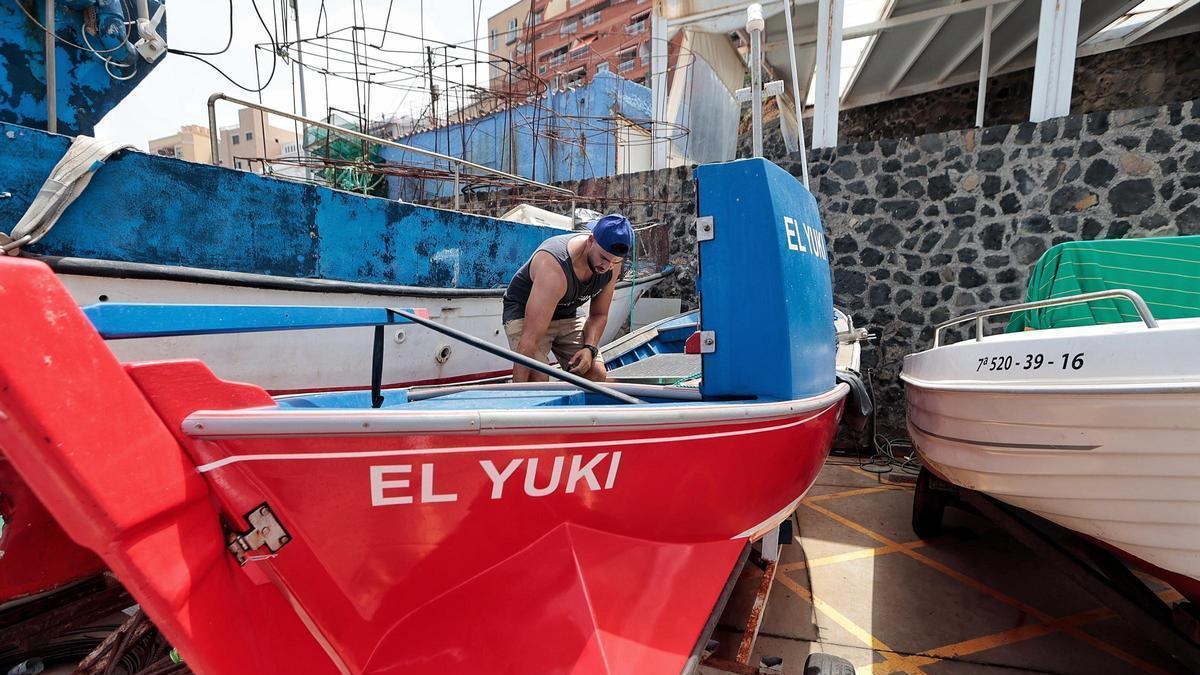
The smell of salt spray, lobster pots resting on the pier, neatly coiled ropes, seagulls wheeling over the shoreline and the chatter of fishermen are all part of the daily scene at the small harbour of Punta del Hidalgo. “There you go, off to sea!” one of the most veteran fishermen shouts to a colleague untying his boat to head out for a day’s work, while others prepare their fishing gear or sip their first coffee of the morning at the harbour bar. The recent transfer of the port facilities to the Cofradía de Pescadores Nuestra Señora de la Consolación fishing guild brings an end to a demand that had dragged on for years, opening a new chapter for the fishing sector on this northern point of Tenerife.
Just a few metres away, the natural swimming pools along the coast draw dozens of bathers each day seeking relief from the summer heat. But cross the breakwater and you find an entirely different world. Small artisanal fishing boats share the water with leisure craft; some bear names honouring family members, such as Melania or Mary Cruz, while others, like La Libertad, reflect their owners’ deep bond with the sea.
Amid the constant comings and goings of boats and sailors, the guild now faces the challenge of managing facilities it previously used without a formal agreement, and which it hopes to turn into a tool to secure the future of the trade. Until now, the group had effectively been running the site on a day-to-day basis. Even without being officially responsible for its management, they paid the water and electricity bills, kept the facilities clean and employed staff to carry out those tasks. The difference is that from now on they can manage the harbour in its entirety, regulate the activity of recreational boats and secure a source of income that allows them to keep growing.
“Our goal is to guarantee the future of artisanal fishing and make sure the guild can support itself, without depending on subsidies,” explains its patron mayor (guild master) David Lorenzo with a smile, better known at sea as ‘Curro’ and who lives entirely off the fishing trade. The agreement, with an initial term of four years extendable by another four, will allow members to manage spaces such as the fish market, the tackle rooms and the facilities used for storing and maintaining fishing equipment. The regional government has also presented a project to organise the slipway, with the aim of optimising the use of the site and improving working conditions for those who make their living from the sea.
A small guild with deep historical roots
Behind this project lies a guild that is small in number but carries historical weight far beyond its statistics. It currently has nearly 30 members and a fleet of up to 14 boats, almost all dedicated to artisanal fishing – the kind that, as its patron mayor explains, “uses smaller-scale gear and requires each piece of tackle to be made by hand depending on the species being targeted”.
“Fishing has been the foundation of this village. Everyone here has a grandfather, a father or some relative who has lived off the sea. It is the past, the present and the future of the people of Punta del Hidalgo,” says Lorenzo. That approach to fishing is reflected in the guild’s daily life. Only two boats are dedicated to tuna; the rest alternate between pots, longlines, dogfish or shellfish, depending on the time of year and the species they are after. “Each type of gear,” explains the patron mayor, “is designed for a particular kind of fish”: “There are some for horse mackerel and black seabream, others for breca, john dory or old wives… depending on what we want to catch, we use one technique or another.”
That artisanal philosophy continues once the catch reaches dry land. The fishermen themselves sell the fish directly, without going through middlemen. “We work harder, but we also get more profit,” says Lorenzo, giving an example: “A middleman can keep around three euros per kilo. If you sell 200 kilos a week, you’re practically losing a month’s wages.”
Yet despite the difficulties the sector faces elsewhere in the Canary Islands, the guild can boast of having a new generation coming through. In recent weeks, a new fisherman in his thirties has joined, and two others, aged 23 and 25, are already part of the organisation. “In many guilds, the majority are 50 or 60-year-olds. We, fortunately, have young people who want to keep making a living from fishing,” highlights Lorenzo, who at 40 has already served ten years as patron mayor.
The next challenge: an Anaga marine reserve
The transfer of the facilities is not the finishing line, but rather the start of a far more ambitious roadmap. With the administrative maze that held the guild back for years finally resolved, efforts are now focused on ensuring artisanal fishing continues to thrive in Punta del Hidalgo. The main challenge now is pushing forward the creation of the Anaga Marine Reserve of Fishing Interest, a long-standing demand from the sector that has been on the table for years and whose administrative process has recently been reactivated.
The project envisages protecting part of the coastline through a zoning system, with areas of maximum protection, others of restricted use, and spaces where professional artisanal fishing could continue under sustainability criteria, while also regulating recreational uses. For the guild, far from limiting extractive activity, the reserve is a tool to recover marine resources and guarantee the continuity of the trade. “If it doesn’t happen, the resource is in danger,” warns Lorenzo again, admitting that each year they need to make a greater effort to obtain practically the same yield. The logic, he continues, is simple: “Allow certain areas to regenerate naturally so that, in the medium and long term, fish abundance increases across the whole area.”
“It will be hard at first, because in the early years there will be a sacrifice to make, but afterwards the sea will produce much more fish again,” he argues. So, where today they need to drop around thirty pots to make a given catch, they trust that with a recovered ecosystem, a dozen will be enough to get the same result, with less effort and less pressure on the resource.
Alongside the reserve, the guild has two other priorities. The first is the modernisation and expansion of the harbour to provide new mooring lines and improve the port’s operability. The second is the complete refurbishment of the guild’s restaurant, whose operation represents its main source of income, aside from subsidies, and which they consider key to consolidating their economic model. “With those three things – the reserve, the harbour and the bar – the guild can and will be able to stand on its own two feet,” concludes the patron mayor with hope.
That, in essence, is the horizon the organisation has been pursuing for years: turning the recent transfer of the port not just into an administrative solution, but into the starting point for securing the good fortunes of artisanal fishing on the coast of Punta del Hidalgo. Because, with the course now clear, the next step is to take the helm of their own destiny once and for all.
What’s happening in the Canaries – straight to your phone
News, weather alerts and practical updates – direct from the islands, in English. We live here and know what’s going on – before the international media catch up. Everything lands on our WhatsApp channel – no middlemen, no algorithm. Curated for families, expats and travelers.

Canary Islands sea hits second-hottest year on record

Legal bid to halt tree felling in Santa Cruz’s La Salud

Fiesta del Charco: A journey through La Aldea’s past

Corralejo dunes power line set for removal

ULPGC launches 14 research projects at Las Canteras

TMT will never be built, says Canary Islands astrophysics chief

Pedro Duque: Canarias is the “ultimate dream” for rockets

Court blow to Tenerife motor circuit project
La Palma faces new volcanic risk planning deadline
