
Data ‘motorway’ upgrade completed
A major project to reinforce the data ‘motorway’ connecting the Canary Islands’ astronomical observatories, both by sea and land, will enable the use of next-generation telescopes, including the coveted Thirty Meter Telescope (TMT). After two years of work, the Instituto de Astrofísica de Canarias (IAC) has completed what it describes as a “technological milestone”. This will ensure that connections at both El Roque de Los Muchachos on La Palma and the Teide Observatory on Tenerife remain secure, eliminating the risk of data loss or isolation in the event of a network incident.
Securing the Northern Hemisphere’s astronomical crown
This upgrade cements the Canary Islands’ position as the leading astronomical reference point in the Northern Hemisphere. It also paves the way for more ambitious projects in emergency management and astrotourism within these national parks. The IAC has declared the Redundancy Project for the Maritime and Terrestrial Optical Network RedIRIS Tenerife – La Palma, which began in 2023, complete. The achievement is the result of a joint effort with RedIRIS and the Secretary of State for Telecommunications and Digital Infrastructures (SETELECO), with a total investment exceeding 23 million euros, financed by the European Union through NextGenerationEU funds from the Recovery, Transformation and Resilience Plan (PRTR).
Two-pronged network deployment
The deployment of this new network is divided into two major sections. On the one hand, a submarine section has been created, representing an investment of 16.8 million euros. This guarantees the IAC a minimum transmission capacity of 1.5 terabytes per second (Tbps) for the next 25 years. This link directly connects the two islands with each other and with mainland Spain. The connection to the mainland is made from Tenerife via high-speed optical channels of 10 Gbps and 100 Gbps.
On the other hand, the terrestrial reinforcement has been allocated a budget of 5.8 million euros with a usage right for 30 years. This section provides two main links of two pairs of dark fibre each, creating a duplicate connection between the La Palma Astrophysics Centre (CALP) and the Roque de los Muchachos Observatory (ORM), and between the IAC’s central headquarters in La Laguna and the Teide Observatory (OT). This significantly multiplies the value of a key infrastructure for the future of science.
Preparing for data-hungry next-gen telescopes
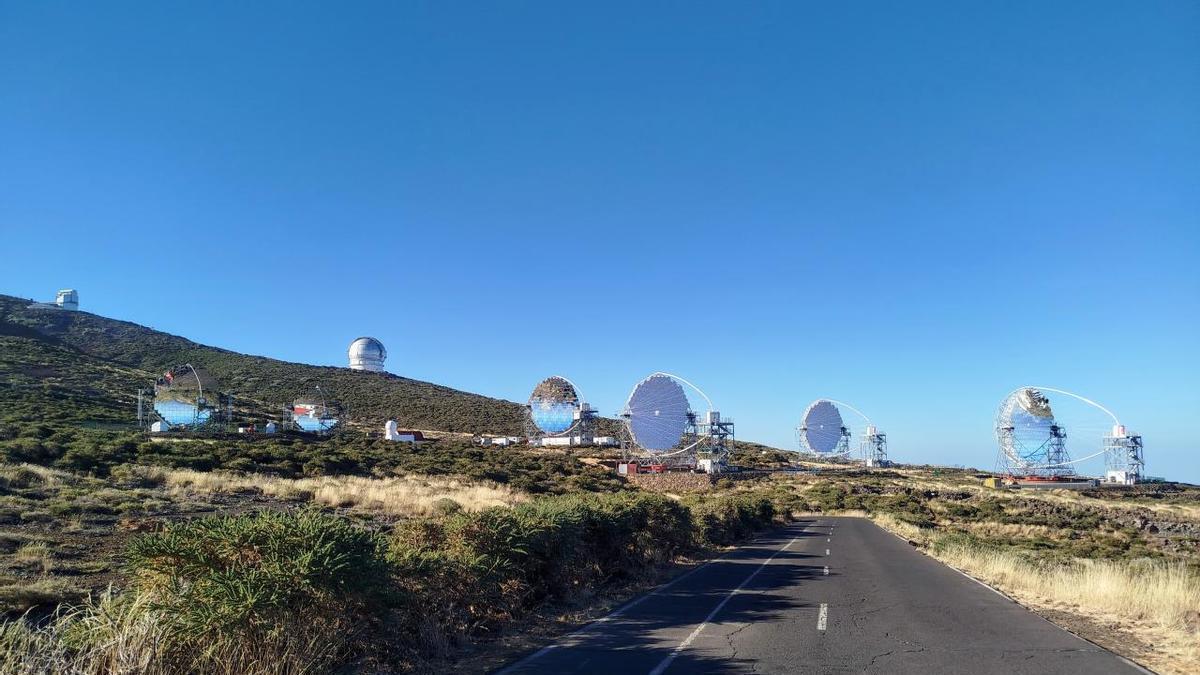
Next-generation telescopes, such as the eagerly awaited Thirty Meter Telescope (TMT), but also the European Solar Telescope (EST) and the Large-Sized Telescope (LST) antennas that make up the Cherenkov Telescope Array Observatory (CTAO), need to process and send vast amounts of information constantly. By duplicating the network, the IAC completely eliminates the risk of losing data or suffering disconnections in the middle of observations. Furthermore, with this technological leap, the Canary Islands are consolidating their international standing as an exceptionally secure, competitive, and prepared territory for hosting the most advanced astronomical projects, attracting the attention of major international scientific consortia.
Benefits beyond astronomy: emergency services and astrotourism
Beyond the strictly scientific field, the deployment of these powerful infrastructures by the contracting companies will open the door for the local community and other public institutions to connect reliably to remote areas such as Teide or Roque de los Muchachos. This will make it possible to implement cutting-edge solutions for emergency management on peaks and in national parks, boost digital tourism or astrotourism initiatives, and deliver an overall improvement in connectivity services across the entire geographical area.
What’s happening in the Canaries – straight to your phone
News, weather alerts and practical updates – direct from the islands, in English. We live here and know what’s going on – before the international media catch up. Everything lands on our WhatsApp channel – no middlemen, no algorithm. Curated for families, expats and travelers.

Canary Islands sea hits second-hottest year on record

Legal bid to halt tree felling in Santa Cruz’s La Salud

Fiesta del Charco: A journey through La Aldea’s past

Corralejo dunes power line set for removal

ULPGC launches 14 research projects at Las Canteras

TMT will never be built, says Canary Islands astrophysics chief

Pedro Duque: Canarias is the “ultimate dream” for rockets

Court blow to Tenerife motor circuit project
La Palma faces new volcanic risk planning deadline
