Free entry for locals
The Cueva del Viento in Icod de los Vinos is to offer free entry to residents of the municipality on the last Sunday of every month. The initiative, announced by the Vice-President and Tourism Councillor of the Cabildo of Tenerife, Lope Afonso, is designed to bring the local population closer to this natural space and promote knowledge of one of the island’s most remarkable volcanic formations.
Impressive visitor numbers
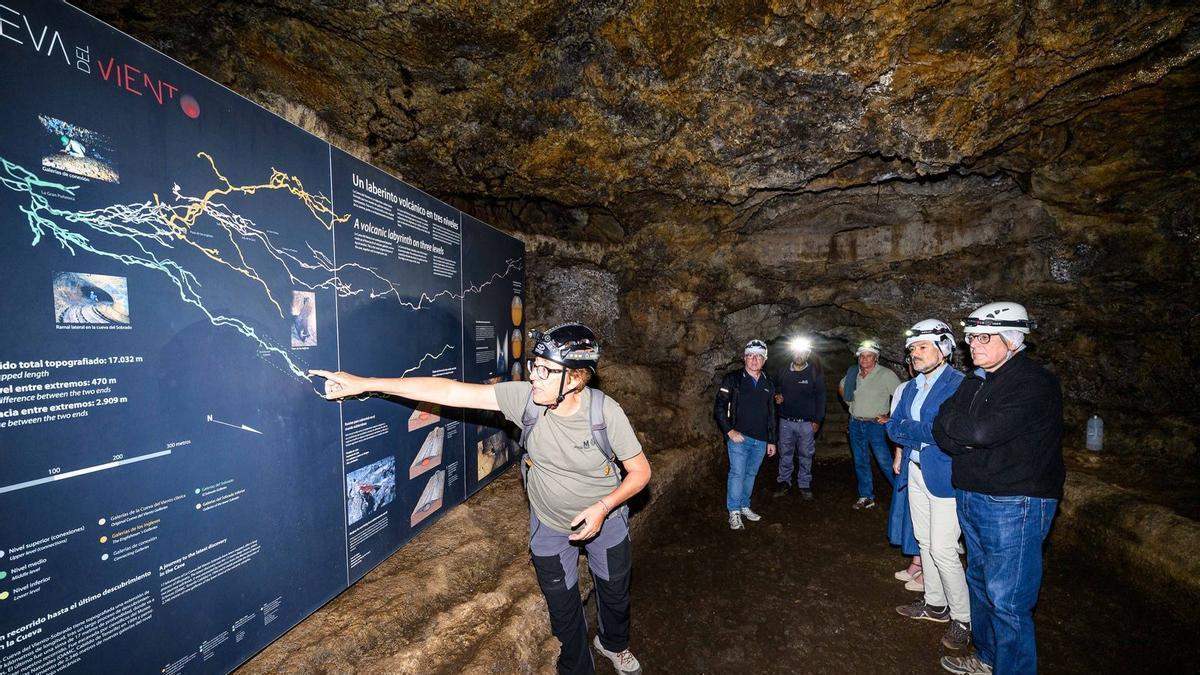
The tourist attraction, managed by the public company Ideco, welcomed 23,409 visitors from 63 different nationalities in 2025. According to figures from the Cabildo, this represents a 96.5 per cent occupancy rate of all available spaces. The cave was visited this Monday by Lope Afonso; the island’s Councillor for Culture, Museums and Sports, José Carlos Acha; and the Mayor of Icod de los Vinos, Javier Sierra, along with other institutional representatives.
Responsible tourism model
The Cabildo maintains that management of the Cueva del Viento is based on a model of responsible tourism, adapted to the environmental and geological fragility of the site. Visits are conducted in small groups of a maximum of 15 people, a restriction that prevents overcrowding, controls the impact on the lava tubes and preserves the natural conditions of the volcanic conduit. The official Cueva del Viento website reminds visitors that it is a protected ecosystem of high value and that guided tours are limited to 15 people per group.
The Tourism Councillor highlighted that this system seeks to balance tourist interest in the cave with the need to preserve a particularly sensitive environment. The management team is also working on developing a night-time route and is analysing the possibility of opening the lower gallery to the public. Any progress in this direction will be made, according to the Cabildo, based on technical and conservation criteria. The aim is to diversify the visitor experience without compromising the stability of the space or altering its natural values. For an underground attraction of this kind, planning new routes requires prior studies on safety, geology, ventilation, humidity and carrying capacity.
Guided tours and educational role
During 2025, 1,552 guided tours were organised at the Cueva del Viento. Of these, 644 were conducted in Spanish, 486 in English and 268 in German. The site also received 154 organised groups and 24 educational centres from Tenerife, confirming its dual role as a tourist attraction and a tool for scientific and environmental education. Afonso noted that the high visitor numbers recorded last year reflect the interest this site generates among both tourists and the local population. In particular, 3,215 Canarian residents explored the interior of the volcanic tube during 2025.
A speleological experience
A visit to the Cueva del Viento retains a strong speleological character. Visitors must wear a helmet and use individual lighting, as the galleries have not been artificially adapted to make the route easier. This decision keeps the natural characteristics of the volcanic tube intact and offers an experience closer to the original environment. Island Councillor José Carlos Acha stressed that preserving the cave requires maintaining its natural configuration and permanently monitoring its condition. The technical team uses Lidar technology to monitor the geological stability of the visitable area. They are also working on monitoring environmental parameters such as temperature, radon and CO₂ concentrations, and humidity levels.
Formation and unique features
The Cueva del Viento was formed approximately 27,000 years ago from lava flows of the Pico Viejo volcano, located next to Mount Teide. It takes its name from the strong air currents that are generated inside the cavity. The volcanic tube stands out for the complexity of its network of galleries, distributed over three superimposed levels, with numerous branches still unexplored. The official website of the site identifies it as the longest volcanic tube in Europe and one of the largest in the world.
Ecological and archaeological significance
Beyond its scenic value, the cave holds ecological, scientific and archaeological interest. It is home to endemic species adapted to the underground environment, such as the Loboptera subterránea, a blind cockroach, and preserves remains of Guanche burials and fossils of vertebrates that have become extinct on the island, including the houbara bustard, the giant rat and the giant lizard.
High satisfaction ratings
Satisfaction surveys conducted after visits reflect a very high rating of the experience. German visitors gave a score of 5 out of 5, while British and Spanish tourists rated it 4.8. The Mayor of Icod de los Vinos, Javier Sierra, thanked the Cabildo for its collaboration and highlighted the importance of making it easier for local residents to access this “natural treasure” located in their own backyard.
Booking and prices
Visits to the Cueva del Viento must be booked in advance through its official website. The general admission is 25 euros for adults and 8.50 euros for children aged 5 to 12. Canarian residents benefit from reduced rates of 15 euros for adults and 5 euros for children.
What’s happening in the Canaries – straight to your phone
News, weather alerts and practical updates – direct from the islands, in English. We live here and know what’s going on – before the international media catch up. Everything lands on our WhatsApp channel – no middlemen, no algorithm. Curated for families, expats and travelers.

Tenerife faces huge tourism expansion despite moratorium calls
El Bejeque in Las Canteras adds sea to its fire

Siam Park Gran Canaria must build its own desalination plant

Fuerteventura’s biggest resort to open on 1 November

Gran Canaria to teach tourism history in schools

Canary Islands see 0.3% rise in foreign tourists in August

Row over 368-bed hotel project in La Gomera

Spanish astronaut trains in Lanzarote for Moon mission

Tivoli La Caleta hosts first red tuna Kaitai in Canarias