A retreat at the edge of the world
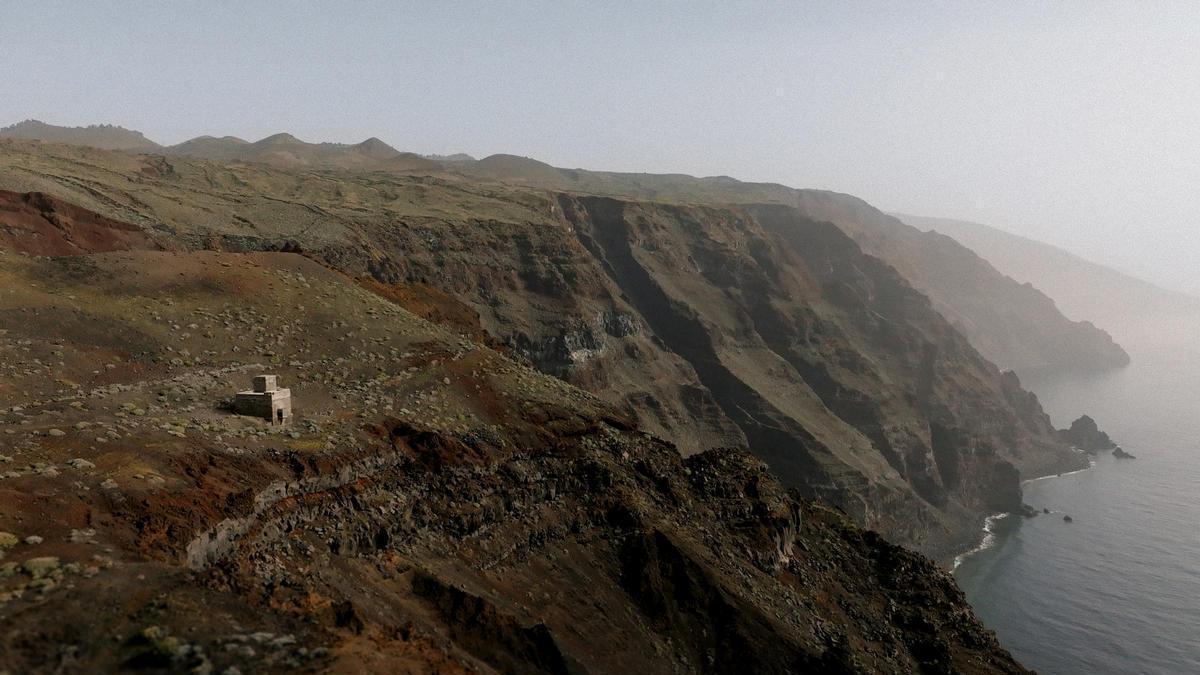
Staying at the Casa del Elevador is like standing at the end of the earth – a place where only you remain. Perched on a cliff on the enigmatic island of El Hierro, with no one else for miles around, there is no Wi-Fi, no television. You are connected only to nature, listening to the call of the shearwaters, the hum of the wind and the murmur of the sea. In this extraordinary lodging in the middle of nowhere, you even have time to imagine the sound of those eruptions – spanning thousands upon thousands of years – that sculpted this arid, vertiginous land, where the lava still feels hot. So unique is the experience that to enjoy it, you must send a letter – the old-fashioned way: by hand, through the post, with a stamp – detailing why you wish to spend a few days in this remote abyss.
What is the Casa del Elevador?
But what exactly is the Casa del Elevador? What is its origin? And whose idea was it? The Elevador is the story of Juan Casañas Morales and the island of El Hierro. He was a former miller, without a university education, now deceased, who decided to take on an impossible challenge. More than 70 years ago, he oversaw the construction of a small building to house the machinery needed to lift water from a natural spring at the bottom of a cliff, at a spot known as Playa Dulce. The goal was to supply water to the town of La Restinga. More than a feat of engineering, it represented an extraordinary example of perseverance, practical intelligence, survival and commitment to the common good – so typical of El Hierro’s history. It operated for a decade but was eventually abandoned and forgotten.
From ruin to refuge
Eight years ago, businessman and photographer Alberto del Hoyo, his wife Silvia Rodríguez, and a close friend, architect Alejandro Beautell – all residents of Tenerife – discovered this structure, characterised by its industrial simplicity, covering just 60 square metres and perched in a unique spot known as Iramas, one of the southernmost points in Europe. They set themselves a dream: to transform this ruin into a unique, contemporary lodging that reinterprets its original function and invites guests to experience introspection. After researching Juan Casañas’s feat and how he overcame countless obstacles to rescue this cubicle in such an inaccessible location, Alberto, Silvia and Alejandro became convinced it had to be restored and turned into something different.
“The idea arose from countless conversations,” explains Alberto del Hoyo. “We set out to honour Casañas’s achievement, to pay tribute to his descendants, and to celebrate all those people of El Hierro who, like him, built their identity from scarcity – and especially from the difficulty of accessing water.” That dream has now been realised. The elevator has become a space for reflection, a unique lodging with a philosophy that is intentionally antagonistic to commercialism – a form of rebellion.
“It’s not a business; it’s a space for contemplation – for observing silence, thought and time,” says Alberto del Hoyo. “Rather than offering comforts, it tries to recover something that is extraordinarily scarce today: the capacity to pay attention.”
Designed for contemplation
Every detail has been meticulously thought out, starting with the architecture of the interior renovation, very much in the style of its creator, Alejandro Beautell. The architect behind such iconic, award-winning works as the Hermitage of San Juan Bautista (El Hierro), the Church of San Miguel Arcángel (La Laguna) and the Casa de La Toscalera (Santa Cruz) has brought his minimalist, essentialist designs – integrated into the landscape and playing with light – to the Casa del Elevador. “Architecture happens in matter, not in form, and this project is an example of that,” explains Beautell. “Here we worked with very humble materials: concrete blocks eroded by time. And we treated them with respect, almost as if they were an archaeological remnant.”
The craftsmanship at the Elevador extends beyond architecture to the tableware, furniture, lighting and decoration. The project has involved Lorena Mazzola, a leather tanner; José Juan Sosa, a traditional knifemaker; Beatriz Ballester, a creator of woollen pieces; Octavio Barrera, a lighting designer; Pedro Paricio, a painter; as well as blacksmiths, carpenters, bricklayers, electricians, stonemasons and other local artisans. Everything is made in the Canary Islands.
Applying by letter
The owners place no specific requirements on the content of the letters required to book the accommodation. “The only thing we ask is that you write to us by hand,” specifies Alberto del Hoyo, who also runs another very special lodging, Hacienda de las Cuatro Ventanas, in the middle of a banana plantation in Los Realejos, Tenerife. “The only thing we value is the symbolic gesture of putting a letter in the postbox and the genuine interest in spending a few days in this house in La Restinga.”
The three people behind the initiative make clear this is not an easy place to stay. “The scenery is not what you might call gentle beauty – rather, it is rugged and abrupt,” warns Del Hoyo. “The wind blows strongly and everything is volcanic. You arrive via a dirt track, and the first impression is overwhelming, though full of authenticity.”
A tribute to El Hierro’s spirit
This rugged beauty is a metaphor for the history of El Hierro. According to Del Hoyo and Beautell, the lack of water defined daily life on the island for generations, shaping its agriculture, economy, settlements and the way people inhabited the land. They recall that this is an island that has learned to turn difficulty into character – with austerity, resilience and the ability to find charm in extreme conditions. “The Casa del Elevador tries to dignify precisely that way of understanding life,” Del Hoyo concludes.
What’s happening in the Canaries – straight to your phone
News, weather alerts and practical updates – direct from the islands, in English. We live here and know what’s going on – before the international media catch up. Everything lands on our WhatsApp channel – no middlemen, no algorithm. Curated for families, expats and travelers.

Tenerife faces huge tourism expansion despite moratorium calls
El Bejeque in Las Canteras adds sea to its fire

Siam Park Gran Canaria must build its own desalination plant

Fuerteventura’s biggest resort to open on 1 November
Gran Canaria to teach tourism history in schools
Canary Islands see 0.3% rise in foreign tourists in August

Row over 368-bed hotel project in La Gomera
Spanish astronaut trains in Lanzarote for Moon mission

Tivoli La Caleta hosts first red tuna Kaitai in Canarias