
Earthquake felt across islands
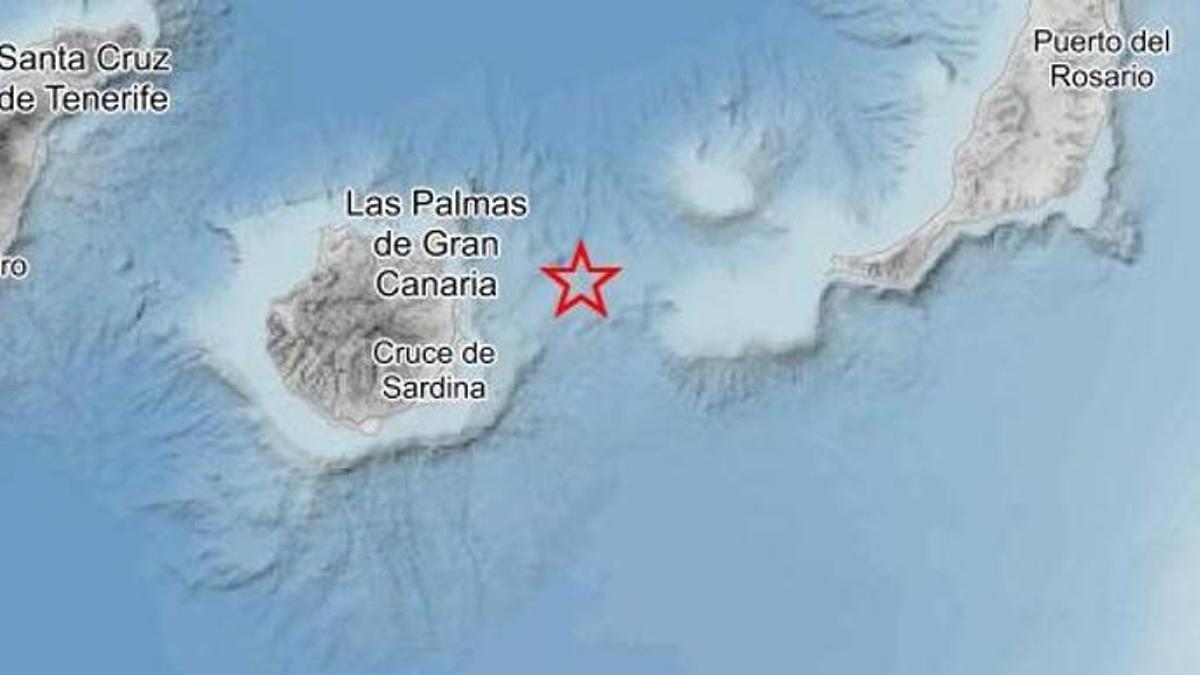
A magnitude 3.9 earthquake was recorded in the early hours of Tuesday, 30 June, off the east coast of Gran Canaria in the Atlantic, according to data from the National Geographic Institute (IGN). The tremor struck at 02:31 local time at a depth of 16 kilometres, with a maximum intensity of III — a level at which the movement is noticeable by the population, particularly when lying down or on upper floors of buildings.
Where the tremor was felt
The shaking was felt in various parts of Gran Canaria as well as in Fuerteventura, specifically in the municipality of Antigua, according to information released by the IGN. The seismic movement occurred in the early hours, a time of day when such phenomena tend to be more perceptible due to the background silence and because many people are at home. The IGN’s official records place the epicentre in the maritime area east of Gran Canaria.
The institute continuously updates information on recent earthquakes in the Canary Islands and warns that data may be subject to revision following further seismic analysis. A maximum intensity of III indicates that the earthquake may have been felt lightly by the population, though it is not normally associated with damage. In such events, some people may notice a vibration, a sudden jolt, or the movement of light objects, particularly if they are at rest.
Understanding magnitude and intensity
Magnitude measures the energy released by an earthquake, while intensity describes the effects observed on the surface and how it was perceived by the population. The Canary Islands frequently record low to moderate magnitude earthquakes. This activity is linked to the archipelago’s geological and volcanic context, situated on the African plate and made up of islands of volcanic origin. Most movements are of small magnitude and are only detected by the National Geographic Institute’s instrumental network.
Recent seismic activity in the Canary Islands
This Tuesday’s episode comes in a year when several earthquakes have brought renewed attention to seismic activity in the Canaries. On 22 May, another quake of magnitude 4.8 was recorded north of Gran Canaria and was felt by the population on several islands. That event was one of the most significant in the archipelago in recent years and generated numerous calls to emergency services, though no substantial damage was reported.
In February, a magnitude 4.1 earthquake was recorded between Tenerife and Gran Canaria, in an area of elevated seismic activity known around the Enmedio Volcano. This area, located between the two islands, is one of the zones where seismic activity is most frequently detected in the Canaries. Although its name refers to an underwater volcano, studies cited by the IGN have repeatedly pointed out that much of this seismicity could be related to tectonic structures or geological faults, and not necessarily to active volcanic processes.
In the case of Tuesday’s earthquake, the epicentre was located east of Gran Canaria and not in the channel between Gran Canaria and Tenerife, which means it should be distinguished from the episodes associated with the Enmedio Volcano area.
Expert analysis: normal activity for volcanic region
IGN experts have insisted in recent weeks that the recent seismic activity in the Canary Islands falls within the normal range for a volcanic territory. The occurrence of isolated earthquakes, even when felt by the population, does not in itself imply an imminent eruptive process. To identify a possible volcanic reactivation, specialists look at a combination of signals, not just a single seismic event: a sustained increase in the number of earthquakes, changes in the depth or location of events, ground deformation, variations in gas emissions, and other geophysical and geochemical parameters.
In eruptions such as those on La Palma in 2021 or El Hierro in 2011, the preceding activity was characterised by numerous seismic swarms and a clear evolution of several indicators. A 3.9 magnitude tremor like the one recorded on Tuesday may attract public attention, especially if perceived in the early hours of the morning, but it should be understood within the framework of the ordinary seismic monitoring maintained by the IGN in the archipelago.
What’s happening in the Canaries – straight to your phone
News, weather alerts and practical updates – direct from the islands, in English. We live here and know what’s going on – before the international media catch up. Everything lands on our WhatsApp channel – no middlemen, no algorithm. Curated for families, expats and travelers.

Canary Islands sea hits second-hottest year on record

Legal bid to halt tree felling in Santa Cruz’s La Salud

Fiesta del Charco: A journey through La Aldea’s past

Corralejo dunes power line set for removal

ULPGC launches 14 research projects at Las Canteras

TMT will never be built, says Canary Islands astrophysics chief

Pedro Duque: Canarias is the “ultimate dream” for rockets

Court blow to Tenerife motor circuit project
La Palma faces new volcanic risk planning deadline
