
Tenerife’s seismic week: microearthquake swarms under Teide
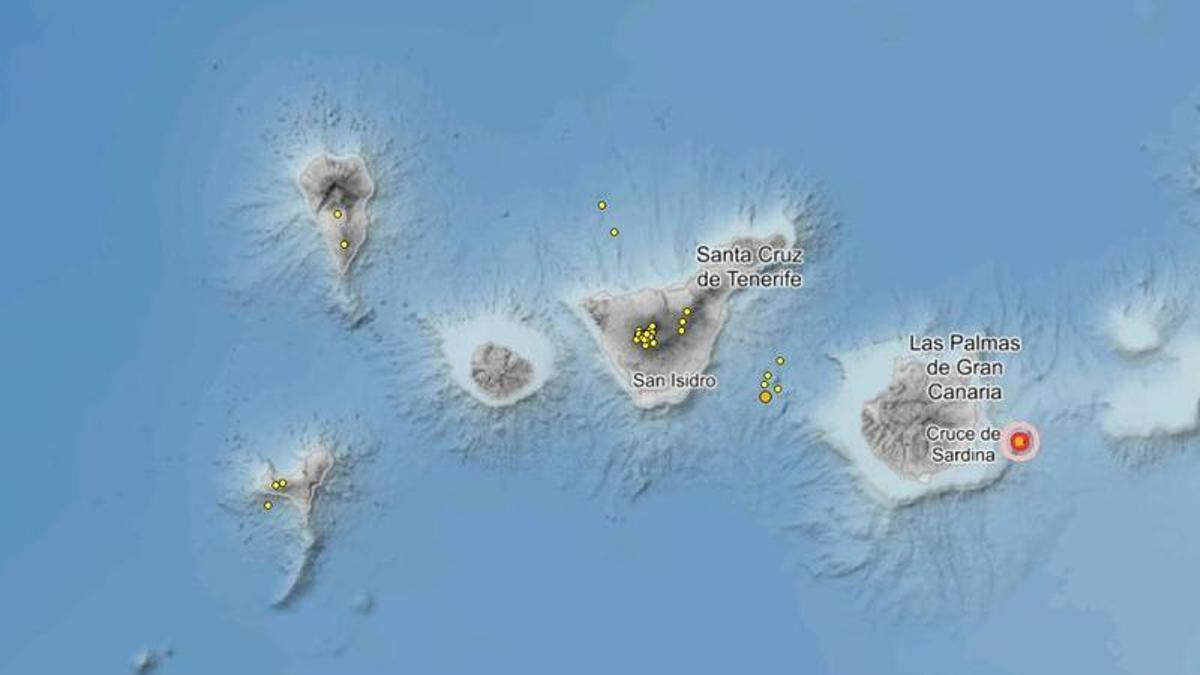
Tenerife has experienced a remarkably active week of seismic activity, with at least three swarms of microearthquakes detected beneath the slopes of Teide National Park. These are low-energy seismic pulses, but they have nonetheless surprised many residents on the island. The activity highlights the ongoing geological movements in the archipelago, which remains volcanically active.
Friday’s tremors concentrated in the south
A look at Friday’s data alone reveals that the ground beneath Tenerife has not stopped moving. Of the 12 earthquakes recorded by the National Geographic Institute (IGN) across the archipelago in the last few hours, 11 were located on the island. More specifically, the municipalities of Guía de Isora and Vilaflor have accounted for the majority of tremors, with just one recorded in another area: La Orotava.
All of these earthquakes were of low intensity, ranging between 0.3 and 1.2 magnitude. Of the 12 tremors recorded on Friday, only one had a magnitude above 2 (a 2.3), and it was the only one not registered in Tenerife. This quake occurred in the Atlantic Ocean, east of Gran Canaria, at 1:33pm local time.
Nearly 1,250 tremors in a week across the archipelago
The Canary Islands Volcanological Institute (Involcan) has registered a total of 1,248 low-magnitude earthquakes across the archipelago over the past week through its Canary Seismic Network. The highest recorded value of 2.7 was linked to a tremor that occurred last Sunday, 21 June, located approximately 60 kilometres northwest of Fuerteventura, according to its weekly report published via Guayota.
In that social media post, the institute clarified that the earthquakes have been located mainly on the islands of Tenerife, Gran Canaria, El Hierro and La Palma. “In La Palma, low-magnitude seismicity persists, but it remains much lower than the seismic activity observed during the 2021 eruption,” it noted.
Volcanic traffic lights: green for most, yellow for La Palma
Involcan also reminded the public that the volcanic traffic lights for Tenerife, El Hierro, Lanzarote and Gran Canaria are currently at green, meaning residents and visitors on these islands can go about their activities with complete normality.
However, more than four years after the eruption on La Palma ended, the island’s geophysical and geochemical parameters have not yet returned to normal. As a result, La Palma remains on yellow alert. This means residents and visitors must continue to pay attention to communications from civil protection authorities.
How to stay safe during an earthquake
Although the earthquakes occurring in the islands are not usually particularly strong, it is always wise to be prepared and know how to act in such a situation. To that end, the IGN offers a series of recommendations on what to do during an earthquake:
- Drop, cover under a table and hold on to it
- As far as possible, stay calm and keep your balance
- Indoors, move away from furniture, windows and light fixtures
- Outdoors, move away from buildings, walls and power poles
- If driving, stop in a safe place, turn on hazard lights and stay inside the vehicle
- If using a wheelchair, brake in a safe spot and protect your head with your arms
- If in a crowded venue, protect your head with your arms and shelter under seats or tables
What’s happening in the Canaries – straight to your phone
News, weather alerts and practical updates – direct from the islands, in English. We live here and know what’s going on – before the international media catch up. Everything lands on our WhatsApp channel – no middlemen, no algorithm. Curated for families, expats and travelers.

Canary Islands sea hits second-hottest year on record

Legal bid to halt tree felling in Santa Cruz’s La Salud

Fiesta del Charco: A journey through La Aldea’s past

Corralejo dunes power line set for removal

ULPGC launches 14 research projects at Las Canteras

TMT will never be built, says Canary Islands astrophysics chief

Pedro Duque: Canarias is the “ultimate dream” for rockets

Court blow to Tenerife motor circuit project
La Palma faces new volcanic risk planning deadline
