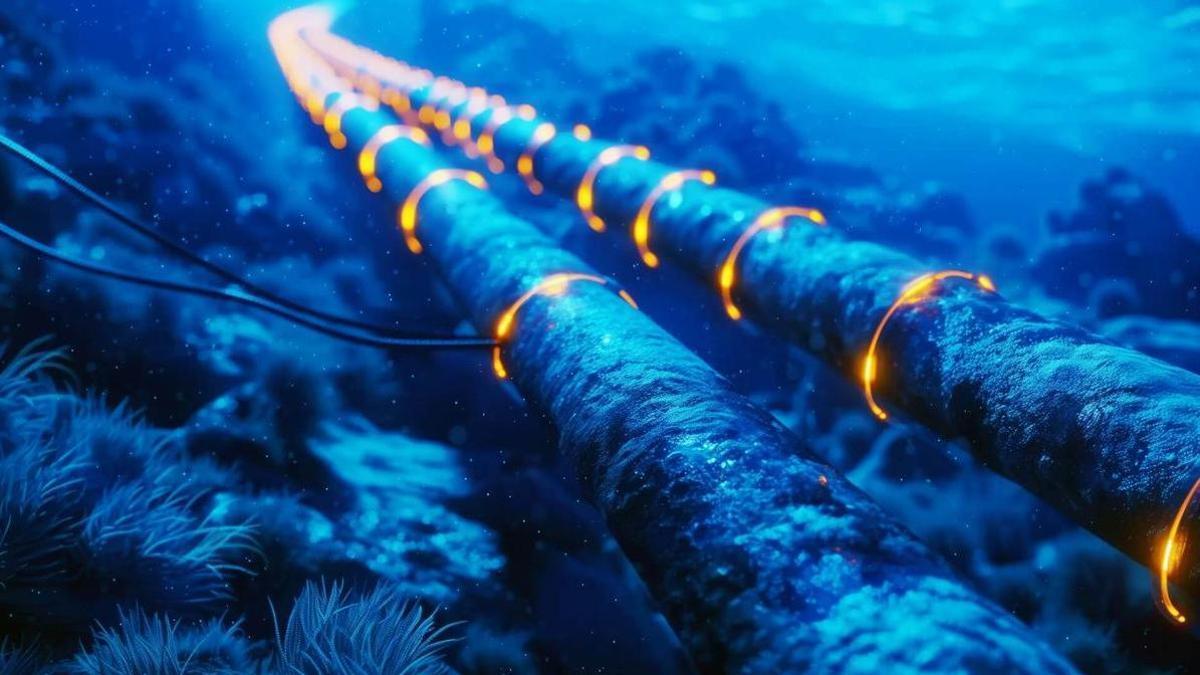
Russia’s ‘ghost fleet’ poses a grave threat to Canary Islands
The Canary Islands are at risk of Russian attacks on its submarine cables, which would cripple telecommunications and energy connections. This stark warning has just been issued by Spain’s National Security Department (DSN), the body that advises the Prime Minister.
“The protection of submarine cables is one of the main concerns regarding hybrid threats and their projection into maritime spaces, given the current security landscape,” the report states, pointing directly to the proliferation of Russian ships in waters around the Islands in recent months.
What are hybrid attacks?
Hybrid attacks are coordinated and synchronised actions that combine conventional (military) and unconventional methods (cyberattacks, disinformation, economic pressure, espionage) to destabilise a state or institution. Russia has been developing these tactics as part of the challenge it has launched against Europe following its invasion of Ukraine. The Canary Islands play a fundamental geostrategic role, placing them firmly in the sights of Putin’s regime.
Specifically, the DSN warns that in the past year, the presence of Russian ‘ghost ships’ “has quintupled” as they “transit through waters close to the Canary Islands’ coasts.” This fleet consists of hundreds of vessels operated by Russia to evade surveillance since sanctions limiting the price of Russian crude oil came into force in 2022. These sanctions were enacted by the United States, the United Kingdom and the European Union in response to the Russian invasion of Ukraine.
Monitoring a fivefold increase in suspicious vessels
The National Security Department admits that, in the face of this danger, the Maritime Action Operations and Surveillance Centre (COVAM) monitors such vessels, reporting an average of 50 per week, based on the list of ships sanctioned by the European Union. “The legal possibility of taking action against vessels of the ghost fleet at sea is a difficult issue to resolve,” the DSN acknowledges.
The Department stresses that the South Atlantic region has “a high concentration of submarine cables linking Portugal and Spain with West and Southern African countries.” In Spain’s case, “the cables connect the Iberian Peninsula with the Canary Islands and interconnect the islands themselves, with a total capacity of 6 terabits per second — a data transfer speed unit — and are owned by Canalink and Telefónica.”
Main risk scenarios and vulnerabilities
The report, which cites previous studies by the European Commission, outlines a series of key risk scenarios, including coordinated sabotage, power cuts, or disruptions to maintenance or supply capacity. It stresses that “the combination of threats, vulnerabilities and dependencies can cause serious disruptions to connectivity and the digital economy.”
The National Security Department also warns that these risks “are compounded” by strategic dependencies on suppliers and technologies from third countries (the United States, China, the United Kingdom, Russia); the concentration of traffic on critical routes and geographical points (such as the Canary Islands); a shortage of maintenance and repair capacity; and a lack of coordination and response plans between EU member states and the necessary cooperation with other states.
National security response and maritime infrastructure
At a national level, the DSN notes that in 2025, the Working Group for the Surveillance, Protection and Resilience of Maritime Infrastructures, which reports to the National Maritime Security Council, “has met on four occasions with two priority objectives: to produce a risk analysis of the 147 maritime infrastructures, particularly submarine ones, in areas of priority interest, and to define and develop a surveillance plan to guarantee their protection.”
The warnings for the Archipelago focus specifically on the threat from Russia’s ghost fleet. These are typically hydrocarbon transport vessels that engage in ship-to-ship transfers (from smaller to larger vessels) of crude oil and refined products of Russian origin, as well as Venezuelan and Iranian, which are then transported to Asian countries. However, according to the report seen by EL DÍA, some of these vessels have the capacity to be used for “illicit activities or even acts of sabotage against critical infrastructure.”
For this reason, the DSN clarifies, “the State Security Forces and Corps are intensifying surveillance of sensitive areas using their naval capabilities, such as submarine gas pipelines, ports and anchorage areas, employing systems such as SIVE, coastal sensors and ocean patrols, in addition to cooperating with the Navy and the European Maritime Safety Agency (EMSA) in identifying ghost fleets and controlling anomalous maritime traffic.”
Fuel laundering through Morocco and calls at Gran Canaria
In February, this newspaper reported that a complex international network was laundering fuel from Russia — banned in the European Union — in waters of the Archipelago or near the Islands, involving Morocco, with a logistical branch in the Canary Islands. The Paxoi, two other very similar tankers — the Kefalonia and the Naxos II — and the medium-range oil tanker Jessie Glory have called at the port of Las Palmas de Gran Canaria 14 times in the last two years on voyages serving the same purpose within the supply chain that Russia uses to smuggle fuel into Spain and other European countries via Morocco. Russia unloads diesel at Moroccan ports, Morocco then sells it on as its own to Spain, and the Russian fuel circulates through the Islands and the mainland.
The newspaper also reported that the Spanish government and the European Maritime Safety Agency (EMSA) are using satellites to monitor the vessels of the Russian ‘dark fleet’ sailing in waters near the Canary Islands. Their traffic has intensified in recent months as a result of the blockade they are facing from US warships in the Caribbean and near Venezuela. Specifically, the measures being implemented include tracking oil tankers involved in the transfer of hydrocarbons in maritime areas located in the Alboran Sea and the Canary Islands.
A complex network of submarine cables linking the islands
The Canary Islands have a complex network of more than 20 submarine fibre-optic and electrical connection cables that link the islands with each other and with the outside world (the mainland, Africa and Europe), with notable systems such as 2Africa, ACE and WACS. In addition, there are multiple inter-island connections (such as Tegopa and Canalink) and new power cables, such as the one recently brought into service between Tenerife and La Gomera to protect these islands from the risk of blackouts like those that have occurred in recent years. Sabotage to these connections would have extremely serious consequences for the Archipelago, which is why Spain has stepped up surveillance of Canarian waters, especially the suspicious movements of the Russian ghost fleet.
Canalink expansion and strategic protection measures
Canalink presented an ambitious expansion plan in November that will involve investments totalling 70 million euros — 69.8 million to be precise. The company, which is owned by the Cabildo of Tenerife and acts as a ‘neutral telecoms operator’ — a firm that builds and maintains a network of connections, in this case submarine connections, for use by other telephone and internet companies — has set itself two main goals: strengthening its infrastructure, that is, the cables that run along the seabed to connect the islands (and the islands with Africa and Europe), and expanding its activity in the province of Las Palmas. This action plan will be implemented through three major projects: the deployment of a new cable between Tenerife and El Hierro; the laying of two more between Gran Canaria, Fuerteventura and Lanzarote; and a branch to connect with Tarfaya in Morocco.
In short, new connections, new cabling, more competition between operators and greater security in the telecommunications network will ultimately help to prevent ‘blackouts’ in the system and, therefore, to some extent alleviate the technological emergency declared by the Government of the Canary Islands last 1 July — the declaration is initially in force until the end of the year.
The strategic importance of this network linking the Islands to the world, and the danger of Russian pirate attacks, has led the National Security Department to advocate new measures to reinforce control of these critical infrastructures in a context of great international conflict, which has been aggravated by the war between the United States and Israel against Iran, currently subject to a very fragile truce that could collapse at any moment.
What’s happening in the Canaries – straight to your phone
News, weather alerts and practical updates – direct from the islands, in English. We live here and know what’s going on – before the international media catch up. Everything lands on our WhatsApp channel – no middlemen, no algorithm. Curated for families, expats and travelers.

Work on TF-5 third lane between Guamasa and Los Rodeos to start in November
Canary Islands international air arrivals fall 1.3% in September

Helicopter evacuates US cruise passenger near Tenerife

El Hierro airport sees 3.6% rise in September passengers
Gran Canaria approves €509k works to shore up GC-200 slope

Canary Islands gets €47.5m for free public transport in 2026
Canary Islands airports see 0.9% fall in September passengers
El Rejo road in La Gomera to close for six hours on Tuesday

Man, 65, seriously injured in GC-1 crash in Agüimes