Journalist breaks silence on 209-day ordeal
Four months after the night he was freed from El Rodeo maximum security prison – and personally handed over to the Spanish Embassy in Caracas by Minister Diosdado Cabello, alongside four other Spaniards – Canarian journalist Miguel Moreno maintains that Venezuela kidnapped him and used him as a political hostage. The 34-year-old had until now chosen not to speak about how the Bolivarian Navy seized the Panamanian-flagged, Dutch-captained vessel he was working on, which was dedicated to searching for shipwrecks, nor about his 209 days in captivity. He remained silent until all his companions were freed, to avoid harming them.
Seized in international waters
In an interview with EFE, he breaks his silence to denounce that the nine crew members of the vessel N35 were captured on 11 June 2025 without cause in international waters, kidnapped, and successively accused of spying for Guyana, searching for oil deposits in Venezuelan waters, and collaborating with drug traffickers. None of these charges were ever substantiated. After six days on Isla Margarita, where they were interrogated by the Directorate General of Military Counterintelligence (DGCIM), they were taken to the state of Miranda, to the El Rodeo prison, and a month later were brought before a judge to hear the charges against them.
These were: terrorism, financing of terrorism, association for the purpose of terrorism, and an attack on the sovereignty of Venezuela – the same charges that appear on the document with which Moreno left prison and entered the embassy, accompanied by Andrés Martínez, José María Basoa, Ernesto Gorbe, and Rocío San Miguel, the other Spanish prisoners. “We’re clean with Interpol, but in the eyes of the Venezuelan system we’re still terrorists,” he says.
Life still on hold after release
The Canarian journalist has not yet fully returned to his former life. He has not recovered his job, and Venezuela has not returned the vessel. He now gives tennis lessons and helps his family, but has been forced to change his phone number, his WhatsApp, and even his bank accounts, because, he claims, the Venezuelan secret service was digging into his identity. Worse still, his mind returns him to El Rodeo more often than he would wish. “I think: right now they’re having three hours of loud music, now they’ll be in the yard for their 45 minutes, now they’re eating… You continue with the routine you had there. The hardest moment is when the cell door closes,” he recalls.
A ‘shoe box’ cell with cockroaches and mosquitoes
During his nearly seven months in El Rodeo, Miguel Moreno lived in a cubbyhole measuring 1.80 by 3.50 metres, where, if he stretched out his arms, he touched the walls. Shared with another prisoner, poorly ventilated, with mattresses on the floor and a hole in the ground for toilet needs. “If you want to see the corridor, you have to bend down to look through a hole in the door. It’s horrible to peer through and see, in the few cells you can make out, people peering back like you, who have been there for months. When you hear the padlock behind you, it’s devastating. You realise you’ve reached the final stop, that they’ve put you in that shoe box until they decide to let you out,” he recounts.
The conditions were miserable, he stresses: cockroaches and mosquitoes wreaked havoc. They were taken to the yard for 45 to 60 minutes daily, from Monday to Thursday only. In the cell, no distractions, nothing to read, barely a Bible. That was for the foreigners, he explains, who were “high-status hostages”, but for the Venezuelans there was a separate place, “an even deeper hole”.
Survival through exercise and mental discipline
In the first days, Moreno was overwhelmed by the shock of confinement, losing weight and muscle mass. Until he understood he had to maintain his exercise if he wanted to avoid ending up “like a bedridden patient”, and also to stay focused and strong of mind. “Many fell into depression. There were suicide attempts every two weeks. Some even tried to throw themselves headfirst from the bunk bed. If you thought about the suffering of the people waiting for you outside, it affected you. It was better to set that aside and focus only on what depended on you,” he says.
Moreno was twice locked up naked and handcuffed in punishment cells for going on hunger strike to demand a phone call. He says he did not falter during either of them, but admits he nearly broke down afterwards when he heard his mother’s voice on the phone, once they were finally allowed to speak.
Eavesdropping on a coup from behind bars
In El Rodeo, prisoners are isolated from what is happening in the world; they only receive news brought by new arrivals and official propaganda broadcast over the prison loudspeakers. From the programmes of Maduro and Cabello (‘Con Maduro Más’ and ‘Con el Mazo Dando’), they began to sense that something serious was happening or about to happen with the United States – a military crisis. In reality, explains the journalist, they were reading between the lines, perceiving a shift from the early resistance speeches of the ruling party to Maduro’s final addresses defining Venezuela as “a nation of peace”. “I would listen to that and think to myself: mate, I’m no longer a political prisoner, I’m a prisoner of war. This country is at war. They’re sinking ships in the east. These people are talking about war,” he recounts.
War did not come, but a lightning military operation did, in the early hours of 3 January, capturing Maduro and taking him to New York. In El Rodeo, they experienced first-hand what was happening in the form of the noise of planes and helicopters flying over the prison all night, but they did not learn the details until two days later. On 8 January 2026, the Spaniards had their heads shaved and were released.
‘A political hostage, used for I don’t know what’
“I was a political hostage, used for I don’t know what. To this day, many people stop me in the street and ask: you, who set you free? Trump [the US president] or Zapatero [the former Spanish president]? And I don’t know. I also don’t know why I ended up a prisoner, nor what negotiations took place, nor how important we were to whoever. But there came a point, after Maduro’s capture, when they started releasing all the internationals in bulk,” he notes.
Criticism of Spanish and European governments
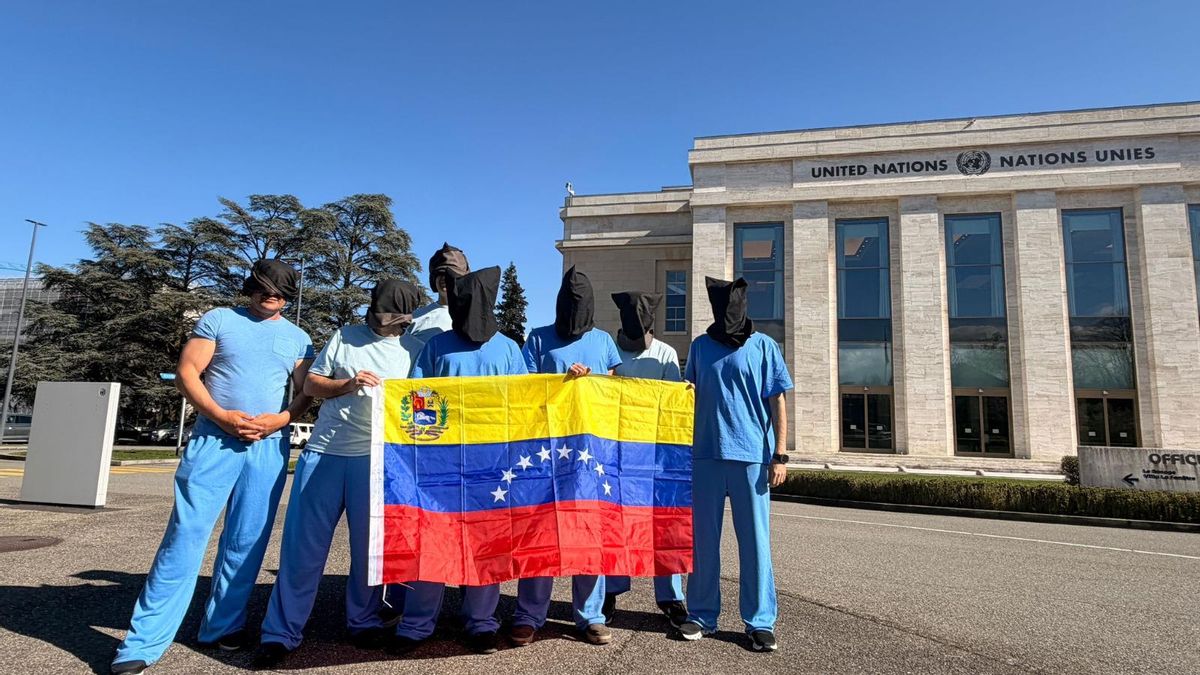
Now that he is back home, he has a collective reproach for all the governments of the released Europeans, including Spain’s: he believes they have not taken proper care of them. “Since we are neither guilty nor anything, we are in limbo; they are not going to help us reintegrate,” he laments, as he shows a photo of former fellow inmates protesting outside the UN headquarters in Geneva, hooded, just as they were when being transferred. “It is as if what happened to us never existed. I understand this is not a routine occurrence, but that is no excuse for the entire state to wash its hands of us and for us not to have received any kind of support from them,” he argues.
What’s happening in the Canaries – straight to your phone
News, weather alerts and practical updates – direct from the islands, in English. We live here and know what’s going on – before the international media catch up. Everything lands on our WhatsApp channel – no middlemen, no algorithm. Curated for families, expats and travelers.

Two tonnes of illegal tropical fruit seized at Tenerife port
Canary Islands approves new €1.6bn development fund
Mogán mayor says her €65,000 salary is too low
Abandoned cars in Canary Islands: hundreds left to rot
Work resumes on 27 affordable rental homes in Las Palmas
Los Realejos residents fight on against propane gas plant
Canarias among Spain’s poorest regions as 36.2% live on low incomes
Canary Islands bananas lose ground to imported bananas
Canary Islands bottom of Spain’s social housing table