
Cosmic Engine Runs Out of Fuel
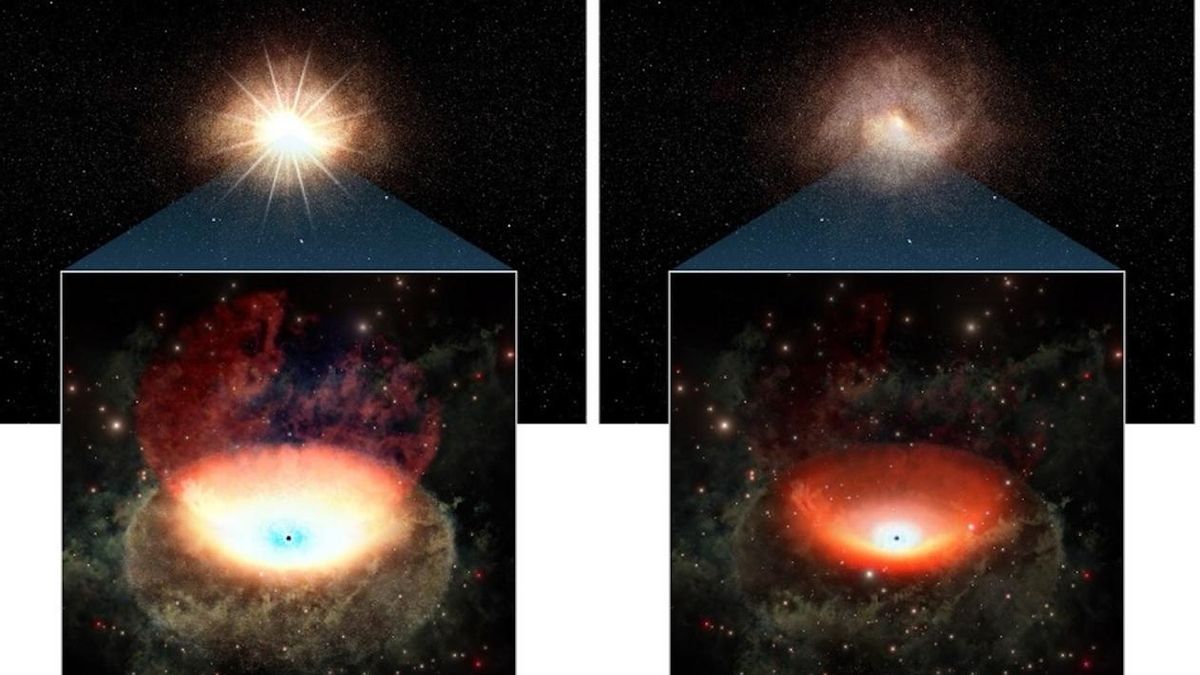
An international scientific team, including researchers from the Instituto de Astrofísica de Canarias (IAC) and the Gran Telescopio Canarias (GTC), has observed a drastic change in a supermassive black hole. Located some 10 billion light-years away, the object dimmed to roughly one-twentieth of its former brightness in just two decades—an extraordinarily short interval on a cosmic scale, the IAC explains.
Collaborative Discovery From La Palma
The discovery was made as part of a collaborative observation project integrating Japan’s Subaru telescope and the GTC at the Roque de los Muchachos Observatory on La Palma, alongside contributions from other observatories worldwide. By combining wide-field surveys of the sky with detailed follow-up observations, the team was able to reconstruct how the activity of this distant black hole evolved over time.
Challenging Decades of Assumptions
At the centre of many galaxies lie supermassive black holes with masses millions or even billions of times that of our Sun. When vast amounts of gas fall towards them, the material forms a hot, rotating disc that shines intensely across the Universe. These luminous regions are known as active galactic nuclei. For decades, it was believed these active phases lasted hundreds of thousands or even millions of years—a period far too long to observe significant changes within a human lifetime. The new observations challenge that view.
“It is as if a powerful cosmic engine suddenly started to run out of fuel,” explains Tomoki Morokuma, a researcher from Chiba Institute of Technology in Japan who led the study. “We are seeing solid evidence that the flow of gas feeding the black hole decreased very rapidly,” he adds.
A Fundamental Change, Not a Fluctuation
Active black holes often show small fluctuations in brightness, and some systems dominated by powerful jets can vary drastically over short periods. However, the new observations reveal a fundamentally different phenomenon. Using data spanning from optical and infrared light to radio and X-ray observations, the team found the dimming could not be explained by dust temporarily blocking the view or by changes in jet emission. Instead, the evidence indicates the accretion disc itself—the structure where gas spirals inwards before falling into the black hole—weakened significantly.
The team estimates the rate at which matter was flowing into the black hole may have decreased by up to fiftyfold in just a few years in the object’s own frame of reference. Such a rapid intrinsic change suggests a major disruption in the gas supply reaching the galaxy’s centre.
Decades of Data Reveal the Truth
Detecting this exceptional phenomenon required comparing observations separated by decades. Wide-field images from the Subaru telescope allowed the team to first identify this unusual object by contrasting recent data with earlier observations, including those from the Sloan Digital Sky Survey. Follow-up observations with the GTC, the world’s largest optical and infrared telescope, provided crucial measurements needed to understand how the black hole’s environment was evolving.
“The data from the GTC’s infrared observations were key to demonstrating that the entire central engine was fading, not just a part of it,” states Nieves Castro Rodríguez, an astronomer at the GTC and co-author of the paper. With the complementary technical capabilities of several observatories, the team reconstructed the system’s long-term history and ruled out other possible explanations.
A New, Dynamic Picture of Black Holes
In recent years, it has begun to emerge that some active black holes can undergo surprisingly rapid transformations. Previous studies have revealed drastic changes in nearby active galaxies, suggesting the growth of supermassive black holes could be far more dynamic than once believed.
“We used to think that supermassive black holes only changed over extremely long timescales,” says José Acosta Pulido, an IAC researcher and co-author of the article. “But this discovery, along with some prior findings on the very few active galactic nuclei that change appearance, suggests some of them can alternate between active and quiet states in just a few years,” he highlights.
The Future of Cosmic Discovery
Wide-field surveys, which capture vast areas of the sky at once, have become a fundamental approach in modern optical astronomy. This study demonstrates how combining data from different epochs and wavelengths can reveal long-term changes in galactic nuclei that would otherwise remain hidden.
With instruments like Subaru’s Hyper Suprime-Cam and future high-sensitivity surveys such as the Vera C. Rubin Observatory (LSST), Euclid, and NASA’s Nancy Grace Roman Space Telescope, many more active galactic nuclei in low-activity or even switched-off states are expected to be discovered. Statistical studies of such objects will help reveal the physical conditions under which the gas supply to supermassive black holes stops or resumes, offering a new perspective on how these cosmic giants grow and influence their host galaxies.
At the same time, developing new theoretical models capable of explaining the rapid changes observed in this study remains a significant challenge for astrophysicists. Toshihiro Kawaguchi of the University of Toyama, who contributed primarily to the theoretical interpretation, explains: “This object shows changes too rapid to be explained by standard models, and it will serve as a benchmark when developing new theoretical frameworks. We will investigate what physical conditions can reproduce the observed data.”
Each new discovery brings scientists closer to answering one of the fundamental questions of modern astronomy: how the Universe’s largest black holes grow and how they stop.
What’s happening in the Canaries – straight to your phone
News, weather alerts and practical updates – direct from the islands, in English. We live here and know what’s going on – before the international media catch up. Everything lands on our WhatsApp channel – no middlemen, no algorithm. Curated for families, expats and travelers.

Canary Islands sea hits second-hottest year on record

Legal bid to halt tree felling in Santa Cruz’s La Salud

Fiesta del Charco: A journey through La Aldea’s past

Corralejo dunes power line set for removal

ULPGC launches 14 research projects at Las Canteras

TMT will never be built, says Canary Islands astrophysics chief

Pedro Duque: Canarias is the “ultimate dream” for rockets

Court blow to Tenerife motor circuit project
La Palma faces new volcanic risk planning deadline
