Medical Innovation in Tenerife Cuts Costs by 97%
The Hospital Universitario Nuestra Señora de La Candelaria in Tenerife has found a formula to guarantee personalised, efficient healthcare while achieving major economic savings. In coordination with the IT department, the hospital is using a 3D printer to fabricate mechanotherapy tools for a fraction of the usual cost. While ordering a batch of such pieces costs around €2,316, producing them on-site reduces the cost to just €56 – a saving of 97.6%.
Personalised Rehabilitation for Hand Injuries
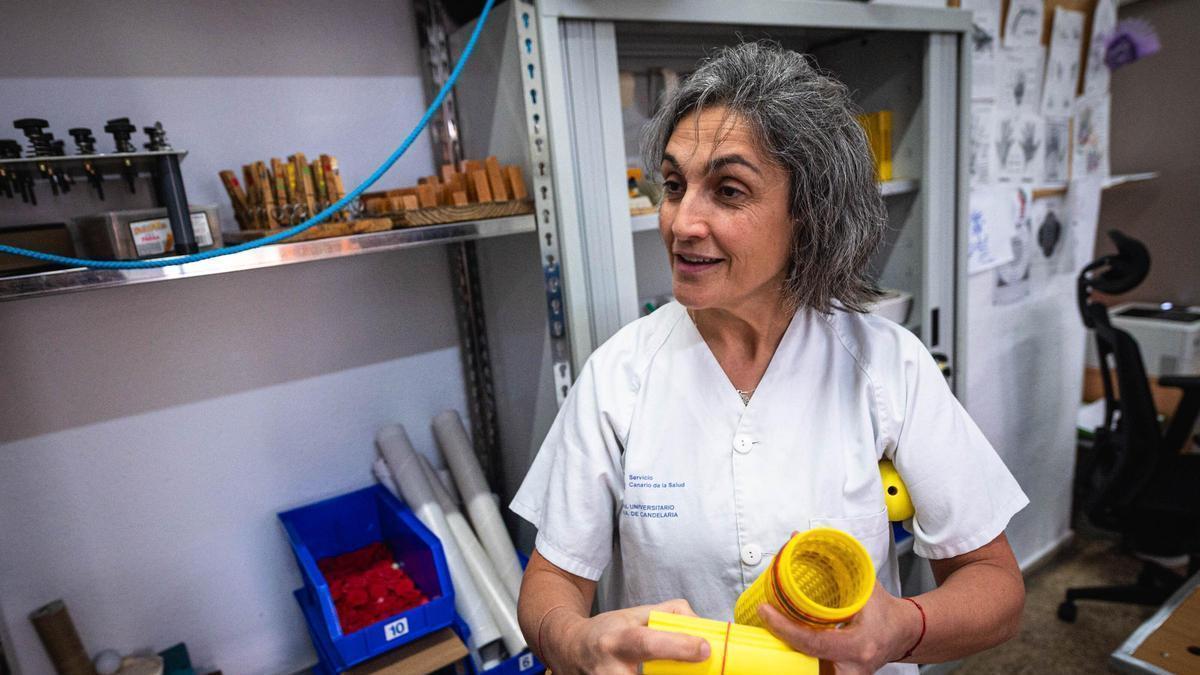
Since this creation method was implemented, the hospital has produced about 12 models and nearly thirty individual pieces. The tools are designed to aid the rehabilitation of patients with hand traumatology, such as tendon ruptures or metacarpal fractures, and limited mobility. “These are people who need to regain functionality and require mechanotherapy tools,” explains Teresa Fernández, an occupational therapist at the hospital.
While standardised, copyrighted rehabilitation equipment already exists and cannot be replicated due to patent laws, the team at La Candelaria creates adapted versions of these products tailored to each individual patient. “With the 3D printer, we have the opportunity to adjust each piece to the patient’s particularities and improve on the original moulds,” adds Fernández.
Improving on Standard Designs
One example is the Canadian board, a standard instrument for treating injuries to the hand, wrist, forearm, and elbow. It is a perforated board with interchangeable pegs that isolate movements, improve mobility, and increase strength after injury. “Despite all its advantages, it is a rigid and not very versatile tool,” notes the therapist. The team has designed several models that allow them to be more precise with the tension force exerted by the patient, as each design is adjusted to the ideal measurements of the person who will use it.
“The original board is quite large, and some patients only need to work on one part of the hand, like a finger, so a small, manageable replica is more convenient,” she mentions. La Candelaria is the only centre in the Canary Islands that personalises and manufactures pieces in this way.
Boosting Patient Capacity
This fabrication system not only saves money and personalises healthcare but also increases the capacity of healthcare professionals. “By having so many pieces, which are cheap to manufacture and very efficient, we don’t depend on a limited number of resources and can attend to more patients,” indicates Fernández. Previously, she worked with an average of seven to nine patients per day. “I had one patient every half hour, but now I have up to three and see about 12 or 15 people per day,” she specifies.
From Idea to Reality: The Technical Process
This ingenuity would have come to nothing without the technical engineers from the IT service. “I explain what I would like to work on, based on my patients’ needs, and they are responsible for materialising the idea I have in mind,” she details. The procedure is simple: they receive a work order, visit the Occupational Therapy area to understand the idea, design a prototype, and produce it where possible.
Fabrication times, however, are more complex. “Making one of the boards used in occupational therapy can take 18 hours,” points out Carlos Yanes, a technical engineer at the hospital. Other smaller pieces – like cylinders – can take five. The duration always depends on the particularities of each tool.
Beyond Therapy: Maintaining Hospital Equipment
In addition to pieces for occupational therapy, the technicians create other maintenance parts – provided they do not maintain direct contact with the patient and have no safety functionality. “They are usually cosmetic trims and elements that are no longer manufactured,” notes Yanes. For example, some of the hospital’s shower trays require discontinued 40-millimetre valves. “We manufacture them and not only save money on the price of the part, but we also avoid major construction work with a simple solution,” he explains. Even old hospital beds that need a specific part can continue to be used thanks to 3D printing.
A National Database for the Future
The team has ambitious plans for the future. “We even have in mind creating a national database with the different prototypes we have manufactured, with the aim of serving as a reference for any hospital in Spain,” says the section head, Alejandro Estévez. For now, this 3D fabrication method is only applied to hand therapy. However, staff do not rule out extrapolating its use to other healthcare services with similar demands in the future. In fact, last week they acquired a new three-dimensional printer which will allow them to optimise their work further.

Two tonnes of illegal tropical fruit seized at Tenerife port

Canary Islands approves new €1.6bn development fund

Mogán mayor says her €65,000 salary is too low
Abandoned cars in Canary Islands: hundreds left to rot
Work resumes on 27 affordable rental homes in Las Palmas
Los Realejos residents fight on against propane gas plant
Canarias among Spain’s poorest regions as 36.2% live on low incomes

Canary Islands bananas lose ground to imported bananas
Canary Islands bottom of Spain’s social housing table