
Legal Vacuum Allows Quarry to Operate in Protected Bird Zone
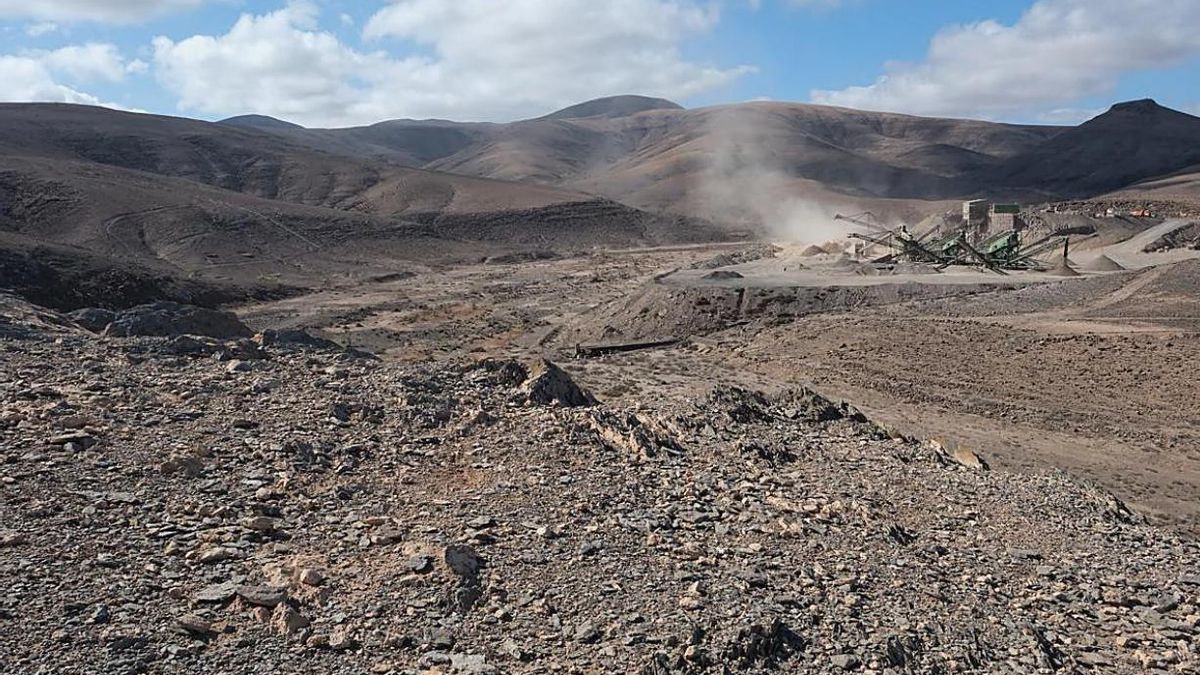
A 21-year legal vacuum has enabled the Fuerteventura-based company Transportes Pablo de León to keep alive a project to extract aggregates within a Special Protection Area for Birds (ZEPA), specifically the ‘Llanos y cuchillos de Antigua’ in the east of the island. This area was declared to preserve the habitat of threatened and migratory species such as the Egyptian vulture, the houbara bustard, the Canary Islands stonechat, and the cream-coloured courser. Despite the Canary Islands Government proposing its inclusion in the European network of protected spaces in 2001, it was not until 2022 that a decree was approved giving legal validity to this ZEPA and all others in the archipelago.
This gap of over two decades allowed the company, which has been operating in the zone since the late 20th century, to partly escape a crime against land use planning and the environment, for which it was accused by the Public Prosecutor’s Office. It also led to the reopening of the environmental assessment file for a basalt quarry project—the company’s latest attempt to obtain a licence.
Environmental Assessment Underway Amidst Protection Concerns
The Regional Ministry for Ecological Transition and Energy is currently evaluating the possible impact of the industrial activity, taking into account its location within the ‘Llanos y cuchillos de Antigua’ ZEPA, which covers some 9,906 hectares. Sources within the department state that it is impossible to predict the outcome of the Environmental Impact Statement (DIA)—whether it will be favourable to the initiative or not. However, they emphasise that the area’s designated bird protection status cannot be ignored.
Transportes Pablo de León, for its part, is convinced that the ZEPA “does not prohibit, it only limits”. According to their version, although the regional government’s environmental professionals “say no to everything in order to do nothing”, in this case “they can no longer do so”. The firm argues that the courts sided with them by considering the operation legalisable and that they must be granted a licence for all their activities there, including the quarry.
Company Cites Jobs and Legal Victories
The company hopes this “terrible and harsh process”, which it claims led to the death of its founder, Pablo de León, due to “pressure and contempt”, will not be prolonged further. “The survival of the company is basic for the maintenance of 40 workers and their families,” they stress.
The firm has indeed secured victories in at least two recent court proceedings. In the first, it managed to reopen the environmental assessment file for its quarry proposal (October 2024). In the second, it was acquitted of two crimes: one against land use planning and another against the environment (March 2025). The Public Prosecutor had sought a five-year fine, the closure of the facilities for a total of eight years, and the removal or demolition of the works.
Complex History of Authorisations and Operations
The charges related to the alleged alteration of the physical landscape through a series of construction, extraction, and mining actions between 2000 and 2017 in the area known as Llano de las Goteras. Aerial photo analysis by the environmental police (Seprona) from 1984 to 2017 documented changes to the terrain from natural resource extraction.
The company did have authorisation for a crushing and classification plant for aggregates, a concrete plant, an asphalt plant, and a diesel depot. However, according to the Guardia Civil, it lacked the necessary mining permit for extracting aggregates from the zone, for two water catchments, and for waste management. Technicians from the Canary Agency for Natural Environment Protection argued the company lacked the necessary operating permits and that the land was within a protected space.
A 2018 site visit documented a dense cloud of suspended dust from the operation, leaving vegetation and rocks “completely covered in dust”. However, no specific disturbance to fauna, particularly birds, was detected. When Seprona officers visited between 2017 and 2020, they observed no recent stone extraction activity on the hillside itself. Authorised machinery (asphalt and concrete plants) was still operating, but workers were processing material trucked in from another installation in La Oliva, in the north of Fuerteventura.
Court Acquittal Based on Lack of Official ZEPA Status
The Criminal Court Number 2 of Puerto del Rosario acquitted the company because it considered it proven that the ‘Llanos y cuchillos de Antigua’ ZEPA had no legal existence between 2000 and 2017, as the Canary Islands Government had neither approved nor published it in the Official Bulletin of the Canary Islands (BOC). With no ZEPA, the land was classified as common rustic soil.
The ruling clarifies that Supreme Court jurisprudence establishes that for a conviction on a territorial crime, the construction must be completely illegal. However, as aggregate extraction on that land can be authorised if a favourable DIA is obtained, doing so without a permit could only lead to administrative sanctions. Regarding the environmental crime, the judge labelled the prosecution’s report as “generic and inconclusive”, stating a before-and-after study of the quarry’s installation was needed to determine its impact on local flora and fauna—a report which was not provided.
Long Road of Appeals and the Final Hurdle
The company admitted in court it had no authorisation for the quarry, which is why it applied for one in 2018. However, the Regional Vice-Ministry for the Fight Against Climate Change halted the process in April 2020, arguing the extraction fully affected the Antigua ZEPA and would damage the natural space’s integrity. The company appealed.
The Administrative Chamber of the High Court of Justice of the Canary Islands (TSJC) sided with the company, concluding the regional government had relied on a Bird Protection Zone that, at the time of the project’s rejection, had not been officially declared or published. A public official had noted as far back as 2005 that no resolution proposing the ZEPA was on record. The high court annulled the government’s resolution and ordered it to reopen the file in October 2024.
A year later, in October 2025, the TSJC upheld the decree declaring the archipelago’s ZEPAs by dismissing another appeal from Transportes Pablo de León, which sought the removal of the Antigua zone from the official list of protected spaces. The company argued the government included it without having previously designated and delimited it. The TSJC certified that the designation, with its surface area and perimeter, was sent to the State in November 2001, and was therefore already designated. The court ordered the company to pay legal costs, capped at €1,500. The company has told this newspaper it will not appeal further as “according to the lawyers, there is nothing to be done on this matter.” The final word on the basalt quarry now rests with the environmental body of the Canary Islands Government.

Canary Islands sea hits second-hottest year on record

Legal bid to halt tree felling in Santa Cruz’s La Salud

Fiesta del Charco: A journey through La Aldea’s past

Corralejo dunes power line set for removal

ULPGC launches 14 research projects at Las Canteras

TMT will never be built, says Canary Islands astrophysics chief

Pedro Duque: Canarias is the “ultimate dream” for rockets

Court blow to Tenerife motor circuit project
La Palma faces new volcanic risk planning deadline
