
Compiled with the help of artificial intelligence, based on Spanish-language information. Source below the article.
Floating banner protest off Tenerife’s coast
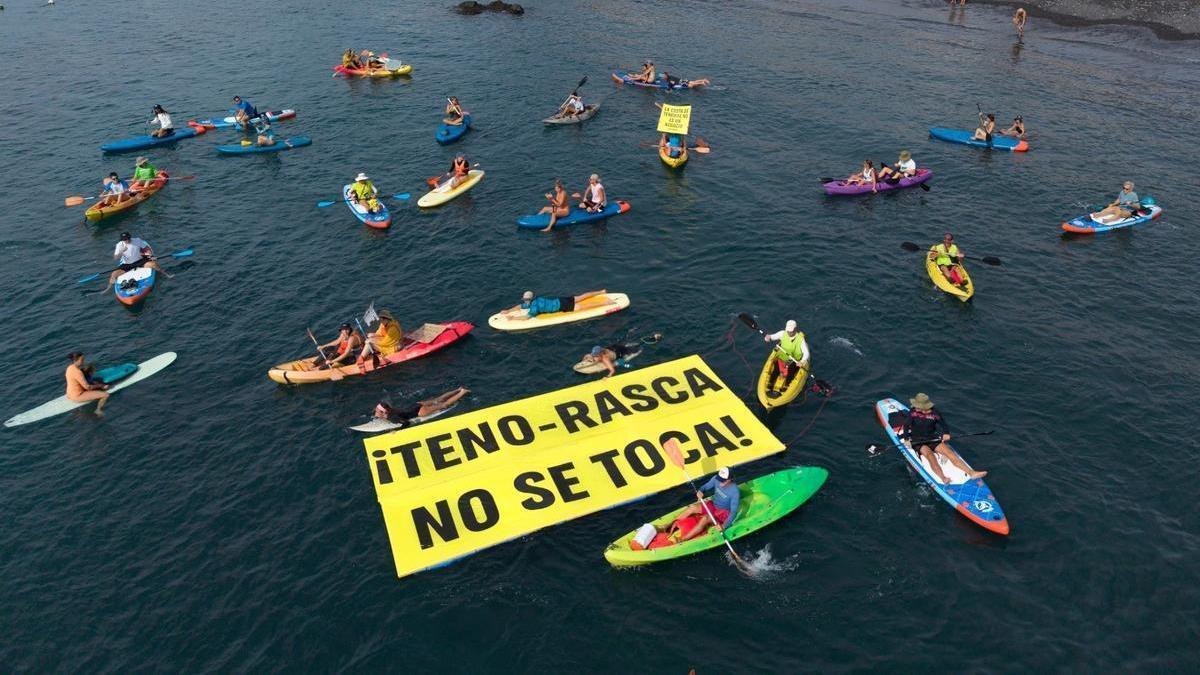
Environmental organisations deployed a floating banner at sea this Saturday bearing the slogan “¡Teno-Rasca no se toca!” (“Hands off Teno-Rasca!”) to demand “effective protection” for the Franja Marina Teno-Rasca Special Area of Conservation (ZEC), in the face of “a multitude of tourism and urban development projects that threaten the island’s south coast”.
The banner was surrounded by around 50 kayaks, paddleboards and surfboards, while more than a hundred people are reported to have gathered on land. The demonstration was organised by Abeque, ADNT, ATAN, Canarias tiene un límite, Greenpeace, Ben Magec-EeA, Coordinadora El Rincón-EeA, Salvar El Puertito, Salvar Salvar Fonsalía and Salvar Punta Blanca, according to a statement issued by the ‘Canarias tiene un límite’ platform.
A site of exceptional biological importance
The Franja Marina Teno-Rasca, which takes in the entire south-west coast of Tenerife, is one of the most biologically and geologically significant areas in the Canary Islands and across the European Union as a whole. “This unique corner of the Natura 2000 network,” the groups stress, “is home to sandbanks, seagrass meadows, marine caves and many endangered species, such as sea turtles. It is also Europe’s first Whale Heritage Site and the third in the world, with as many as 28 species of cetacean.”
Threats to the coastline
The campaigners have also warned that this area is “seriously threatened” by mass tourism, untreated discharges, noise pollution, industrial fishing, maritime traffic, “uncontrolled” active tourism and an “enormous wave” of large-scale urbanisations and luxury tourism and residential megaprojects.
“From the slopes of the Guaza mountain to Los Gigantes, the greed of those who see the land only as a place to speculate and swell their balance sheets has in its sights the few stretches of the coast that remain undeveloped,” the organising groups declared.
Summer campaign halted theme park plans
They note that this summer, public mobilisation succeeded in halting the development of the ‘Underwater Gardens’ theme park project at Punta Blanca, which, in the groups’ view, dressed up as “restoration” a “tourist attraction that did nothing but increase the pressures the Franja Marina Teno-Rasca is already under”.
The organising bodies say they have identified as many as 16 projects in development in this area, which would have “serious consequences” for biodiversity and the local population. “Thousands of tourist beds, golf courses that will drink every day from the water supply of thousands of people on an island living under a water emergency, luxury urbanisations climbing the slopes, over the last refuges of species that exist nowhere else on the planet… The population can take no more, and we want to tell the politicians that they have to stop now,” the protesters asserted.
The demands
Among the demands of the organisations behind the protest are an immediate tourism moratorium, the halting of all projects that threaten the Teno-Rasca ZEC and its surroundings, a public commitment from the Cabildo not to support “tourism infrastructure disguised as sustainability”, and “comprehensive and effective protection” for the entire Teno-Rasca Special Area of Conservation and the adjacent coastline.
They also call for the necessary updating of the Teno-Rasca ZEC Management Plan, including a study of the area’s limits and carrying capacity, permanent monitoring and the expulsion of companies that fail to comply with regulations, and the promotion of binding public participation.
The groups are calling for a review of abuses in environmental impact assessments, to avoid the fragmentation of projects, which would prevent their effects from being properly evaluated; the promotion of “genuine” nature restoration projects, in both terrestrial and marine ecosystems; and “a change of model” that prioritises life and the land over property speculation and the mass tourism model.
What’s happening in the Canaries – straight to your phone
News, weather alerts and practical updates – direct from the islands, in English. We live here and know what’s going on – before the international media catch up. Everything lands on our WhatsApp channel – no middlemen, no algorithm. Curated for families, expats and travelers.
Lanzarote’s La Atlántida tunnel joins world geological heritage list
Arrest at Maspalomas dunes as ranger is injured
Tenerife’s race to save fallen shearwater chicks
La Palma deep drilling to test geothermal potential
Iberdrola plans Tenerife’s biggest battery storage plant

The wild canary that gave its name to the Canary Islands
Canary Islands sea hits second-hottest year on record
Legal bid to halt tree felling in Santa Cruz’s La Salud
Fiesta del Charco: A journey through La Aldea’s past
