From tourist waste to wearable art
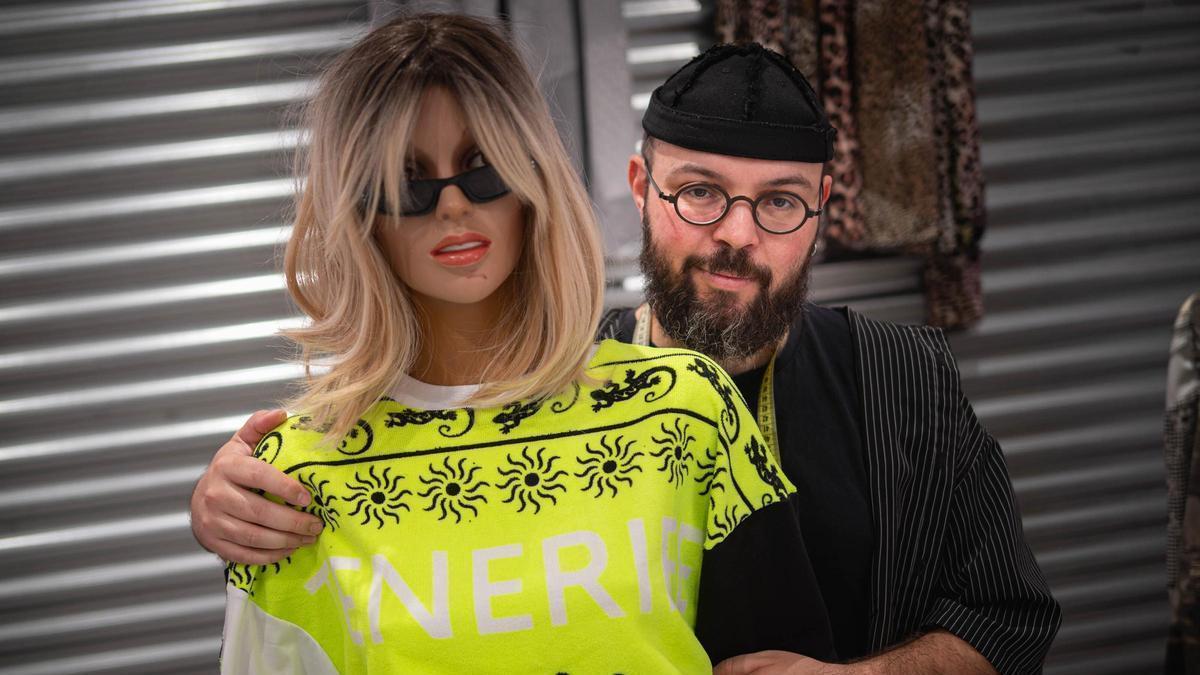
With a tape measure around his neck and his hands guiding the final pieces of fabric under the needle of a sewing machine, Juan Labory works surrounded by textiles that long ago ceased to be simple waste. Around him, five mannequins display the garments from his latest collection in a space that is both shop and workshop. In the very heart of Calle San Agustín in La Laguna, this Tenerife-born designer is bringing to life a project that turns rubbish left behind by tourists into fashion – and, in many cases, sells it back to those same visitors, completing the cycle.
A campaign against mass tourism
His new campaign, ‘From Tenerife with More Resilience’, aims to call out mass tourism and the impact of industries like fashion, which according to the UN is the second most polluting sector after oil. “The art world is very limited, especially on islands like ours,” Labory says. “That’s why I create fashion for all those people who choose to build their lives here, with the aim of making Tenerife a forward-thinking place.”
“I also try to do activism and social critique about the tourism situation in the Canary Islands, and it’s funny because I give a second life to the towels that tourists leave behind, and then I sell them back to them,” he adds with a smile.
The art of upcycling
To transform raw materials – waste to some – into hoodies, skirts or trousers, Labory (the name of both the designer and the brand) uses upcycling as his central technique. This method differs from standard recycling, which breaks waste down into its primary forms through industrial processes. Instead, the designer directly modifies existing garments or objects to give them greater aesthetic and functional value, without breaking down any materials.
“I take what people don’t want, and instead of throwing it away, I give it a new use from scratch, without transforming or customising it. I cut up those materials and make new fabrics using patterns I’ve created myself,” explains the La Laguna native.
Tourist towels as a favourite material
The towels abandoned by tourists are his favourite raw material. He goes directly to clothing collection organisations, such as Ataretaco (where he also serves as creative director), or to hotels themselves, in search of resources he can give a fresh start. “It’s something really innovative; it’s the first time anything like this has been done in Tenerife,” he says proudly.
Lessons from Berlin
He learned this distinctive way of working in Berlin, where he studied fashion after leaving his lifelong home in the Canary Islands to pursue his dream. Although he has always “liked second-hand, sustainable and vintage clothing” since he was a child, his fascination with the German capital was so great that it was there he fully defined his signature style, driven by that vibrant creative atmosphere and its values.
“So many cultures converge in one city,” he illustrates, “that a very special community of artists is created.” After his time in Germany, he returned to Spain, but this time to Madrid. “I worked as a stylist, did fashion editorials, worked in advertising… until I got a bit tired of the precariousness. After four years, since I’d always wanted to launch my own fashion project, I decided to come home and do what I always knew I wanted to do – and why not, in La Laguna,” he recalls.
A dream realised in La Laguna
“At first,” he admits, “I had the idea of opening a workshop-shop so customers could see me working on the very garments I was going to sell.” Eventually, his most cherished dream came true – a reality for over three years now. “People are shocked – surprised – when they see the kind of clothes I make, because they’re not used to this type of design. I even try to do educational work and explain why we should promote sustainable fashion and fight against the pollution caused by the fast fashion and ultra-fast fashion phenomena,” he declares.
Looking to the future: fashion as activism
In the future, Labory wants to continue expanding the reach of his project without losing the essence that has defined it from the start in the La Laguna municipality: the “blend of fashion, art and social activism.” His goal, therefore, is not merely to grow as a brand commercially, but also to consolidate a way of understanding textile creation as a tool for raising awareness.
The designer aims to take his work beyond the confines of his shop and into educational and cultural settings where he can have a direct impact on younger generations. “I imagine myself doing educational work, influencing people more, raising more awareness…” he noted before returning to sew a couple of offcuts, though he also left the door open to “developing workshops in schools and taking my proposal to museums,” moving away from the conventional fashion circuit.
A philosophy of conscious consumption
Summing it all up, Juan Labory says: “We have to be aware of what we buy, how we buy it and where we buy it, and that is implicit in what I do: I am a sustainable fashion activist.” That sentence encapsulates the philosophy of his work in just a few words. His fashion not only reuses materials; it also reuses ideas, transforms them, gives them new meaning and returns them to the public sphere in the form of garments – turning waste into design, and design into a message.
What’s happening in the Canaries – straight to your phone
News, weather alerts and practical updates – direct from the islands, in English. We live here and know what’s going on – before the international media catch up. Everything lands on our WhatsApp channel – no middlemen, no algorithm. Curated for families, expats and travelers.

Canary Islands’ hidden gems ruined by social media tourism
Free Loro Parque entry for Punta Brava residents

Imserso holidays in Canarias: 879,213 places on sale

Guachinche Tenderete: traditional food in Tenerife

Casa Rafael: Tenerife restaurant famous for its rabbit stew

Playa Grande and Charcón reopen after water quality scare
HYROX arrives in Tenerife: 10,000 athletes set for island debut

Tenerife Italian restaurant praised by food creator
Masca residents protest over road closure plans