
Predicting the corona
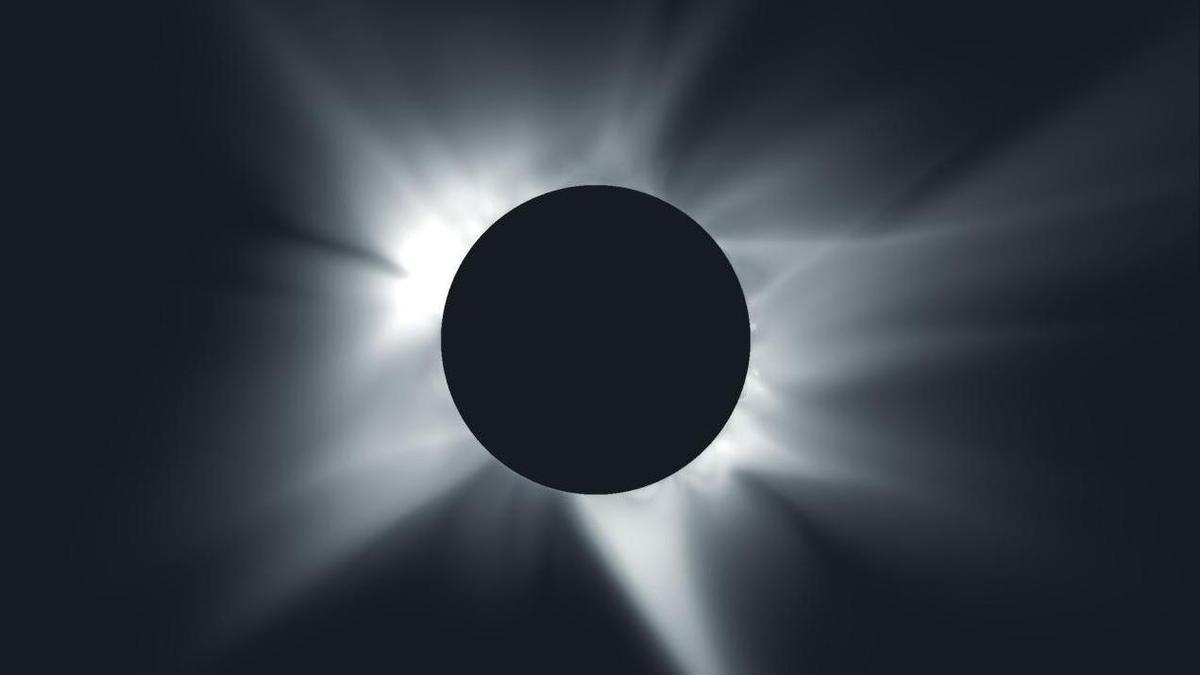
The La Palma supercomputer has produced a numerical prediction of how the solar corona will look during the eclipse on 12 August. The Instituto de Astrofísica de Canarias (IAC), working with the research group Predictive Science Inc. (PSI, San Diego, California), has succeeded in simulating one of the Sun’s most mysterious structures with a high level of detail. “During the eclipse we will be able to confirm whether our calculations are correct,” says Valentín Martínez Pillet, director of the IAC.
The solar corona – the Sun’s outermost layer – is shaped by magnetic fields on the solar surface. To build the simulation, scientists used data continuously measured by NASA’s SDO and ESA’s Solar Orbiter satellites, as well as the international GONG network (Global Oscillation Network Group), which has one of its key stations at the Teide Observatory in Tenerife, managed by the IAC.
How the simulation works
Since it is impossible to observe the entire Sun at once, the model reconstructs the distribution of the magnetic field by joining observations taken strip by strip over a complete solar rotation. With this magnetic map as a starting point, La Palma’s supercomputer solved highly complex magnetohydrodynamic (MHD) equations to predict how coronal structures and rays will form on the day of the eclipse.
The mystery of coronal heating
Beyond the aesthetic prediction, this work has a scientific objective: to unravel the problem of coronal heating, one of the greatest unknowns in solar and stellar physics. Although much research on the solar corona is carried out in space, little is still known about its structure. The mystery arises from the abrupt temperature change between the Sun’s surface and the corona. While the solar surface sits at around 6,000 degrees, the corona reaches temperatures of millions of degrees. “And we have no idea why,” says Martínez-Pillet.
This prior prediction will help shed light on the mystery. By comparing real images captured during the eclipse with the numerical prediction made before the event, astrophysicists will be able to assess the accuracy of their models, correct hypotheses about thermal balance, and learn which physical processes dominate heating in this part of the Sun, which is only visible from Earth during a total solar eclipse.
Why it matters for space weather
Understanding the dynamics of the corona is important for advancing space weather forecasting, as these magnetic structures directly influence the solar storms that affect telecommunications networks, orbiting satellites and technology on Earth.
The NATE project
The IAC is involved in the NATE (North African Telescope Eclipse) project, which will observe the solar corona in Palencia. Led by the IAC, the project launches in Palencia on 12 August, and will consolidate a year later in Morocco for the total solar eclipse of 2 August 2027. This line of cooperation will unite in a common effort the ultra-peripheral island region, depopulated rural Spain and North Africa. The project has the support of the Government of the Canary Islands.
This initiative draws on experience gained from the successful Citizen CATE (Continental American Telescopic Eclipse) experiments, developed in the United States during the eclipses of 2017 and 2024, and set up by the US National Solar Observatory (NSO) of the National Science Foundation and the Southwest Research Institute.
What’s happening in the Canaries – straight to your phone
News, weather alerts and practical updates – direct from the islands, in English. We live here and know what’s going on – before the international media catch up. Everything lands on our WhatsApp channel – no middlemen, no algorithm. Curated for families, expats and travelers.

Canary Islands sea hits second-hottest year on record

Legal bid to halt tree felling in Santa Cruz’s La Salud

Fiesta del Charco: A journey through La Aldea’s past

Corralejo dunes power line set for removal

ULPGC launches 14 research projects at Las Canteras

TMT will never be built, says Canary Islands astrophysics chief

Pedro Duque: Canarias is the “ultimate dream” for rockets

Court blow to Tenerife motor circuit project
La Palma faces new volcanic risk planning deadline
