
Compiled with the help of artificial intelligence, based on Spanish-language information. Source below the article.
Luxury construction swallows up the Tenerife coastline
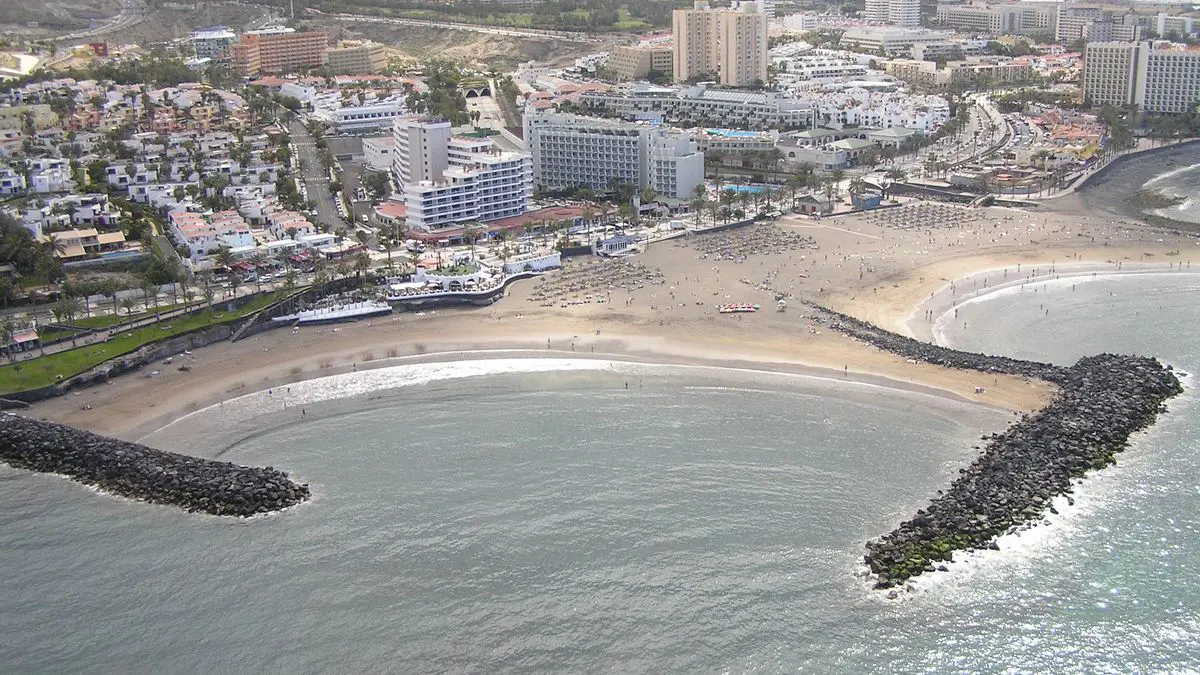
Luxury tourism construction is gradually swallowing up the coastline of Tenerife and the rest of the Canary Islands. The archipelago loses four kilometres of natural coast every year as a result of artificialisation, according to the SOS Costas Canarias report produced by the Canarina Foundation and the Sustainability Observatory. Now, a further 950 metres of seafront at Guía de Isora, in the Playa San Juan area, is under threat from a luxury villa project and two hotel developments totalling 1,100 beds, in the midst of a wave of protests against the mass tourism model.
Council approves reparcelation of Costa San Juan sector
Guía de Isora Council, led by Coalición Canaria (CC), approved in September the Reparcelation Project for the Costa San Juan Sector, covering a total area of 267,130 square metres. Most of the land was originally agricultural. However, according to the project report, the collapse of this activity over recent decades has “led to” barely 9% of the land retaining its production. “The remaining agricultural land is currently in a state of abandonment,” the project states by way of justification. The reparcelation of the sector thus allows almost half of the total land, 41.56%, to be converted to hotel tourism use, according to documentation seen by this newspaper.
This is divided into two plots covering 111,270 square metres, intended to host two five-star grand luxury hotel establishments. Plot 1 covers 69,927 square metres and has a maximum capacity of 600 places. The second takes up an area of 41,343 square metres with a capacity of 500 accommodation places.
Luxury villas priced between one and two million euros
The project also envisages 33 plots for the construction of detached homes. These are luxury villas, and to establish their sale value, the report itself includes a collection of adverts published on Idealista for other chalets for sale in the nearest areas. All of them are located in the municipalities of Adeje and Arona, with prices ranging between one and two million euros. In addition, this area will have tourism facilities, sports facilities, a road network, a pedestrian network and 900 square metres for tertiary uses, among which all categories of hospitality are permitted except that of “large restaurant”.
Along these lines, the project calls for the dismantling and demolition of existing buildings in the sector that were used for agricultural support purposes, such as warehouses, tool rooms or irrigation installations, given their “abandonment”. The only exception is two buildings intended for residential use, which “are compatible with urban planning regulations”.
Protests on land and at sea
This Saturday 31 October, a land and sea gathering is taking place in Playa San Juan to “halt the destruction of Tenerife’s south-west coast”. Under the slogans “Teno-Rasca no se toca” (“Hands off Teno-Rasca”) and “our coast is not a business”, the protest will begin at 10.30am. The organising bodies, including Greenpeace, Ben-Magec and ATAN, are urging residents to take part from land or in the water by kayak, paddleboard or surfboard.
Two companies own 95% of the land
The material execution budget for the works amounts to 15.4 million euros, according to a project drafted by GIUR S.L. in November 2022. According to the documentation, two companies will be responsible for building most of the sector: Costa San Juan Inversiones S.L. and Costa San Juan Hoteles S.L. Between them they own 95.18% of all the land. Guía de Isora Council also has some plots assigned for tertiary use, in addition to those in public ownership, such as roads and open spaces.
To find out who owns these companies, one has to unpick an entire corporate web. Both Costa San Juan Inversiones S.L. and Costa San Juan Hoteles S.L. have as their joint administrator the company Risco del Mar Tenerife Sur S.L., whose joint administrators are the companies Antida Mar S.L., Inversiones Dawe Sur, Inversiones Awey Tenerife and Weyro Inversiones. All of them are also joint administrators of the company Club Los Menceyes and share a registered address: number 91 Avenida del Palm-Mar (Arona).
Los Menceyes says development is at urbanisation stage
Sources at Grupo Los Menceyes explained that the development of the sector is currently at the urbanisation execution stage, which covers both the infrastructure and the public spaces and provisions set out in the planning. “The progress of these works will allow the following phases of development to be specified progressively, so that, as of today, it is not possible to give a specific date for the start of construction on the tourism or residential plots,” they told this newspaper.
They added that the scheme also includes a significant provision of public spaces, with approximately 62,431 square metres earmarked for green areas, gardens, a cycle lane, parking, two urban parks and various sports and community-use spaces, including areas for older people and pets. “It is, therefore, an intervention that goes beyond tourism and residential uses and incorporates a significant dimension of open spaces and services for the surrounding area,” they assessed.
On whether the homes will be for residential or tourism use, Los Menceyes maintain that “the planning envisages residential-use plots intended for the construction of homes”. “Their development must, in any case, comply with the applicable urban planning determinations and the regulations in force at any given time,” they indicated. Regarding the hotel projects, they assure that their development is “still at an initial stage”, so their specific characteristics, configuration and execution timetable are pending definition. “As the execution of the sector progresses and the various schemes are specified, more information on these aspects will become available. For the moment, we consider it premature to anticipate details that are not yet defined, although we trust we will be able to offer more precise information as the development progresses,” they concluded.
Belgian group behind The Cliff project
Los Menceyes is a powerful Belgian business group based in Tenerife. Led by the honorary consul of the Netherlands on the island, Stan Weytjens, its name refers to the Guanche kings who governed the island. In recent months, they have been at the centre of controversy over their intention to urbanise the hillside of the Montaña de Guaza Natural Monument (Arona), a space integrated into the Natura 2000 network, with a luxury project christened ‘The Cliff’.
Transparency Commissioner intervenes
These two tourism projects have forced the Canary Islands Transparency Commissioner to intervene, requiring Guía de Isora Council to report on them. The body thus upheld the case of the Tenerife Association of Friends of Nature (ATAN), which requested the file on 25 February and had received no response to date. In a resolution issued on 25 September, the Commissioner gave the council 15 days to hand over the documentation or, if it did not exist, to “report on such non-existence”.
ATAN requested from Guía de Isora a copy of the licences granted on the plots of the Costa San Juan partial plan and the complete associated file; information on the technical inspections carried out since the start of the scheme and on the technical reports produced by this body; and environmental reports or authorisations held by the project or the works being carried out. The environmental association denounces the opacity of the municipal government and states that this is not an isolated case. “Administrative silence has become a recurring strategy in Canary Islands councils when they are asked for planning information,” they maintain. “Time is allowed to pass, citizens are forced to lodge complaints and access to information is delayed while the works advance. When the documentation arrives, if it arrives, it is often no longer useful for preventing the damage,” they add in a statement.
Podemos warns of tourism saturation
For its part, Podemos Canarias has described as an “absolute absurdity” the plan to set this project in motion when Tenerife is facing “a critical situation of tourism saturation and pressure on its resources and services”. The party also denounces that the works are starting with an Environmental Impact Declaration whose validity they have questioned since 2023, affecting the archaeological surroundings of Aguadulce and creating new pressures on protected species and spaces, both on land and at sea.
“It is difficult to understand what logic could justify continuing to build hotels today on an island overwhelmed by tourism pressure,” says Cristo González, island spokesman for Podemos Tenerife. “We don’t need another operation to fill the coast with concrete. We need to start asking ourselves how much more Tenerife can take,” González states.
What’s happening in the Canaries – straight to your phone
News, weather alerts and practical updates – direct from the islands, in English. We live here and know what’s going on – before the international media catch up. Everything lands on our WhatsApp channel – no middlemen, no algorithm. Curated for families, expats and travelers.

Driving licence glasses rule that could cost you €200
Puerto de la Cruz car park to reopen after five years

Puerto de la Cruz old bus station demolition out to tender

Mercadona reopens Santa Úrsula store after €4.5m revamp

Las Palmas among Spain’s cheapest taxi cities in 2026

PP plans to scrap social security fees for new freelancers

PP plans major income tax cut for young Canary workers

Canary Islands coalition plans limits on foreign home buyers

CC and Primero Canarias unveil 100-point election manifesto
