Compiled with the help of artificial intelligence, based on Spanish-language information. Source below the article.
A young life cut short in El Hierro
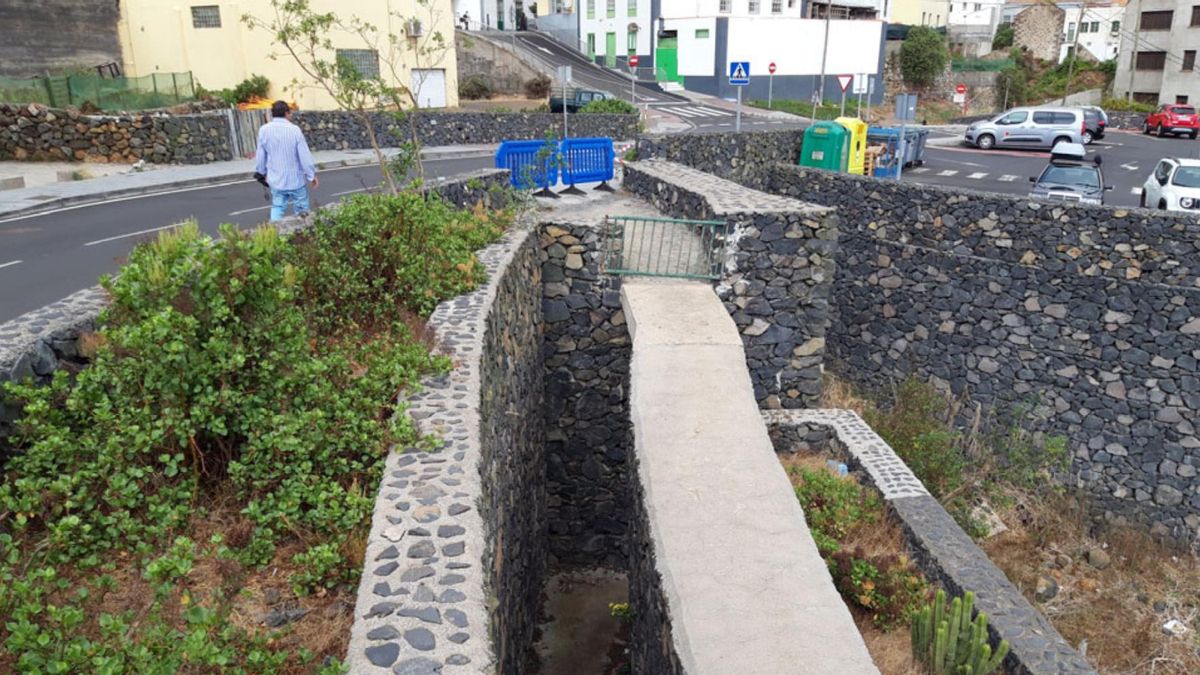
La Dorta died at the age of twenty at the Doctor Negrín Hospital in Gran Canaria, the island where she lived. Hours earlier, she had fallen down a drop of nearly six metres in the municipality of Valverde, on El Hierro, where she was on holiday. The events took place in the early hours of 24 July 2022. The young woman, who was studying a double degree in Translation and Tourism at the University of Las Palmas de Gran Canaria (ULPGC), was enjoying a night out with friends at a well-known nightclub in the island’s capital, a municipality of just over 5,000 inhabitants. At one point, she stepped away from the group with another young man and went into a dimly lit area seeking privacy to urinate. She climbed over a low stone wall barely 55 centimetres high and fell through a gap beside the access ramp to a private plot. Despite the height of the drop, there was no safety fence at the spot. It was neither lit nor signposted. After the fall, she was airlifted by helicopter to Gran Canaria, where she died as a result of the severity of her injuries.
Two legal cases, four years on
Four years later, two legal proceedings are under way. The criminal case was reopened last May by a substitute judge and is awaiting the reconstruction report commissioned from a specialist Civil Guard team. In the administrative proceedings, the family is seeking compensation from Valverde Council on grounds of state liability. Within the framework of this second procedure, an official document has come to light that undermines the council’s position.
The file submitted by the authority includes an internal memo signed in 2017 (five years before La Dorta’s death) confirming that the council, which was managing the works through the municipal architect, had planned and budgeted for a safety railing at that spot, but ultimately decided not to install it on the grounds that the height of the enclosing walls was sufficient. “It was not carried out, moreover, because the project plans do not indicate its location, and because it is the view of the works management that the height of the enclosures and the nature of the sloping land it borders are sufficient,” the document states in relation to item number 6.02, a galvanised steel railing budgeted at €3,320.94. The works director considered at the time that this phase of the works had been completed.
A deadly trap
For the family, this is a crucial fact in assessing the possible liability of the authority in the events. “It was a deadly trap,” summarises Maite, La Dorta’s mother. “Knowingly and deliberately, the council signed off the aforementioned ramp without the barrier that would have prevented the young woman’s death,” argues the family’s lawyer in the appeal lodged in the administrative proceedings. He adds: “The perimeter stone walls, of varying height between 40 and 65 centimetres (55 at the spot where the young woman fell), in no way fulfil the function of a safety railing or parapet, their height being plainly insufficient to protect a person from a fall from that height.”
In that appeal, the family accuses Valverde Council of seriously and persistently failing in its duties of maintenance, safety, lighting, signposting and protection of the public space. The disputed works were carried out between 2010 and 2017. Valverde Council had committed to the owner of a plot to build an access ramp to bridge the considerable difference in level between that parcel and the public road. Although it was not in the project, as a technician from the authority itself admitted before the Diputación del Común (the Canary Islands’ ombudsman), this work was carried out in the fourth phase of the construction of a new road between Calle San Francisco and Calle San Juan in the island’s capital.
Private access, public land
An expert report submitted to the courts by La Dorta’s family warns that the ramp was built without a specific project, without plans, without technical documentation and without the required licence. The architect signing that report also establishes that the exact site of the accident lies within a cadastral parcel owned by the council. In other words, although the space serves as access to a private plot, the land where the fall occurred is municipal public domain. “It is a decisive fact,” says the family’s lawyer, who stresses that the drop of nearly six metres constituted an obvious and foreseeable danger for anyone passing through the area and that, despite this, it was freely accessible and was neither fenced, lit nor signposted.
In July 2022, when the events occurred, that access was delimited by a small metal gate around 90 centimetres high that prevented access to the concrete ramp. This gate was flanked by two small stone walls of varying height, from 40 to 65 centimetres. Between one of those low walls and the stone wall there was a gap of nearly six metres in height. It was through that spot that La Dorta fell. “The place functioned as an open viewing platform, with no access control whatsoever, directly connected to the public pavement,” the family’s appeal states. It considers it highly significant that, days after the fatal accident, the council put up fences to prevent entry into that space. “It is an implicit acknowledgement of the pre-existing danger and demonstrates that simple, inexpensive and effective means existed to have prevented the tragedy,” it maintains.
As for the question we all ask ourselves, whether the accident suffered by La Dorta could have been avoided, “I must say that, faced with the evidence provided, emphatically yes, since if adequate protections had existed, the fatal accident would have been avoided,” stated the architect who signed the expert report submitted by the family. It is now also known that the safety railing had been budgeted for and was not installed by decision of the council. For the claimants’ lawyer, the absence of a safety fence at the spot is proof of the authority’s absolute lack of control.
A previous fall five months earlier
The family stresses that the danger of the place was not unknown to the council. Barely five months before La Dorta’s accident, another young man suffered a fall at the same point and in identical circumstances. He survived, but suffered serious injuries. The family maintains that, despite the seriousness of that incident, which is also being investigated in the courts of Valverde, the local authority adopted no safety measures.
For the claimants’ lawyer, there is another crucial element demonstrating that what had happened months earlier was known in the municipality. It so happens that the main witness in the criminal case, the young man who accompanied La Dorta to the scene, is the son of Carlos Brito, the current mayor of Valverde and at that time a councillor and local police officer. In his statement before the court, this witness admitted that it was his father who informed him that some time earlier another young man had already fallen down that same drop.
Awaiting the Civil Guard report
The criminal case into La Dorta’s death was reopened on 25 May by a substitute judge. The proceedings are being heard at the court in Valverde. Its presiding magistrate, Ana Rosa Domínguez, had issued an initial order to shelve the case in October 2023, considering that the fall was a fortuitous accident, that the victim had voluntarily assumed the risk and that there was a gate (around 90 centimetres high) delimiting the spot where the fall occurred. Months later, in January 2024, she again rejected the appeal for reform lodged by the family, which appealed once more — this time with an appeal — to the Provincial Court. The Public Prosecution Service requested at that time that the appeal be dismissed, considering that there was insufficient evidence to continue proceedings for an alleged offence of manslaughter through gross negligence.
The prosecution service, however, qualified what the investigating judge had stated. “It is true that there is a kind of fence or gate (admittedly of low height) that delimits access to the concrete ramp and that it was closed at the time of the events, but it is not through it that La Dorta gained access, but rather by climbing over the wall that follows it. And it is true that said wall is of low height and does not warn of the height of the drop,” the prosecution stated in that document, although it agreed with the magistrate that the young woman’s actions amounted to an assumption of risk.
In May 2024, the Sixth Section of the Provincial Court of Santa Cruz de Tenerife confirmed the provisional shelving of the case, finding no criminal relevance in the events and referring the matter to the administrative courts to resolve the case. That order from the provincial body nevertheless stressed that there were no delimiting railings at the spot and that, according to the testimony given in court by the owner of the plot, that ramp had been built by Valverde Council for the purpose of giving him access to his property.
A procedural turning point
The procedural turning point came in May this year. The private prosecution (La Dorta’s family) had submitted a new report from the architect expert questioning the version given by the only direct witness as to the mechanics of the fall and the final position of the body. On the basis of that report, a substitute judge, Antonio Mazuecos, issued an order reopening the case and commissioned two procedures from the Civil Guard’s Criminalistics service: a technical-forensic inspection with measurement of the bloodstain and a reconstruction of the events using a dummy (a test mannequin with La Dorta’s weight at the time of the accident) and 3D computer graphics. The Civil Guard’s specialist team has already attended the scene to carry out these procedures, but has not yet submitted its conclusions report.
The private prosecution maintains that the final position in which the simulated body (dummy) ended up during the reconstruction tests does not match the mechanics of the fall described by the witness. The presiding magistrate has now returned to Valverde. On 10 July she issued a new order urging the prosecution service to give its view on the possibility of agreeing to shelve the case once again. She did so without having yet received the Civil Guard’s 3D reconstruction report and without giving the private prosecution the opportunity to respond. The family’s lawyer appealed that order with a strongly worded document: “We are faced with a flagrant violation not only of the procedural rules governing criminal proceedings, but of the very guiding principles of criminal law, amounting to a constitutional infringement.”
The prosecution service has also indicated that it is inappropriate to shelve the case without having the report commissioned from the Civil Guard’s specialist team. For the moment, La Dorta’s family is not directing the accusation against anyone in particular. Valverde Council has not responded to questions put by this newspaper, arguing that a judicial process is under way and that it will not comment on the case until it has concluded.
What’s happening in the Canaries – straight to your phone
News, weather alerts and practical updates – direct from the islands, in English. We live here and know what’s going on – before the international media catch up. Everything lands on our WhatsApp channel – no middlemen, no algorithm. Curated for families, expats and travelers.

Gran Canaria educator stranded in Senegal for two months

Clavijo calls Spanish rental decree ‘nonsense’
Canary Islands housing protests draw thousands

10,000 march in Las Palmas over housing crisis
Gran Canaria: quality tourism is already a reality

Lanzarote water supply hit as desalination plants stop
Nearly 10,000 march in Las Palmas over housing crisis
Gran Canaria housing protesters vow to fight on

Union demands resignations over Canary Islands school conditions