Compiled with the help of artificial intelligence, based on Spanish-language information. Source below the article.
La Palma’s slow recovery from the 2021 eruption
La Palma is slowly piecing itself back together after the devastation wrought by the 2021 volcanic eruption. Many homes and entire neighbourhoods were wiped out by lava flows, including that of La Laguna. This village in the municipality of Los Llanos de Aridane was included in the law for the economic and social recovery of the island, allowing residents to apply for licences and rebuild destroyed properties.
However, on top of the blanket of lava covering the neighbourhood, another obstacle emerged two years ago: the unauthorised occupation by a businessman of twelve plots to extract and trade in volcanic aggregates.
Investigation into unauthorised extraction
The Canary Agency for the Protection of the Natural Environment (ACPMN) has opened proceedings against businessman Manuel Rodríguez González for carrying out this activity on common rural land without authorisation. According to the case file, which runs to more than 800 pages and to which this newspaper has had access, the man has been extracting aggregates from 12,000 square metres of the Tajogaite lava flows since at least 2024, as Cadena SER first reported.
One of the affected neighbours, who owns one of the plots and wishes to remain anonymous, adds that despite the warnings and requirements issued by the ACPMN, the accused continues his operation to this day, and claims that the town hall has never sealed off the works.
The accused owns at least one of the plots he is exploiting. Even so, the ACPMN stresses that the surface area he has occupied far exceeds the boundaries of his registered plot and affects eleven others belonging to ten different owners. One of them, according to the case file, belongs to the island council itself.
Residential recovery zone rules
Under the agency’s resolutions, the businessman cannot carry out this activity even on his own plot. The land in question, in accordance with the Law for the Economic and Social Recovery of La Palma, lies within a Residential Recovery Zone, where the lava flow is less than 10 metres thick. In this zone, affected individuals may apply for licences to rebuild destroyed properties. Industrial use is also contemplated, but only in the category of artisan workshop, compatible with residential use.
Timeline of the case
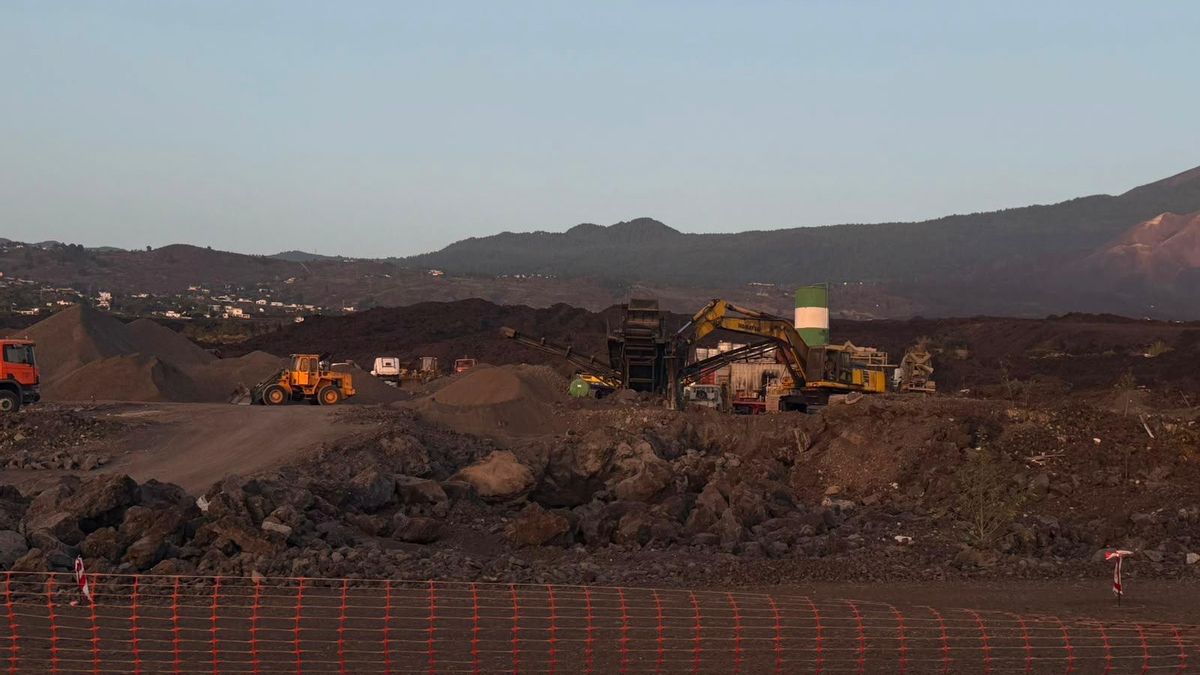
The case file was opened on 15 January 2025, following a complaint lodged by the Cabildo of La Palma, which warned of the unauthorised extraction of aggregates and volcanic rock in this village of Los Llanos de Aridane using heavy machinery, for subsequent processing at a crushing plant installed in the same area. A environmental officer attached to the Cabildo travelled to the site, where he confirmed that an aggregate treatment plant had been installed, along with the associated machinery, affecting an area of 12,000 square metres.
In one of its reports, the agency clarifies that this treatment plant is not linked to any of the works being carried out by public authorities to restore infrastructure affected by the eruption.
As early as May 2025, the agency concluded that the use was incompatible with the law, and in June it notified the businessman of an order to restore the area. He merely alleged that he had submitted two licence applications to Los Llanos de Aridane town hall, and in November the agency concluded that the works could not be legalised and ordered Rodríguez to demolish the structure and restore urban planning legality in the area. The resolution, as confirmed to this publication by the Regional Ministry of Territorial Policy of the Canary Islands Government, was not appealed and is final. Even so, it has not been enforced to date.
In various photographs taken in January 2026, almost a year after the environmental officer’s visit, several lorries can be seen working in the area, along with piled-up tyres and machinery for crushing rocks.
The Regional Ministry has stated that on 18 September the agency made a further move and once again required the accused to submit a restoration project within one month as a first step towards voluntary compliance with what was ordered in the previous resolution. The deadline for submitting the project expires on 19 October, they explain.
Possible criminal proceedings
Given the seriousness of the actions, the Regional Ministry continues, the ACPMN is processing the sanctioning case and plans to bring these facts to the attention of the Public Prosecutor’s Office in case they could constitute a criminal offence.
In an interview given to Televisión Canaria, the businessman denies the surface area figures recorded by the agency and claims he occupies 10,000 square metres of his own property. He also says he has requested permission six or seven times from the town hall because he wants to build on the plot where his property stood. Furthermore, he states that he only has problems with the neighbours of the plot adjoining his to the south.
Neighbours reject claims of consent
The owners of one of the affected plots state that they became aware of the facts in September 2025 through a letter from the ACPMN, notifying them that the businessman was extracting aggregates from their land. He went so far as to claim before the administration that he had the verbal consent of all the neighbours to carry out this extraction, which initially, in the eyes of the Canary Islands Government, makes us accomplices to the crime, they say.
Along these lines, they categorically deny having consented to any of the actions he has carried out on their plot and maintain that they have taken place without their consent or approval. “We are talking about a person who, with impunity and full knowledge, invades our property and devotes himself to extracting aggregates with heavy machinery,” they argue.
They say this activity has caused them obvious harm because their land now has uneven ground, pits and holes that will make reconstruction more difficult in the future. “Our mother and our grandmother were born in the house we lost to the volcano. Over decades and generations, it has been a reflection of the effort and dreams of our great-grandfather, who built his life and his family in La Laguna, and it pains us to see how this man’s actions violate our family’s memory,” they say.
They also criticise the businessman for using his status as someone affected by the volcano as an excuse to present himself as a victim and thereby cover up the crimes he has been committing. “All the neighbours who appear in the case file are equally affected by the volcano, and none of us, except the aforementioned individual, has devoted themselves to invading other people’s plots and committing an environmental crime, enriching themselves in the process.”
Ecologists accuse authorities of passivity
The Ben Magec-Ecologistas en Acción federation criticises the authorities for their total passivity in the face of this illegal activity. In a statement, Ben Magec says that in October 2025 they requested from the Directorate-General for Industry of the Canary Islands Government the full copy of the authorisation files for the aggregate treatment facilities identified in the area, and asked whether the activity had undergone an environmental impact assessment. In parallel, they say they sent a similar request to Los Llanos de Aridane town hall. Almost a year later, the federation has received no response and the file has never been provided, they indicate.
The neighbour with whom this newspaper spoke also denounces the town hall’s lack of transparency. “We wonder why we have not been given answers to all the requests for information, documentation and action we have made to Los Llanos de Aridane town hall, a right that, after more than three months of silence, we consider to have been violated,” they lament.
The neighbours say they requested a Local Police presence in the area in June and the halting of the works, but they still do not know whether this presence occurred or what actions were taken. “We feel powerless and abandoned by the authorities, which, far from enforcing the administrative resolution […] have shown inaction throughout this year,” they declare.
“This is land belonging to families who have already lost everything as a result of the eruption and who now see their plots being exploited without their consent. The facilities are perfectly visible and it is widely known that sand is being sold there,” Ben Magec reiterates. For this reason, they insist that it is impossible to maintain that the authorities were unaware of what was happening.
“They continue to hide the information requested while turning a blind eye to such an environmental attack,” asserts the federation’s spokesperson in La Palma, Pablo Díaz. Ben Magec points out that these events are a direct consequence of the lack of planning and organisation of the territory affected by the eruption and demands that the town hall seal off the illegal plant. They also warn that it is highly likely that the economic benefit the businessman has obtained during these years of activity outside the legal order far exceeds any sanctions that might eventually be imposed. “If that happens, the sanction ceases to be a deterrent and becomes a simple payment for plunder,” they conclude.
What’s happening in the Canaries – straight to your phone
News, weather alerts and practical updates – direct from the islands, in English. We live here and know what’s going on – before the international media catch up. Everything lands on our WhatsApp channel – no middlemen, no algorithm. Curated for families, expats and travelers.
Two Tenerife beaches reopen after water quality alert

Canary Islands satellite spots oil spill from space
Two more Tenerife beaches closed over sewage contamination

NASA honours Canary Islands 112 for Artemis moon mission role
Tajogaite’s scientific legacy five years on
Magnitude 3.0 earthquake recorded west of Lanzarote
Canary Islands look to volcanic heat for energy
Canary Islands’ ancient potatoes face climate threat
Tenerife deploys drones to cut drowning deaths