Canarian inventors create lifesaver 2.0 that’s twenty times smaller
A group of young Canarians have created a lifesaver 2.0 – a more modern version of this essential safety device. While the goal remains the same: preventing drownings from turning into fatalities, the appearance of this product bears little resemblance to the familiar orange and white ring buoy that hangs near beaches and swimming spots.
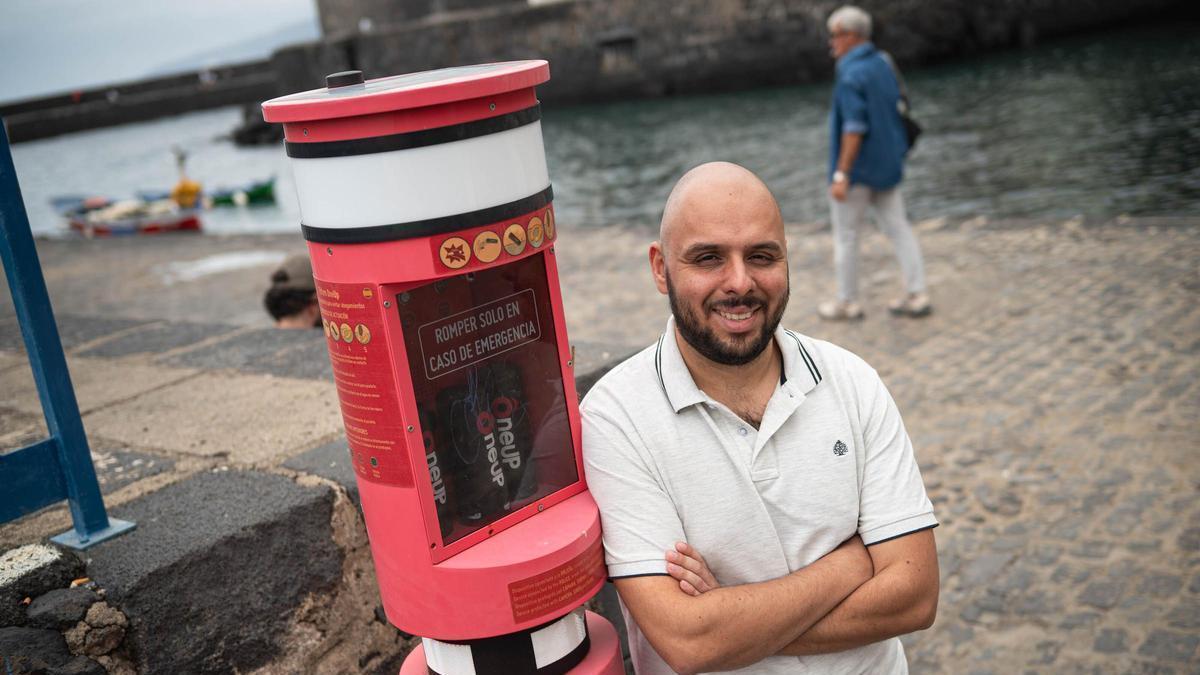
This change is not merely aesthetic but represents a significant improvement in efficiency. The new model is twenty times smaller and seven times lighter. “This means anyone can throw it up to 30 metres, or even 40 metres if you’re sporty,” explains Rubén Sánchez, export manager of OneUp Saves, the Canarian company behind the invention.
Small but mighty: fits in a soft drink can
When not inflated, the device fits practically inside a soft drink can. At bathing spots such as Charco La Laja in San Juan de la Rambla, Tenerife, it is stored inside a red safety column – a totem housing these smart lifesavers. Anyone can use them; all you need to do is break the glass and grab one. Simply throw it towards the person in trouble, and it inflates automatically upon contact with the sea.
Another important feature, unlike the conventional ring buoy, is an opening that means the person needing help doesn’t have to dive under to position themselves inside it.
Inspired by Red Cross Mediterranean rescues
Canarians Saúl de León and Luis Borges embarked on this project in 2017 after watching a documentary about Red Cross rescues of migrants in the Mediterranean. It was then they realised that, although most drownings occur close to the shore, major water safety companies have focused their efforts on those travelling aboard ships. “When the lifeguards tried to pull them onto the boat, there was a moment of intense tension because, as they were drowning, they pushed the rescuers away and prevented them from acting, meaning they often arrived only to watch them die,” argues Sánchez.
From that initial reflection, a small, compact product was born that has already saved more than 40 lives – three of them in the last few weeks. The majority of these rescues have taken place in the Canary Islands, where the devices are most prevalent, but others have crossed borders. “Last week we were at a Maritime Rescue meeting attended by other countries, and a group from the Netherlands approached us to say that thanks to OneUp they had prevented a fatality at sea,” he recounts.
For Sánchez, this news brought particular joy, as it marked their first sale. “I sold it to a small German distributor who had equipped the Dutch Air Police, and now I find out that because they dropped it from a helicopter, they managed to save someone,” he says. For him, it’s no longer just about the impact of walking along Las Canteras in Las Palmas de Gran Canaria and seeing the red totem with its lifesavers inside – when he looks at it, he also thinks of all those bathers who have been rescued.
First rescue at Las Canteras beach
He remembers the first life they saved: “It was precisely at Las Canteras, in July, around 3pm, with the beach absolutely packed. As it happened, the person was drowning where there were no lifeguards, but there was one of our totems. Other bathers threw them a OneUp, and they managed to keep them safe until the professionals arrived.”
Achieving that first rescue was not easy for its creators. They spent more than a year developing the product, and then the pandemic hit – although in this case, it brought something positive. “Lockdown changed the business world and the way of doing business because people started looking much more inward. Thanks to that, we were able to develop our project, designed and patented in the Canary Islands,” he confesses.
From humble crowdfunding to international reach
What began with a modest crowdfunding campaign – individuals contributing small amounts to finance the idea – has evolved into multiple products and more than a hundred totems distributed across the archipelago and Portugal. In this regard, Sánchez highlights a high level of acceptance among public administrations. However, he stresses that everything moves very slowly. “There seems to be willingness, but it never quite materialises,” he adds.
In 2021, the regional government proposed installing these lifesavers at all bathing spots, but the project was never carried out. “Although responsibility for these spaces lies with the municipalities, other institutions can also help,” he maintains. In his view, Charco La Laja is a good example of how necessary this invention is, with around ten rescues carried out there using OneUp.
Gran Canaria leads deployment
Gran Canaria is the island with the greatest presence of these devices for two reasons: firstly, that’s where their headquarters are, and secondly, the Cabildo has requested at least one totem per coastal municipality. Behind it come Fuerteventura, with its many kilometres of coastline, and Tenerife, because of its natural swimming pools, which are often quite dangerous.
Sánchez says that since joining the company, he hasn’t heard of a single rescue using the traditional ring buoy. “They’re very difficult to handle; you can’t throw them. I’ve only seen them used as an aid when someone is getting close to shore, but even then they’re quite dangerous because they’re so heavy,” he explains. What he does appreciate about the traditional device is what it symbolises: “You see one and immediately think it’s something that provides safety.”
Preventing chain-reaction drownings
Drownings rarely involve just one person. “There’s always a first bather in trouble, another who jumps in to save them, and another who goes in to try to pull the first two out, so it ends up involving several people,” he notes. For the team, being able to help all these people is “a satisfaction and a source of pride.”
Along with trying to be present along the entire Canarian coast, the next goal is to find a way to help migrants arriving from Africa. “We’re always ready to collaborate,” he emphasises.
What’s happening in the Canaries – straight to your phone
News, weather alerts and practical updates – direct from the islands, in English. We live here and know what’s going on – before the international media catch up. Everything lands on our WhatsApp channel – no middlemen, no algorithm. Curated for families, expats and travelers.

Tenerife’s Char Fuego y Brasas named 13th best steak restaurant in Europe

Gran Hotel Taoro: a foodie destination in Puerto de la Cruz

Canary Islands hotel prices rise 4.11% in September

Icod de los Vinos launches twelve self-guided routes
Four new openings shaking up Las Palmas dining scene

Tenerife faces huge tourism expansion despite moratorium calls
El Bejeque in Las Canteras adds sea to its fire

Siam Park Gran Canaria must build its own desalination plant

Fuerteventura’s biggest resort to open on 1 November