
Compiled with the help of artificial intelligence, based on Spanish-language information. Source below the article.
Close encounter with asteroid 2026 PC6
The night before the Sun hid behind the Moon in one of the largest solar eclipses the Canary Islands has seen in two decades, and as the Perseids lit up the sky with their green flashes, a daring asteroid approached Earth closer than anything else this year. The celestial object, the size of a bus and named 2026 PC6, was captured from the Canary Islands at just 14,573 kilometres from our planet.
In other words, the asteroid shared the orbit of geostationary satellites for a few hours – those which provide the GPS network to Earth and sit at around 20,200 kilometres out. The asteroid, spotted by the Canary Islands node of the Atlas planetary defence telescope system, travelled from one side of the planet to the other, without causing any damage, in just a day.
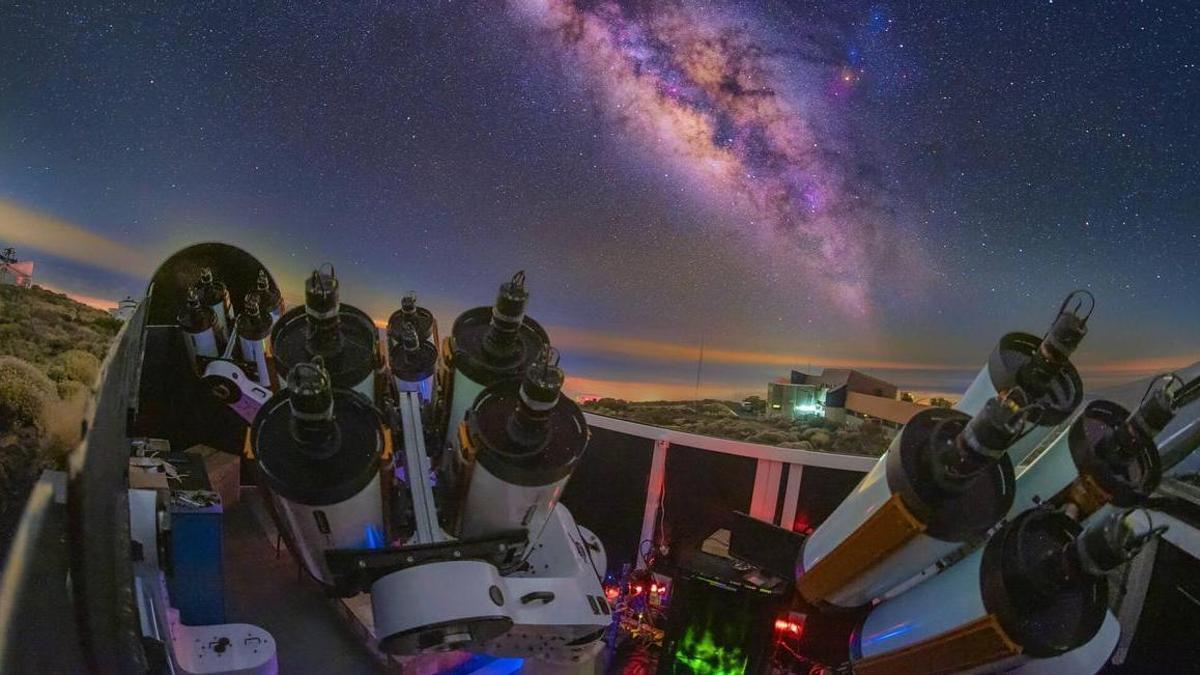
Specifically, the object was caught by Atlas-Teide, a network of 16 small telescopes operated by the Instituto de Astrofísica de Canarias (IAC) at Teide Observatory. The tiny asteroid – because on an astronomical scale, a ten-metre object is laughably small – flew past the Canary Islands at a “breakneck speed”. According to IAC calculations, it crossed the sky at two degrees per second, which equates to covering a third of the entire celestial dome in one hour. In other words, every minute the bolide could cover the apparent space in the sky of four full Moons lined up in a row.
A close call before the eclipse
Its closest approach occurred at 1:50am on 12 August – just hours before two other astronomical spectacles coincided: the solar eclipse and the Perseid meteor shower. But the sixteen eyes of the Atlas telescope noticed its imminent arrival a day earlier. At 2:20am on 11 August, this hunter of dangerous asteroids was already on alert.
“Detecting objects like 2026 PC6 is precisely the priority objective of the Atlas system,” insists Javier Licandro, IAC researcher and head of the Atlas-Teide project. Specifically, this tracker of hazardous asteroids is designed to discover celestial bodies so small, dark and fast that they are usually invisible to other telescopes until they get close enough to Earth.
“Having discovered it and being able to follow its trajectory shows that this node on Teide fulfils the function for which it was designed,” the researcher stresses. Knowing this information is key to taking measures to avoid a dangerous exposure of the population to a potential impact.
“We can predict its trajectory and know where and when it will hit Earth at least a day in advance,” Licandro explains, adding that if the object were larger, it could be detected even several days earlier. The same system would serve to alert us to all kinds of objects that might reach our planet, because even an asteroid as small as 2026 PC6 could cause damage on Earth.
The Chelyabinsk precedent
In this case, the asteroid would largely disintegrate on entering the atmosphere; but it would do so at such speed that it could generate a shockwave. “It would create a huge explosion in the atmosphere that could cause serious harm to people and infrastructure,” says Licandro.
A classic example of this type of event is the bolide – only slightly larger than the asteroid just detected – which fell over the Russian city of Chelyabinsk in 2013. The meteoroid flew over several provinces and the city at the moment it entered Earth’s atmosphere, before impacting 80 kilometres from the town. In its explosion, it released 500 kilotons of energy – thirty times more powerful than the Hiroshima nuclear bomb. “A shockwave was generated which shattered windows and roofs, and left more than 1,500 people injured,” he recalls.
Having advance information is therefore the key to taking civil protection measures. “If we know it is going to impact the next day, we can alert people not to go near windows or, better still, to leave them open,” Licandro insists. In this sense, Atlas-Teide “fulfils the function for which it was designed, which is none other than watching the sky to give us the earliest possible warning of a potential impact.”
How Atlas works
This asteroid tracker based on Teide is one of five nodes of the Atlas project (an acronym for Asteroid Terrestrial-impact Last Alert System) around the world. The early detection and warning system is funded by NASA and developed by the University of Hawaii, and was conceived to detect bodies on approach trajectories to Earth and provide the greatest possible warning time before a potential impact.
“There are other projects that do a similar job, such as the Pan-Starrs telescope or the Catalina Sky Survey (CSS) programme, which can detect smaller objects but over a more limited area,” the researcher explains. Atlas-Teide was installed in January 2025 at the Tenerife observatory, becoming the third node of this international project in the northern hemisphere (this one and the two installed in Hawaii). The asteroid-hunting network is completed with two more telescopes in the southern hemisphere: one in Chile and a fifth in South Africa. “With this network, we can detect one in every four objects approaching Earth,” Licandro insists.
Built and installed by the IAC at Teide Observatory, Atlas-Teide is operated every night in cooperation with the University of Hawaii, and can scan a quarter of the sky every night. “If all five nodes are working, we can sweep the entire celestial dome,” he stresses. During the night, researchers work hard to spot strange flashes of light in the sky. “What we look for are objects that move or change their brightness during the night,” the researcher explains.
An impressive track record
Since it began work in May 2025, the node located on the lower slopes of the Teide volcano has discovered around twenty NEAs (Near-Earth Asteroids), has reported the position and brightness of more than 5,000 of these objects and has also made more than a thousand detections of possible supernovae, of which almost two hundred have been confirmed and classified.
2026 PC6 is the first of three NEAs discovered from the peaks of Tenerife this August 2026. This small asteroid will not pass near Earth again until 2037. “And even then, it will be 1,000 times further away than now,” the researcher summarises. The fact that our planet and an asteroid’s orbit coincide is far from common. “Earth has to pass through that exact same point, so the event can repeat, but only after a long time.”
In fact, this same asteroid has already visited our planet on three previous occasions: in 1948, 1961 and 1989. And on none of those occasions did it come as close to Earth as it did this August.
What’s happening in the Canaries – straight to your phone
News, weather alerts and practical updates – direct from the islands, in English. We live here and know what’s going on – before the international media catch up. Everything lands on our WhatsApp channel – no middlemen, no algorithm. Curated for families, expats and travelers.

Canary Islands sea hits second-hottest year on record

Legal bid to halt tree felling in Santa Cruz’s La Salud

Fiesta del Charco: A journey through La Aldea’s past

Corralejo dunes power line set for removal

ULPGC launches 14 research projects at Las Canteras

TMT will never be built, says Canary Islands astrophysics chief

Pedro Duque: Canarias is the “ultimate dream” for rockets

Court blow to Tenerife motor circuit project
La Palma faces new volcanic risk planning deadline
