Compiled with the help of artificial intelligence, based on Spanish-language information. Source below the article.
Spain approves two housing decrees after Maricarmen eviction outcry
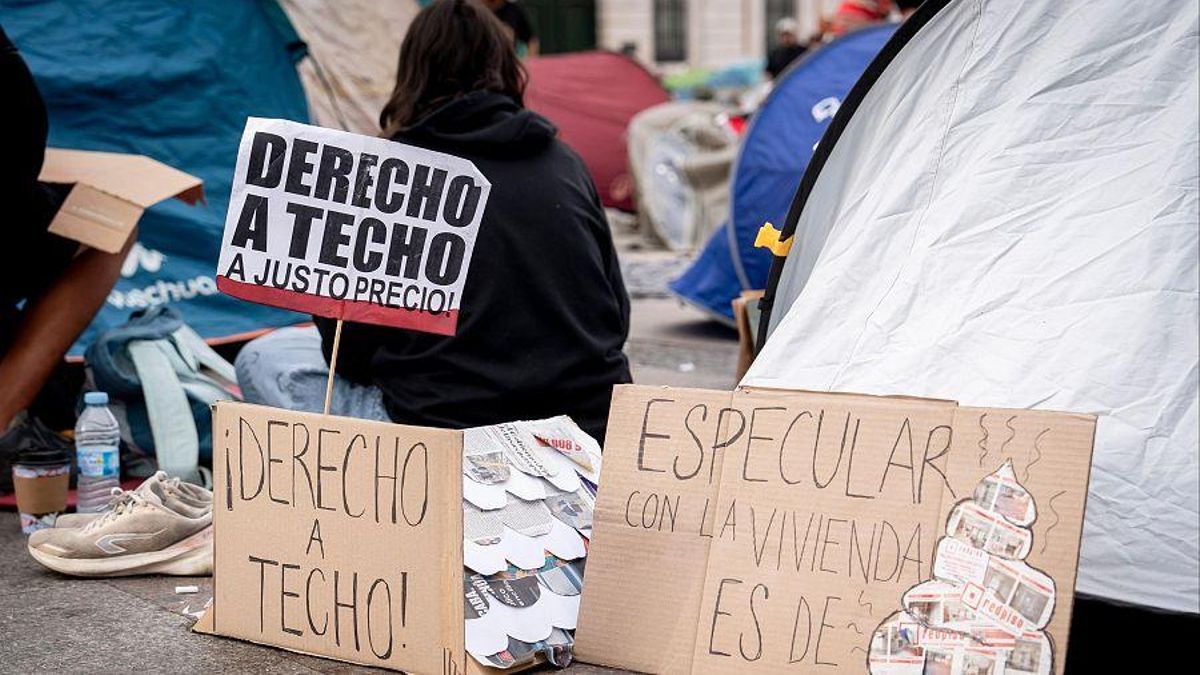
After hours — and days — of anticipation, Spain’s Council of Ministers approved two housing decrees on Tuesday in an attempt to respond to the outcry on the streets following the controversial eviction of Maricarmen. Sumar and the PSOE managed to bring their negotiating positions closer during talks on Tuesday morning, and measures on housing will finally be adopted and then ratified this Friday, 2 October.
The Canary Islands also play an important role, since Coalición Canaria’s only MP, Cristina Valido, will have to vote in Congress for the measures to enter into force definitively. CC has not revealed how it intends to vote.
Why there are two separate decrees
The reason for there being two texts is purely parliamentary. One of the decrees contains what the PNV and Junts can support in Congress, while the other covers what Sumar considered essential. The PSOE therefore designed the package so that the measures would not depend entirely on all parties’ support and would not collapse. It is worth noting that in March 2026 the Government had already approved two separate anti-crisis decrees, with the freeze on rents handled separately.
The decree is still awaiting publication in the BOE (the Official State Gazette), but according to sources at the Ministry of Housing, the approved package contains four blocks of measures.
Eviction protections extended to 2030
One of the most significant measures is the extension until 2030 of protection against evictions for vulnerable households that have no alternative housing. The mechanism provides reinforced protection when the owner is a large landlord or an investment fund, while in other cases the procedure requires the authorities to seek a housing solution first.
In the Canary Islands, this point will have a direct impact, because finding and making available an alternative home requires the participation of the regional and local authorities. The 2026-2030 State Housing Plan already provides for the autonomous communities to facilitate housing solutions for people in vulnerable situations, including households affected by evictions.
The new package also establishes a two-year extension for rental contracts ending before 31 December 2028, provided the established conditions are met. Alongside this, the second royal decree-law proposes the automatic renewal of rental contracts. This second piece of legislation responds to one of the main demands of Sumar and the Tenants’ Union, but its parliamentary approval is still pending and its support is not guaranteed.
Tax relief for tenants and landlords
The second major block directly affects rental prices and conditions. Tenants with annual incomes below €33,000 will be able to benefit from a tax deduction on rent. The package also introduces incentives for landlords who reduce or maintain rents, with tax reductions that can reach 100% in certain cases when the new rent is lowered by more than 5% compared with the previous contract and the remaining requirements are met.
The update of certain rents is also limited when the rent is above the Reference Price Index, although the application of these measures in stressed areas will depend on the relevant competences. A further novelty is the specific regulation of seasonal rentals — a particularly sensitive issue in the Canary Islands because of the pressure on the residential market in tourist areas.
Temporary contracts will have to be justified. The reason for the temporary nature must appear expressly in the contract, be genuine and be verifiable. If there is no effective cause justifying that the rental is temporary, the contract may be considered a permanent home from the outset. The decree also extends certain guarantees under the Urban Leasing Law to these rentals, including those relating to deposits and fees.
In the case of rentals by the room, the combined price of the rooms may not exceed the limit applicable to the full property. Tenants will also have guarantees similar to those of a conventional residential rental. For the Canary Islands, this regulation intersects with regional legislation. Canary Islands law already sets out specific obligations for certain short-term rentals and requires the reason for certain contracts of up to 31 days to be justified.
Crackdown on speculation and tourist flats
The third block concentrates measures aimed at curbing certain speculative operations and preventing more homes from leaving the residential market. The Government plans to limit until 2028 the purchase of housing by investment funds and large operators, with the scope depending on the final definition of the entities affected. The intention is to restrict certain speculative purchases and encourage large operators entering the market to earmark properties for affordable rent.
The treatment of tourist flats is also changing, with plans to apply 21% VAT to tourist-use properties that until now fell under certain exemptions. The stated aim of the Executive is to change the tax treatment of this activity and prevent homes that could be used for the residential market from ending up as tourist rentals.
On top of this, councils in stressed areas could impose a surcharge of up to 50% on property tax (IBI) for homes used for tourist accommodation, rising to 100% when a single owner has four or more such properties. SOCIMIs (listed real estate investment trusts) will also face tax changes, with a special 25% levy on certain undistributed profits from residential rentals, although with reductions linked to the percentage of homes earmarked for affordable rent.
The Canary Islands’ key role — and its missing stressed areas
One of the keys to the decree is how it will affect the Canary Islands, where the regional government does not apply the state Housing Law and there are no officially recognised stressed areas, despite several municipalities meeting the requirements set out in the law — and even the requirements of the affordable housing legislation being prepared by the European Union.
Under that law, councils must launch the procedure and provide the studies that substantiate the situation, while the declaration itself is the responsibility of the regional government. Although four councils have made a formal request, the Canary Islands government has not responded to them.
As a result, the measures in the new decrees that are specifically tied to stressed areas will not apply in Canary Islands municipalities until the regional government recognises at least one such area.
Help for first-time buyers and €371 million for the Islands
The fourth block is aimed at those who want to buy a home but do not have enough savings to cover the deposit. The new Tu Casa line, managed through the ICO, provides loans of up to €50,000 at a 0% interest rate for the purchase of a first permanent home, as a complement to bank financing. The loan may reach the lower of either 20% of the property’s value or the established limit. The measure is intended to make it easier for households that can afford a mortgage but struggle to put together the money needed for a deposit.
The package also includes incentives for landlords who put homes on the market at affordable rents, together with measures designed to mobilise housing towards the residential market.
In parallel, the 2026-2030 State Housing Plan already provides for a total investment of €7 billion, of which €4.2 billion comes from the State and €2.8 billion from the autonomous communities. The Canary Islands has been assigned €222.6 million in state funding, to which a further €148.4 million in regional contributions is added, reaching €371 million over the plan period.
Uneven impact across the Islands
The impact in the Canary Islands could be especially significant because of a combination of factors: the weight of tourist rentals, the pressure on the residential market, the difficulty of accessing housing and the need to increase the stock of affordable homes.
But not all the measures will go equally far in the Islands. Those relating to contracts, taxation, protection against evictions and the regulation of seasonal rentals are state-wide in scope, while other actions will depend on how the Canary Islands government and councils apply them.
Stressed areas will be especially important. The state law establishes that it is councils that must initiate the procedure and submit the necessary documentation, while the final decision rests with the Canary Islands government. Also decisive will be the money available to build and mobilise housing. The State Plan reserves €222.6 million in state funds for the Canary Islands between 2026 and 2030, while the regional government contributes a further €148.4 million. The planning stipulates that part of those resources go to housing construction, another part to renovation and another to protection and access policies.
So the new decree will not by itself change all the rules of the housing market in the Canary Islands. Its real effect will also depend on how the state measures are applied, on the decisions of the regional government and councils and, in the case of stressed areas, on whether the regional government agrees to declare any.
Clavijo opposes the deal
Meanwhile, the President of the Canary Islands, Fernando Clavijo, has come out against the agreement on this decree, saying it cannot be resolved in 48 hours and that not all the burden can fall on property owners.
What’s happening in the Canaries – straight to your phone
News, weather alerts and practical updates – direct from the islands, in English. We live here and know what’s going on – before the international media catch up. Everything lands on our WhatsApp channel – no middlemen, no algorithm. Curated for families, expats and travelers.

Housing crisis in Canary Islands: a failed legislature

Housing crisis dominates Canary Islands pre-election debate

26 new social homes fast-tracked in Gáldar, Gran Canaria

Blackstone owns 506 homes in Las Palmas de Gran Canaria
Spain’s business cartels and the fight for fair markets
PSOE warns Tenerife fire prevention cuts risk lives

Driverless truck crashes into Air Force gate in Las Palmas

Lanzarote housing assembly demands action on evictions

World’s first octopus farm scrapped in Las Palmas