Compiled with the help of artificial intelligence, based on Spanish-language information. Source below the article.
The end of the national parliamentary term, marked by the calling of a snap general election for 29 November, has had one undisputed protagonist: housing. Major social protests, fuelled by deeply painful cases such as that of Maricarmen and by the refusal of the right-wing PP, Vox and Junts to approve decrees that would have introduced urgent measures to tackle evictions and the growing housing crisis, brought the issue to the fore. Amid the political wrangling, a debate opened up on a matter that is essential to people’s lives.
A market that has failed
Faced with the painful reality of people who cannot access housing, or who, if they do, spend 50% or more of their meagre salary on paying for it – becoming clearly impoverished in the process – the institutions have failed. With differing degrees of responsibility. The Spanish state has the capacity to intervene in the market, curb speculation and incentivise affordable rental housing, but it is the regional governments that must find land, promote public housing and manage pools of empty properties; and those governed by the PP and Vox have sabotaged such efforts.
Coalición Canaria and its regional government have also failed to comply with the housing law. From government, the party has done nothing in the region where house prices are rising fastest, and it voted in the Congress of Deputies against the second decree. The Canary Islands government misdiagnoses the problem by limiting it to an administrative matter. The housing crisis requires action on public supply, affordable rental housing and market regulation, not just on planning procedures.
The measures that made things worse
The Canary Islands right has encouraged speculation by amending the Canary Islands Economic and Fiscal Regime (REF) so that the Canary Islands Investment Reserve (RIC) can be applied to the construction of rental housing without any rent cap. It has also approved a regional decree-law that favours the construction of homes priced above 250,000 euros – beyond the reach of young people and workers. By contrast, it blocks the declaration of stressed housing areas, as is happening in Las Palmas de Gran Canaria. And it does nothing to cap rental prices, mobilise empty properties, coordinate all public administrations to build protected housing or significantly increase the public housing stock.
What needs to be done
Action on housing must begin by demanding that it be recognised as a subjective right in the Constitution. This means steadily increasing the public rental housing stock; investing a stable percentage of the Canary Islands’ GDP in housing each year; declaring stressed areas wherever the legal requirements are met; mobilising empty housing towards residential letting; guaranteeing lasting protection for affordable housing; and coordinating the regional government, island councils, town halls and public companies to build homes.
Far from the unbearable noise that has come to define national politics, it is very positive that people are talking about what genuinely affects their lives: housing, working conditions and wages, pensions, healthcare, education and care policies, and the effects of the climate crisis on health and safety. These are some of the issues up for debate in this electoral period, offering viable solutions that strengthen the welfare state and improve the daily lives of citizens.
A wave of solidarity and a general strike
In the end, it took a particular case – though far from a unique one – to ignite an enormous wave of public solidarity: the eviction of an 87-year-old woman, the public support it generated and her death in hospital a few days later. It also triggered a parallel and equally significant wave of insults, disinformation and hatred from much of the right-wing media and political establishment. And it has once again put housing at the top of the social and political agenda, where it should always have been.
It was a social and political wake-up call, with large numbers of people taking to the streets – many of them young – demanding an end to the current unjust situation and putting forward proposals to overcome it. That momentum continues with the general strike called for 11 November and the protests that will accompany it, which serve to raise awareness and to demand deep-rooted change from the institutions so that the right to housing becomes a reality. Such changes seem impossible if the PP and Vox govern, as the polls currently suggest.
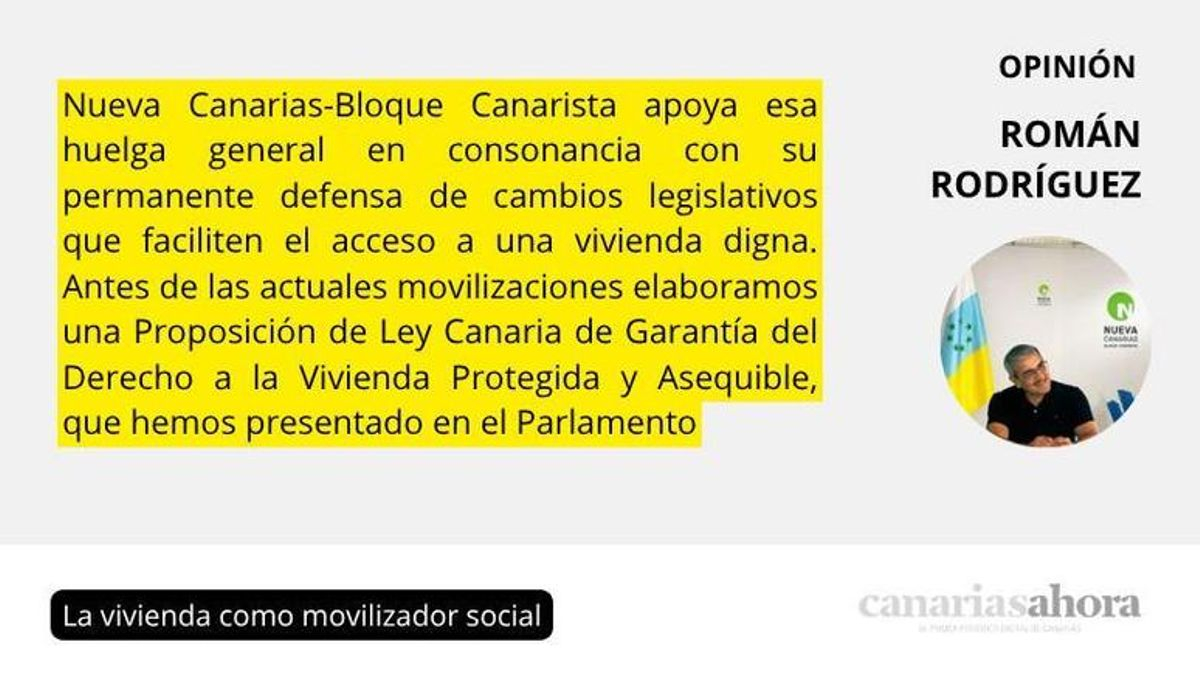
Nueva Canarias-Bloque Canarista supports the strike, in keeping with its long-standing defence of legislative changes that make it easier to access decent housing under reasonable conditions while combating speculation. Before the current protests, we drew up a Proposed Canary Islands Law on the Guarantee of the Right to Protected and Affordable Housing, which we have presented in the regional parliament. We believe that housing must be an effective right, not a privilege for those who can afford market prices. We are also convinced that things can and must be changed through self-government, given that the Canary Islands holds the relevant powers in this area and has the instruments and resources to tackle the problem if there is genuine political will and a defence of the general interest – something the CC-PP government has entirely lacked.
What’s happening in the Canaries – straight to your phone
News, weather alerts and practical updates – direct from the islands, in English. We live here and know what’s going on – before the international media catch up. Everything lands on our WhatsApp channel – no middlemen, no algorithm. Curated for families, expats and travelers.

Housing crisis dominates Canary Islands pre-election debate

26 new social homes fast-tracked in Gáldar, Gran Canaria

Blackstone owns 506 homes in Las Palmas de Gran Canaria
Spain’s business cartels and the fight for fair markets
PSOE warns Tenerife fire prevention cuts risk lives

Driverless truck crashes into Air Force gate in Las Palmas

Lanzarote housing assembly demands action on evictions

World’s first octopus farm scrapped in Las Palmas

Postal voting opens for Canary Islands election