Compiled with the help of artificial intelligence, based on Spanish-language information. Source below the article.
Canary Islands housing crisis deepens as rent caps ignored
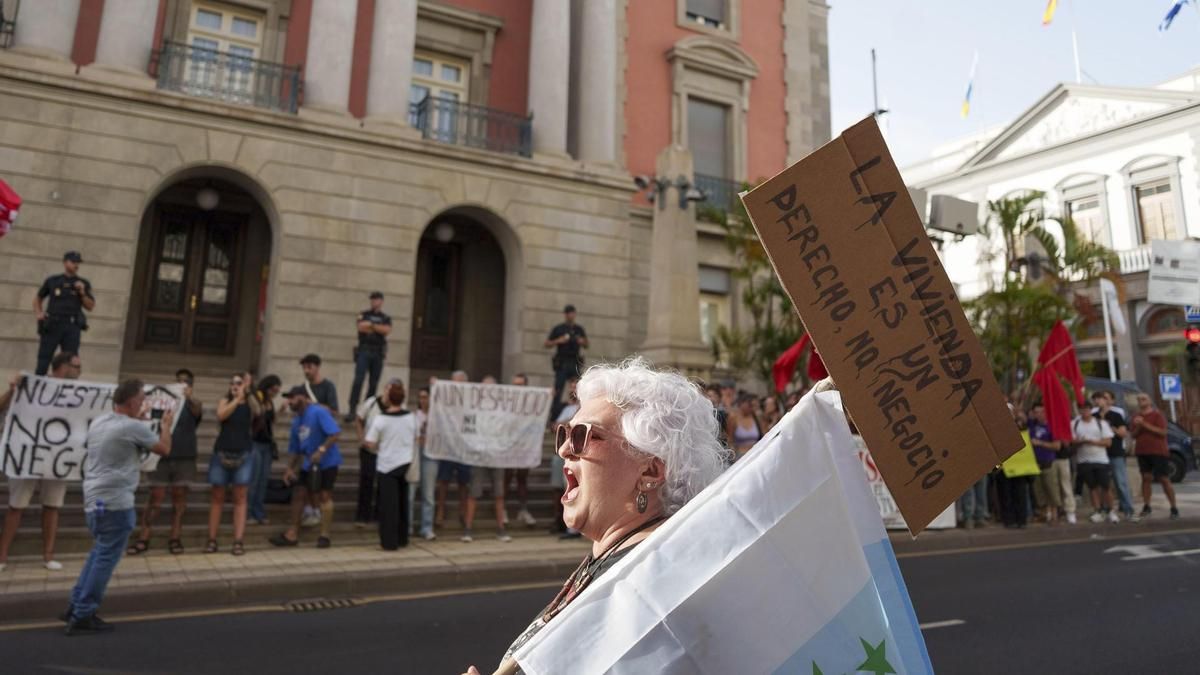
The case of Maricarmen, the elderly woman who has just been evicted in Madrid by a vulture fund, was the final straw in the housing crisis sweeping the country and has triggered an impromptu encampment demanding a law in the capital to protect people from property speculators and to prioritise the right to live in a home over the economic interests of companies and individuals. The Canary Islands is not immune to this picture and, in fact, is one of the autonomous communities with the greatest problems of access to housing, as several circumstances converge: the lowest salaries in the country, record levels of tourism, with an exponential increase in homes dedicated to holiday rentals, and an unstoppable rise in property prices, with more than 30% of buyers of foreign origin and the price per square metre in urban areas among the highest in the country.
The regional government’s response: build more and faster
Faced with this, the regional government, a coalition of Canarian Coalition and the PP, declared a housing emergency at the start of the parliamentary term. On this basis, it drafted and approved a new regional housing law with the aim of alleviating the difficulty of accessing a home at an affordable price. The formula: build more and faster. The Canarian government’s argument is that simply increasing supply is enough to reduce prices. That is why the law has not included any specific measures to contain prices, curb speculation, or prevent large holders from hoarding properties. In fact, the measures contained in the law are aimed solely at speeding up bureaucratic procedures and licences so that construction can proceed more quickly, with fewer controls, and legalising changes in land use, thereby losing, for example, land earmarked for facilities such as health centres or parks, in order to build apartment blocks on it.
Prices keep rising despite the new law
The result is that, for now, the crisis in the islands, far from being overcome, is worsening. Builders applauded the new law, but prices continue to rise. The regional government blames the state Housing Law, but it should be remembered that it is not applied in the islands, nor has it ever been. As some experts have pointed out and the parliamentary opposition has repeatedly stated, the housing problem in the Canary Islands is not a lack of built homes, but economic problems in accessing them. In fact, it is estimated that there are more than 200,000 empty homes off the market in the archipelago. The Canarian law also does not include any measures to incentivise those properties coming onto the market.
No tensioned zones recognised in the islands
But what is happening with tensioned zones in the Canary Islands? The answer is simple: there is not a single recognised tensioned zone in the islands, but not because they fail to meet the requirements, rather because the Canarian government has not accepted any request to declare one, as it refuses to apply the state Housing Law in the islands. Under that law, the municipality must request the declaration from the regional government, as it is the latter that has the authority to do so. So far, only three have done so formally (Las Palmas de Gran Canaria, Granadilla, which was then governed by the PSOE, and Adeje), but the Canarian government has not accepted any request. Other municipalities, such as Santa Cruz de Tenerife, San Bartolomé de Tirajana, La Orotava and Los Llanos de Aridane, made a timid attempt to study whether to make the request, but the matter stalled there and none took the step of making a formal application. Others have rejected it outright in their municipal plenary sessions, such as La Laguna and Los Llanos de Aridane.
Las Palmas de Gran Canaria: two years of delays
The most striking case is that of Las Palmas de Gran Canaria. The city council made a formal request to the CC-PP government back in 2024 for it to produce the necessary reports to determine whether the requirements were met. The executive responded that the reports should be produced by the council. The council did so and submitted them, but once again the government responded with evasions. According to the council, it was asked for reports that were not mandatory under the law solely in order to delay the process. The result is that, two years after starting the process, the Canarian government still has not declared a single tensioned zone in the islands.
At least ten municipalities could qualify
Taking into account the requirements of the law, at least ten municipalities in the islands (San Bartolomé de Tirajana, Adeje, Mogán, Arona, San Miguel de Abona, La Oliva, Antigua, Arico, Puerto de la Cruz and Granadilla de Abona) could be declared tensioned zones. All of them are tourist municipalities. In the four most populous cities in the Canary Islands – Las Palmas de Gran Canaria, Santa Cruz de Tenerife, San Cristóbal de La Laguna and Telde – some districts would also be classified as tensioned for rental purposes. In the Canarian municipality that receives the most tourists, San Bartolomé de Tirajana, two of its four districts would also receive that designation.
The upcoming EU law and its impact on the Canaries
That is with regard to the state Housing Law, but what about the Affordable Housing Law being prepared by the European Union? According to the criteria presented just two weeks ago, the majority of the most populous municipalities in the Canary Islands would also meet the requirements to be considered tensioned zones. That regulation, which still has to pass through the European Parliament and the Council of the EU, considers a tensioned zone to be any location where the average price of a home equates to at least eight years of the average income of its inhabitants. In addition, that price-to-income ratio must have increased over the last decade. This last requirement, however, would not need to be proven if the effort required to buy a home equates to ten or more years of income.
The conclusion, after Canarias Ahora analysed data from the General Council of Notaries and the National Statistics Institute (INE) between 2015 and 2023, is that 26 of the 30 most populous municipalities in the Canary Islands could be declared tensioned zones under the future EU law. The most tensioned area is Adeje, in the south of Tenerife, where luxury tourism coexists with the largest shanty town settlement in the entire Canary Islands. In 2023, the last year with updated average income data, the effort required to buy a home equated to 24.57 years of salary. In second place is Guía de Isora, also in the south of Tenerife, with 24.32 years of income required. It is followed by San Miguel de Abona (18.02), also in the south of Tenerife; Mogán (17.28), in the south of Gran Canaria, and Tías (17.27), in Lanzarote.
The four Canarian cities with more than 100,000 inhabitants would also meet the criteria to be declared tensioned zones. In Las Palmas de Gran Canaria, the price of a home equates to 10.75 years of salary; in Santa Cruz de Tenerife, 12.32. In La Laguna and Telde, the effort reaches 12.55 and 10.46 years, respectively.
What a tensioned zone declaration would mean
Under the state law, in such a zone the CPI is no longer taken as a reference for rent increases, a cap is imposed and prices are regulated in those areas, whether owned by large holders (with five or more properties) or small landlords, both for contracts on properties already on the rental market and for new contracts. Those caps will depend on the type of contract and ownership, taking into account the previous rent in force for small landlords and through the application of the price containment index for large holders.
Under the future European law, if a tensioned zone declaration is obtained, councils could impose restrictions on holiday homes that are not the owner’s habitual residence. They could limit the purchase or use of properties for non-residential purposes; apply tax penalties to empty homes or require prior declarations of use before purchase. The restrictions would only affect properties acquired after the law comes into force, with no retroactive effect.
Brussels points the finger at the Canaries
Among Brussels’ arguments for pushing this law is that between 2013 and 2024 the average price of housing in the EU rose by almost 60%, while household income rose by only 40%. This, moreover, is particularly affecting low- and middle-income households, young people and essential workers (such as teachers, healthcare staff and emergency personnel) and seasonal workers, who cannot afford to live in the municipalities where they work. And it puts the focus directly on the Canary Islands: the EU proposal identifies the islands and tourist destinations as the areas with the greatest imbalances in this regard. It notes that the scarcity of land in these territories makes it difficult for housing supply to react quickly to increases in demand. It also recalls the impact of holiday homes, which represent a high percentage of the residential stock in these locations.
And while the whole of Europe debates tensioned zones, in the Canary Islands, the CC-PP government continues to evade the issue, entrusting everything to construction.
What’s happening in the Canaries – straight to your phone
News, weather alerts and practical updates – direct from the islands, in English. We live here and know what’s going on – before the international media catch up. Everything lands on our WhatsApp channel – no middlemen, no algorithm. Curated for families, expats and travelers.

La Laguna awards €18.6m El Cardonal rehabilitation contract

Mass protest in Las Palmas against evictions and overtourism
Canary Islands banana prices finally rise after summer crisis

Police exam scandal reaches Canary Islands Parliament
Gran Canaria woman, 87, finally owns El Lasso home

Tenerife eviction halted after mass protest in Santa Cruz

Canary Islands defy national slump as property sales rise 2.1%

Family demands probe into Fuerteventura demolition operation
Canary Islands: Tourists Now Outnumber Residents