Compiled with the help of artificial intelligence, based on Spanish-language information. Source below the article.
Canary Islands satellite detects oil spill from space
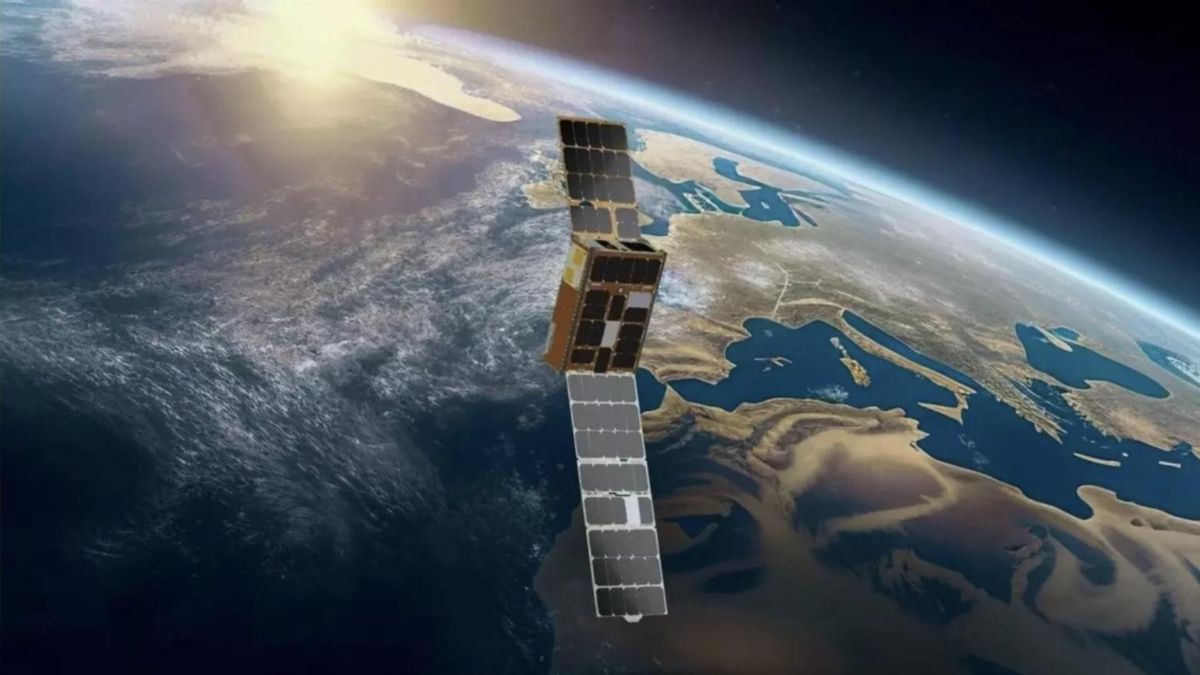
The Alisio-1 satellite, the first space mission developed in-house by the Instituto de Astrofísica de Canarias (IAC), has detected from orbit an oil slick linked to the tanker Caroline Bezengi, which ran aground near the Omani island of Al Qibiliya, in the Al Hallaniyat archipelago in the Arabian Sea.
Infrared camera built entirely in the islands
The image was captured on 22 September using Drago-2, an infrared camera developed entirely in the Canary Islands by the IACTEC-Espacio team, and reveals the extent of the spill around the vessel. The detection represents a real-world demonstration of the capabilities of space technology developed in the Canary Islands for Earth observation and the detection of marine pollution.
Explosion left the tanker stranded off Oman
The Caroline Bezengi suffered a serious incident in early June 2026 while sailing in waters close to Oman. The vessel, a large crude oil tanker, was rocked by an explosion that left it crippled and it subsequently ran aground on a rocky area near the island of Al Qibliyah. The exact cause of the incident has not been conclusively established.
After running aground, the tanker began losing hydrocarbons, producing an oil slick that has been tracked using various satellite observation systems. Omani authorities have carried out salvage and spill containment operations with the collaboration of international specialists. Weather and sea conditions in the area have hampered these efforts.
Spill estimated at 400 square kilometres
In August, Omani authorities estimated that the pollution visible on the sea surface covered around 400 square kilometres. The size and shape of an oil slick, however, can vary considerably because of currents, wind and swell.
The image obtained by Alisio-1 is a false-colour composite produced from the two spectral bands of Drago-2, centred at 1,100 and 1,600 nanometres. Both belong to the so-called short-wave infrared (SWIR), a region of light invisible to the human eye that provides information about the land and sea surface which cannot be seen in a conventional photograph.
The band at around 1,100 nanometres is particularly useful for detecting spills because oil and oil-water mixtures produce a characteristic response in this part of the spectrum. This makes it possible to distinguish them from the surrounding water. The IACTEC-Espacio team has also cross-checked the Alisio-1 observation against images captured by the Sentinel satellites under the European Copernicus programme.
A sharper eye on the Earth below
Drago-2 is a compact camera designed to observe the Earth in short-wave infrared and developed entirely by IACTEC-Espacio. On board Alisio-1 it offers a resolution of roughly 50 metres per pixel, compared with around 300 metres per pixel for its predecessor, Drago-1.
One of the main advantages of having a space mission of one’s own is the ability to schedule observations over specific areas of interest when the orbit and acquisition conditions allow. This capability enables Alisio-1 to study specific phenomena and to test the applications of technology developed in the Canary Islands against real cases.
Validating a mission built for environmental monitoring
Tracking the Caroline Bezengi therefore offers an opportunity to validate one of the applications for which both the satellite and its infrared camera were conceived: the detection and monitoring of hydrocarbon spills from space.
As well as marine pollution, Alisio-1 and Drago-2 are designed for applications related to monitoring wildfires, volcanoes, flooding, desertification processes and crop development. The IAC stresses that having this technology of its own can be especially useful for monitoring environmental phenomena in different regions of the world, including the waters around the Canary Islands.
The case of the tanker Caroline Bezengi demonstrates in a real episode how a space mission developed in the islands can contribute to the detection and monitoring of oil spills from space.
What’s happening in the Canaries – straight to your phone
News, weather alerts and practical updates – direct from the islands, in English. We live here and know what’s going on – before the international media catch up. Everything lands on our WhatsApp channel – no middlemen, no algorithm. Curated for families, expats and travelers.
Two Tenerife beaches reopen after water quality alert
Two more Tenerife beaches closed over sewage contamination

NASA honours Canary Islands 112 for Artemis moon mission role
Tajogaite’s scientific legacy five years on
Magnitude 3.0 earthquake recorded west of Lanzarote
Canary Islands look to volcanic heat for energy

Canary Islands’ ancient potatoes face climate threat
Tenerife deploys drones to cut drowning deaths
Gran Canaria wildfire breaks out in Telde