Compiled with the help of artificial intelligence, based on Spanish-language information. Source below the article.
The rise of social media tourism in the Canary Islands
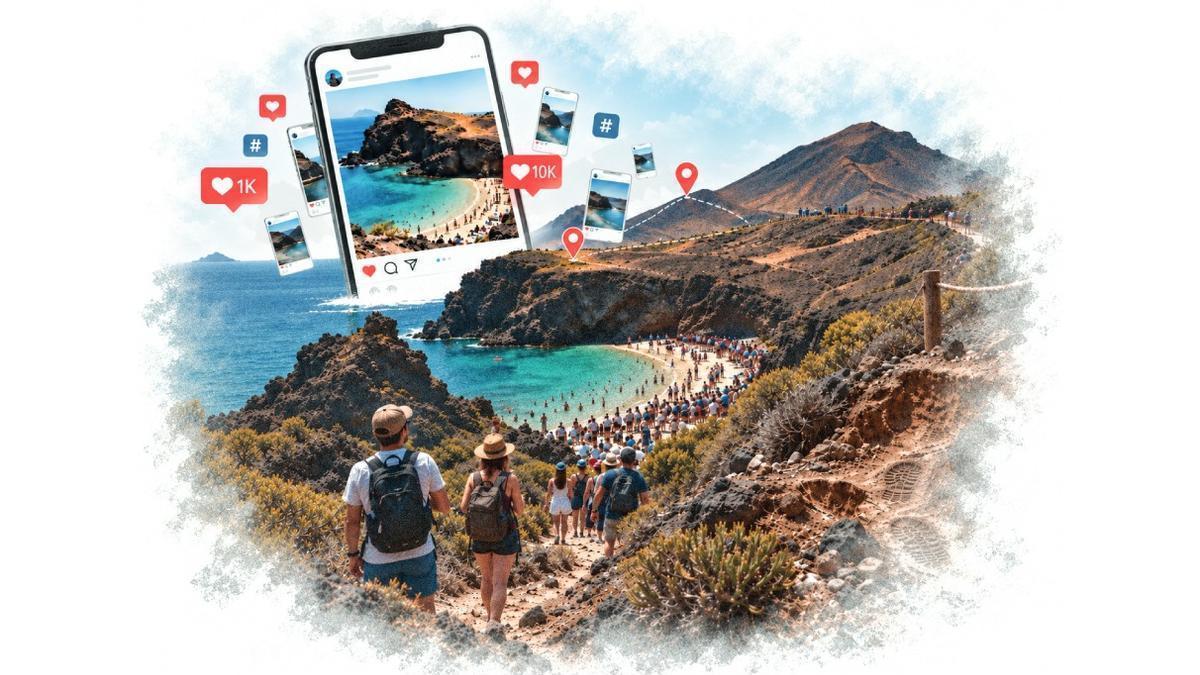
Simply typing “Canarias”, “Tenerife” or “Gran Canaria” into the search bar of social media platforms such as TikTok or Instagram brings up an endless stream of videos about the Islands. While there will always be the occasional clip discussing the Guanches, explaining traditional dress or telling the story behind a street name, most of the content is remarkably similar: a list of must-visit places if you’re visiting the Archipelago.
There is a clear reason behind this flood of recommendations: they tend to be users’ favourites or, at the very least, the ones that rack up the most views and likes. Among the most repeated suggestions are places historically linked to tourism, such as Las Teresitas in Tenerife or Timanfaya National Park in Lanzarote, but there are also many remote spots that are gradually losing their hidden status. It is increasingly common to find videos explaining step by step how to reach a volcanic tube or a concealed natural pool.
From sun and sand to “anything for the photo” tourism
Alongside the traditional sun-and-beach tourism – and the many other types on offer – a new trend is gaining popularity among visitors: doing anything for the photo. Local residents, however, appear far from pleased with these videos and often respond firmly. “That secret spot is no longer a secret – social media has destroyed the Island,” one user warns in the comments of a TikTok video.
Beyond the unease it stirs among residents, the arrival of mass tourism to remote locations also has consequences for the environment itself. Abel López, a Geography lecturer at the University of La Laguna (ULL), criticises how digital platforms are turning natural spaces into genuine products. “These are particularly sensitive enclaves, so the environmental impact is enormous – from a greater risk of wildfires at certain times of year to soil degradation and the accumulation of litter,” he explains.
Even so, he insists that social media is by no means the sole culprit, but it has certainly been a powerful accelerator. “What traditionally became popular little by little, through the traditional media, can now happen within months if a video goes viral,” he argues. With models such as sun-and-beach tourism, he notes, the bulk of visitors were concentrated in very well-defined areas, such as Costa Adeje or Los Cristianos in southern Tenerife. “Now we are burning through every corner, and the resident who used to go to those solitary spaces to escape the overcrowding of urban areas now finds them saturated. It’s not about hiding the Canary Islands, but about protecting them,” he maintains.
The deadly risks behind the perfect photo
Irresponsible promotion on social media does not only affect the natural surroundings: it can also have fatal consequences for tourists themselves. Beauty and danger are not mutually exclusive terms, and places such as Cofete beach in Fuerteventura or Los Charcones in Lanzarote are as hazardous as they are enchanting. Exposure to the whims of the sea or to steep, hard-to-reach routes in pursuit of the best framing for a photo represent an unnecessary risk that has claimed numerous lives across the Archipelago.
Chano Quintana, president of the association for the prevention of accidents in the aquatic environment, Canarias 1500 km de Costa, warns that many tourists, motivated by capturing the perfect photograph, ignore the risks that tides or difficult terrain pose to their physical safety. “Influencers and specialist travel magazines are a great monster we are up against in our campaigns on water accident prevention,” he explains.
These kinds of paradise-like locations typically lack lifeguard services. The president asserts that, despite being “areas unsuitable for swimming”, tourists who come to the Canary Islands on holiday “think they simply must take a dip in order to get their photo or video”. The danger, moreover, can go unnoticed at first glance. Natural pools located in rocky areas create a false sense of security in tourists, who believe that, being protected by the perimeter of the pool, they are completely safe from the strong swell out at sea.
However, when a series of successive waves arrives, they quickly raise the water level inside the pool, causing the swimmer to float and lose their footing and contact with the ground. The wave that rushes in then drags the person out towards the open sea “as if they were a cork”, due to the constant overflowing of water. “There are many areas that, although you can’t tell at first glance, have a steep incline. You take three steps at the water’s edge and you’re already waist-deep,” he adds.
Remote trails, hidden coves and the walk that comes first
Many of the places showcased on social media had remained outside the spotlight of mass tourism precisely because of how remote they are. Many of the coves and viewpoints favoured by Canary Islanders, such as Güi Güi beach on the west coast of Gran Canaria, require a demanding hike beforehand. On that very route, accidents can occur which, as well as endangering the person’s health, force the mobilisation of resources such as helicopters owing to the difficult access.
“These are rugged routes with no defined path. At many points they are narrow dirt tracks where any spell of bad weather can soften the ground and send you slipping,” explains Quintana, who also points out that the typical sun-and-beach tourist “doesn’t wear hiking boots, but flip-flops” – a factor that increases the risk of an accident.
For these reasons, Quintana is calling on media outlets specialising in this kind of content and on influencers to also inform people about the risks these places entail – “something that generates fewer likes than posting a photo when the sea is calm”, but which could be the most effective way of saving lives. “There is no better life jacket than information,” concludes the president.
What’s happening in the Canaries – straight to your phone
News, weather alerts and practical updates – direct from the islands, in English. We live here and know what’s going on – before the international media catch up. Everything lands on our WhatsApp channel – no middlemen, no algorithm. Curated for families, expats and travelers.

Tenerife’s Char Fuego y Brasas named 13th best steak restaurant in Europe

Gran Hotel Taoro: a foodie destination in Puerto de la Cruz

Canary Islands hotel prices rise 4.11% in September

Icod de los Vinos launches twelve self-guided routes
Four new openings shaking up Las Palmas dining scene

Tenerife faces huge tourism expansion despite moratorium calls
El Bejeque in Las Canteras adds sea to its fire

Siam Park Gran Canaria must build its own desalination plant

Fuerteventura’s biggest resort to open on 1 November