
Compiled with the help of artificial intelligence, based on Spanish-language information. Source below the article.
A hamlet hidden in the Anaga mountains
Tucked away in the Anaga massif, within the municipality of La Laguna, lies the small settlement of Cabeza de Toro, also known as Cabezo Toro. Reached by entering through Las Mercedes and heading towards Cabeza de Toro, the hamlet consists of no more than half a dozen houses scattered “in two clusters” just beyond the signpost pointing to Carboneras, Taborno and Chinamada.
Late morning, and in search of refreshment, the visitor must press on to Auxi’s shop at Las Carboneras, which could well be considered the “capital” of this enclave, relegating Cabeza de Toro to the status of a mere neighbourhood. The shop first opened its doors in the last century when Daniel and Maruca built the first house here, right beside a concrete ramp where a guagua bus stop now stands. It was the very genesis of this settlement, which became a local landmark thanks to Margarita and Juan, the couple who ran a store that fed the hunters who came to the area on Thursdays and Sundays.
The menu back then was simple: a salad, some potatoes and gofio amasado, according to their granddaughter Mónica Déniz, who admits she misses the racket of schoolchildren when teachers bring them to explore the area in April or May. “What is it they’re doing over there? Did the teacher send them?” asks Auxi, referring to a young visitor named Rubén. Auxi has run the shop at Las Carboneras for fifteen years, having converted what was once her father’s bar.
Errands, school runs and few neighbours
Inside the shop, two of the six pupils from the rural school at Las Carboneras arrive to run an errand for their grandmother, coins clutched tightly in their fists. “School starts next week and we’ll be seven,” explains the older of the two brothers, who, having completed their mission, head back home.
Auxi, the shopkeeper, politely declines to be interviewed about the only spot on the route where one can stop for breakfast, but she does offer a thought. “I’ve seen what you’ve done on Tenerife Vaciada, but we’re not too bothered about that because people think this place is abandoned, and it simply isn’t true.” She then wishes us luck in tracking down any of the residents of Cabeza de Toro, where perhaps a dozen people still live.
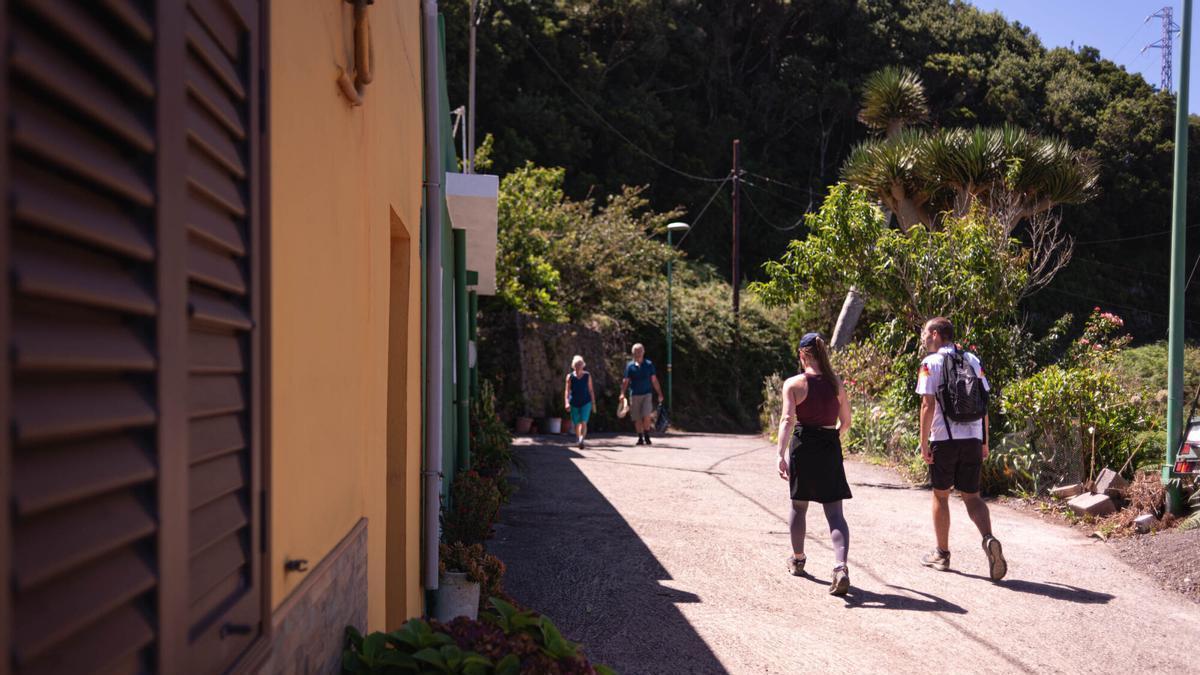
This hamlet could easily be mistaken for a lay-by off the road, as it winds up a dirt track where three or four houses are scattered around El Cargadero, which sits along the Camino Real de Las Carboneras. The path looks like the main street of a walker’s castle, with hikers passing through in an hour outnumbering the half-dozen locals who live there.
Victoria’s story: a life shaped by the land
Among the oldest residents is Victoria, who lives here with her husband and values the importance of the place she calls home, as it was once the main thoroughfare between Las Carboneras and Chinamada. She admits, however, that for shopping or seeing a doctor, her point of reference is Las Mercedes. Mid-conversation, when she mentions the former residents Daniel and Maruca, she cannot help but become emotional. “They’re no longer here.”
Victoria, who declines to be photographed because she says she “doesn’t know how to talk”, shows an intimate knowledge of Cabeza de Toro, inch by inch. To the visitor’s eye, it is a lay-by with three or four houses and a valley. To her, who has lived here for virtually all her life, every corner has a name passed down through the generations. Indeed, every patch of land seems to have its own moniker: El Cargadero, Las Escaleras, the old Camino Real and, higher up, Las Casas del Lomo, which refers to the neighbouring settlement of El Río.
The old Camino Real de Las Carboneras was the main route through the area long before the road arrived. From here, a path also branches off towards Chinamada and Las Carboneras. Victoria recalls a time when travelling through this part of Anaga bore no resemblance to doing so today. Her life has always been tied to the land and this environment. “We worked in the fields and lived as best we could,” she sums up, with the same serenity that pervades the place itself.
Local identity and daily routines
And although administratively the area falls within the municipality of La Laguna, when asked where she feels she belongs, she does not hesitate: “I feel I belong to Las Carboneras and La Laguna.” That connection continues to shape her daily life. The gas canister is delivered from Las Mercedes; for groceries she heads down to La Laguna and, when she needs medical attention, she can visit the clinic at Las Carboneras or travel to the health centre at El Cristo, in central La Laguna.
Victoria looks around to count how many currently live in the area: a daughter, a brother and a few other neighbours. “About three or four,” she estimates. There are no children left either. “To be honest, we’re all getting on a bit,” she admits. Some of the houses now stand empty, bereft of the bustle of bygone days.
Tourism, tradition and change
Today, El Cargadero, the “capital” of Cabeza de Toro, is kept alive by Victoria’s family, who also tend this natural enclave with care. In the house next door lives Mónica Déniz, Victoria’s daughter, with her husband, Antonio de Jorge; both drive for Titsa, the island’s bus company. Their youngest daughter, Verónica, who is in the fifth year of primary school, is the youngest resident of the settlement. The eldest has already left home, with a professional future far removed from the days when potatoes, corn and bubangos (pumpkins) were grown in front of the house.
This neighbour, whose meatballs fill the hamlet with a delicious aroma, offers a reflection on the importance of tourism, while others seem more concerned with restricting parking for residents in Anaga. “Tourism has not been looked after,” she states firmly, warning that cultivation of the land has been left behind and that the local economy is now dependent on keeping the doors open to visitors. She recalls when around twenty people lived in the settlement. Times, times.
What’s happening in the Canaries – straight to your phone
News, weather alerts and practical updates – direct from the islands, in English. We live here and know what’s going on – before the international media catch up. Everything lands on our WhatsApp channel – no middlemen, no algorithm. Curated for families, expats and travelers.

Canary Islands to get 26 new substations by 2030

Canary Islands poverty rates stuck since pandemic

Court backs eviction over verbal room rental in Arona

Canary Islands pushes for 10-year residency rule for foreign buyers

Canary Islands public websites locked down over PHP security flaw

Supreme Court next stop for illegal Arguineguín homes

How to apply for public housing in the Canary Islands

Viral meningitis outbreak hits three children on El Hierro

Canary Islands tourism chief offers dialogue on residentialisation
